


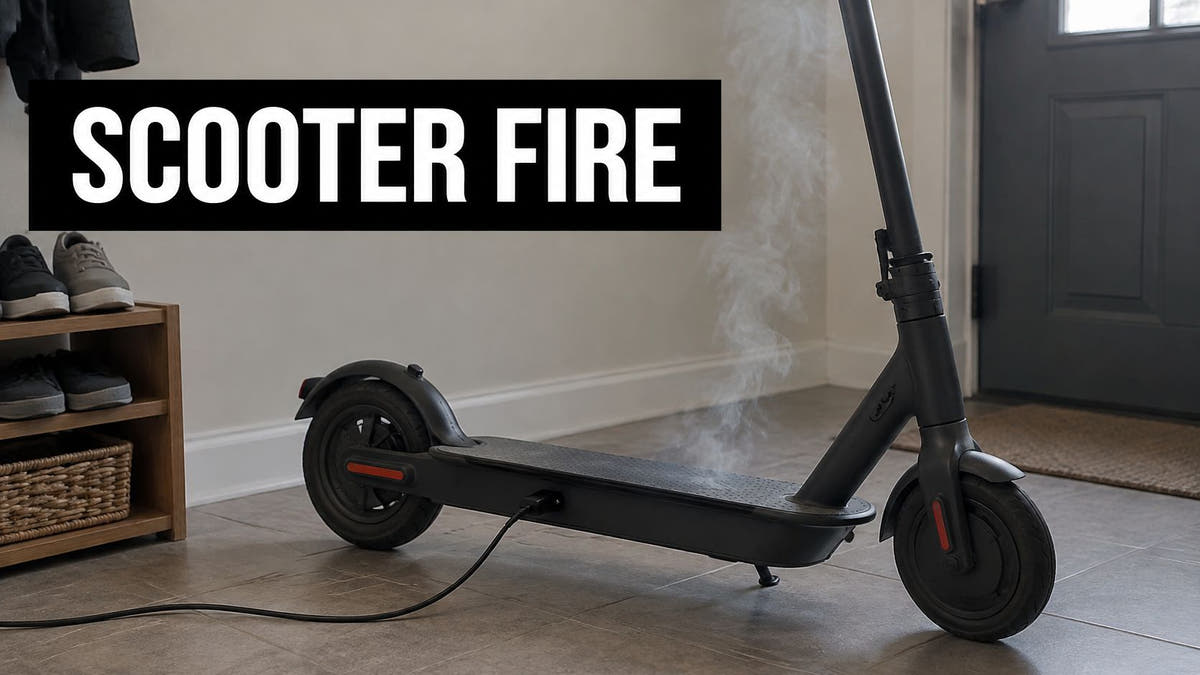
You've plugged your scooter in after the commute, kicked off your shoes and noticed the deck feels warmer than usual. Then there's a faint chemical smell. Is it normal charging heat, a tired battery or something you need to get away from?
The useful distinction isn't between a good scooter and a bad one. It's between a battery you can safely stop using and inspect professionally and a battery you must leave alone while you evacuate. An electric scooter fire can develop quickly, so make that decision before reaching for the charging cable.
Warning Signs That Mean Stop Charging Now
Early changes are easy to dismiss, especially when the scooter still rides normally. Mild warmth during charging can be normal, but new, increasing or unusual heat needs attention. You can't diagnose an internal fault by touching the deck.
The warning signs below are a sorting tool, not proof of a particular fault. Charger mismatch and poor ventilation are possibilities, not the only explanations for heat.
Battery warning signs, what they mean and what to do
| Warning sign | What it usually means | What to do now |
|---|---|---|
| Battery feels warm during a normal charge | Mild warmth can be normal; unusual warmth can indicate charger mismatch, poor ventilation or a battery fault | If there are no other warning signs, switch off and unplug safely. Move only a cool, stable scooter to a hard, nonflammable surface and check charger compatibility |
| Casing hot after a normal ride | Heavy loading, hills or a deteriorating pack may be contributing | Stop riding and charging. Let it cool naturally in a clear, ventilated place without handling a dangerously hot pack, and arrange inspection |
| Swelling or bulging casing | Gas build-up inside the pack | Stop charging and riding. Keep people away and preserve clear exits; don't carry a swollen pack through the building |
| Popping or cracking sounds | Cells may be venting or failing | Leave it in place, evacuate and call emergency services from outside |
| Sweet or solvent-like smell | Possible electrolyte leakage or cell failure | Get out and don't charge again. Don't approach it to open windows; ventilate only if possible without exposure |
| Sparks, smoke or melting plastic | Active electrical fault, possible thermal runaway | Evacuate, close doors behind you if safe and call emergency services |
New York Attorney General battery-safety guidance identifies abnormal smells and physical changes as reasons to stop using a battery immediately. Don't lean close to confirm an odour or put your face over the charging port.
When inspection is no longer the right response
Smoke, hissing or venting means move away, not move the scooter. Call 999 in the UK or 112 across the EU from a safe place. Disconnect power only if you can do it without approaching the battery, reaching through smoke or delaying escape.
For a cool scooter with no smell, swelling or active warning signs, our Segway scooter repair guide offers context for arranging fault diagnosis. It isn't a reason to open a suspect battery yourself.
Stop-use rule: A swollen battery must not be charged again, even if the scooter still starts and rides.
How to Handle a Scooter Fire Step by Step
A smoking or burning scooter is a suspected thermal-runaway emergency, not a small wiring problem to investigate. Your job is to get people clear and give firefighters useful information, not to save the scooter.
Use the evacuation sequence below, with one important clarification: professional firefighters may use water for cooling. Don't interpret the graphic as meaning that lithium-ion batteries react to water like metallic lithium.
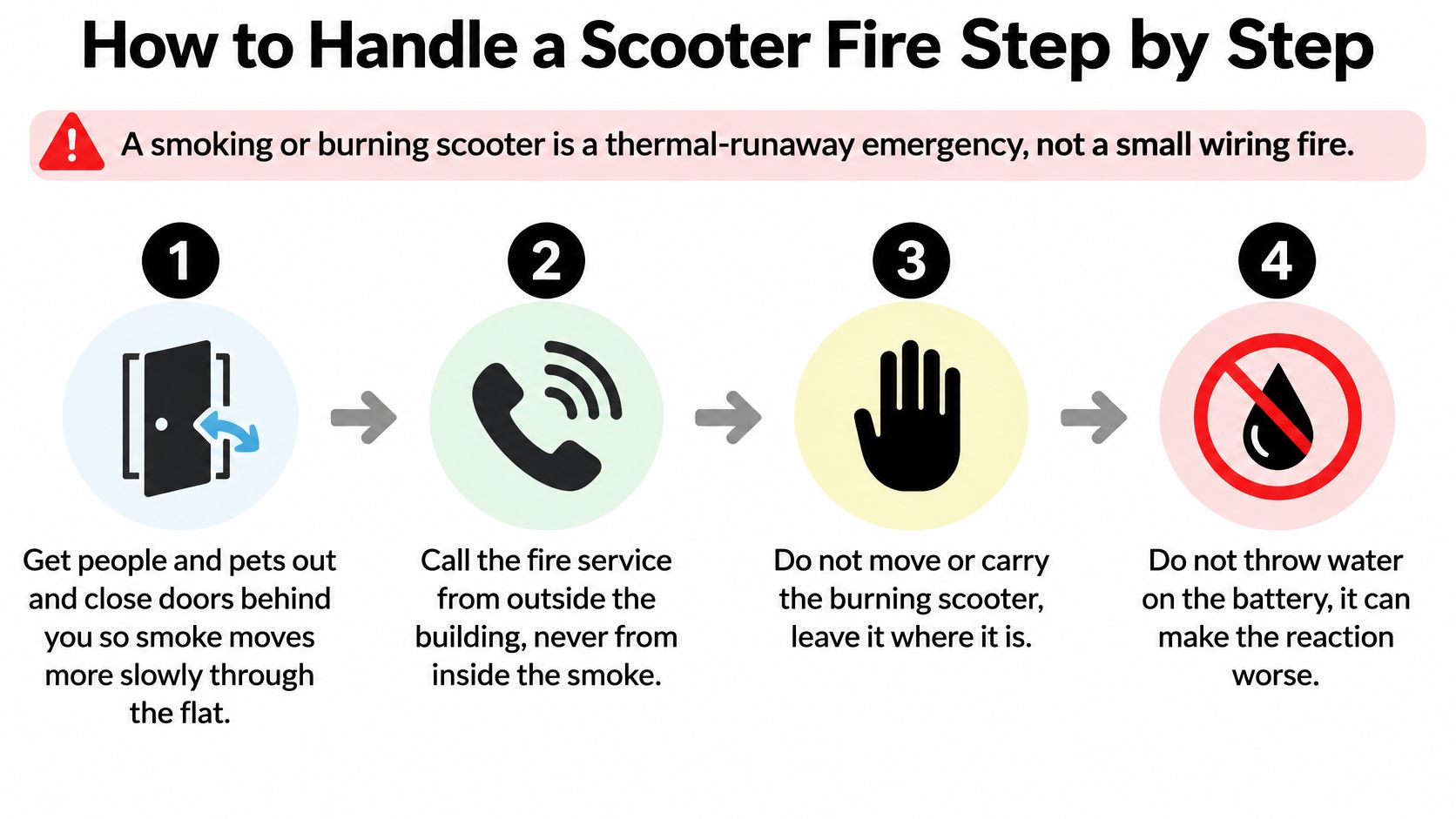
Get out before attempting anything else
- Evacuate people and pets. Shout a warning and leave by a clear route. Close doors behind you if you can do so safely, helping limit smoke spread. Don't go back for belongings or search through smoke.
- Call from outside. Dial 999 in the UK or 112 in the EU and say an electric scooter's lithium-ion battery is smoking or burning. Give the address, its location inside the building and whether anyone is trapped. If smoke blocks your escape, get behind a closed door away from it and tell the operator where you are.
- Leave the scooter where it is. Don't carry a hot, hissing, popping, chemical-smelling, sparking, smoking or melting pack. You could suffer burns, inhale toxic smoke or drop it along the escape route.
- Don't dismantle or improvise. Don't pull out an integrated battery, cover it with a household blanket or approach it with a bucket. A small extinguisher may knock back visible flames without stopping the internal failure. Let crews choose the cooling method.
The video below provides additional visual context; if an incident is happening now, leave rather than watching it.
Once firefighters arrive
Tell crews whether the scooter was charging, which charger was connected and what you first heard or smelled. Mention any recent crash, water exposure or replacement battery. These details are more useful than guessing what caused the fire.
No visible flame doesn't mean the pack is safe. It can reignite after appearing extinguished, so stay out until firefighters clear the home.
- Preserve evidence safely. Photograph the scooter, charger and labels only after access is declared safe. Don't disturb the pack to get a better picture.
- Follow the crew's instructions. Isolate it outdoors on concrete only if they explicitly say that's safe and explain how. Don't ride, recharge, post or put it in household rubbish.
- Report the product. Notify the supplier and the UK Office for Product Safety and Standards through the relevant product-safety reporting route, or your national market-surveillance body. Arrange specialist disposal rather than transporting it unannounced.
Why Lithium-Ion Batteries Overheat and Catch Fire
Think of a battery pack as a tightly packed row of dominoes. Each cell stores energy, and a failing cell can heat its neighbours enough to make them fail too. A healthy pack keeps those cells within controlled operating limits.
A dent, puncture, internal short circuit, contamination or overcharging can upset that balance. If the battery-management system can't control the developing fault, heat accelerates chemical reactions inside a cell. Those reactions generate still more heat.
That feedback loop is thermal runaway. The cell can release flammable gas, toxic smoke and intense heat, potentially producing a jet of flame.
Why switching off isn't enough
The U.S. Consumer Product Safety Commission's electrical-system analysis identifies thermal runaway as the principal mechanism behind these micromobility battery hazards. The important distinction is that this is an electrochemical failure, not a wire that stops heating when you pull the plug.
Disconnecting the charger can remove an external energy supply, but it can't necessarily stop reactions already underway inside a cell. Nearby cells may then fail in sequence, which is why an apparently local problem can involve the whole pack.
The diagram shows those triggers and the cell-to-cell chain reaction. Treat charger compatibility as a technical requirement, not a judgement based on price alone.
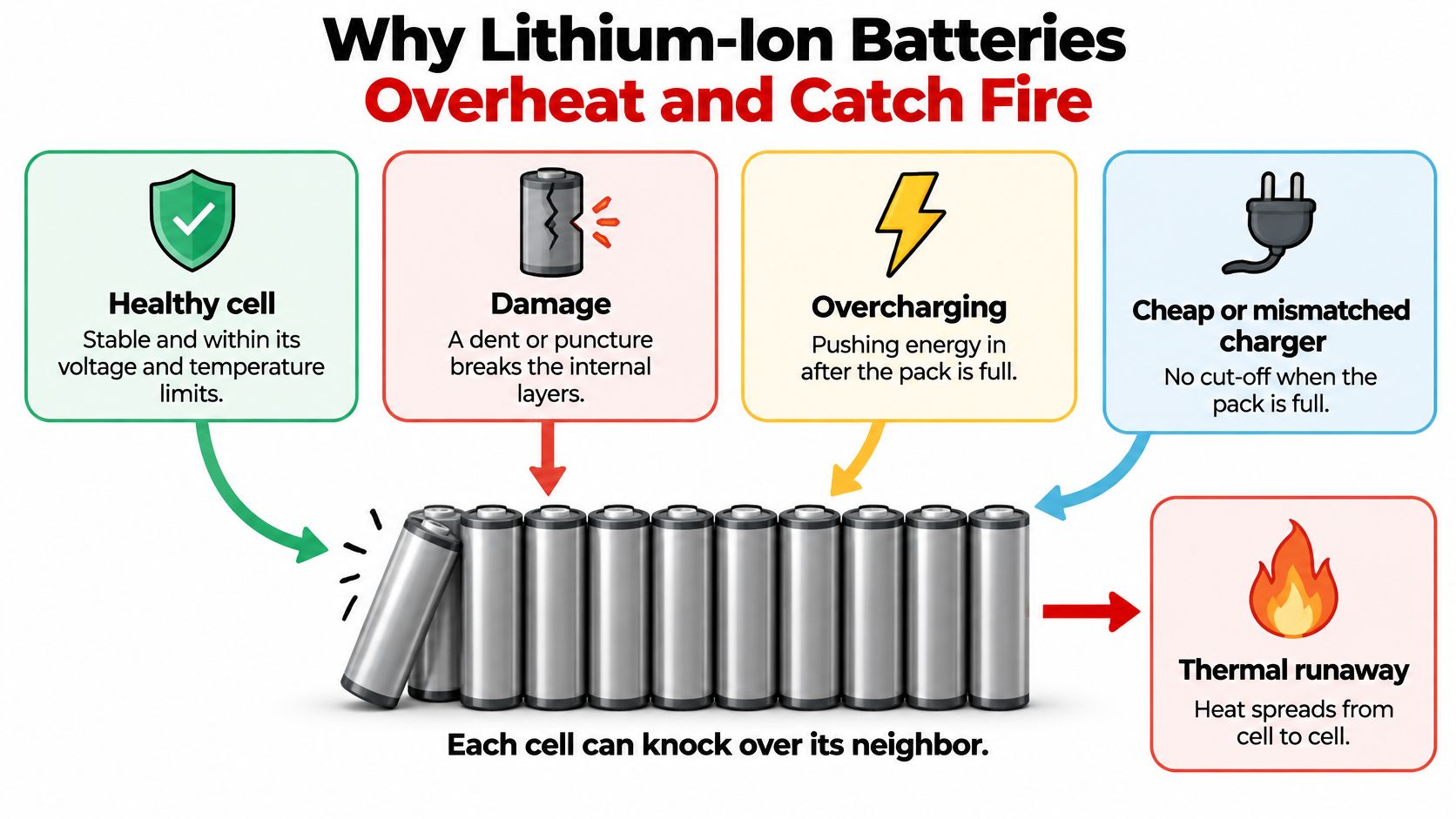
Protect the system, not just the plug
A household blanket can't reliably stop reactions inside sealed cells. An extinguisher that removes visible flame doesn't establish that the pack has cooled or that neighbouring cells won't fail later.
A charger that fits the socket isn't necessarily a charger that suits the battery.
Compatibility includes the specified voltage, charging current, polarity, connector arrangement and any required communication or control features. Matching just one label value isn't enough.
The practical controls work together:
- Protect the enclosure. Don't keep riding after an impact that dents or cracks the battery compartment.
- Keep the electrical system matched. Use the manufacturer-approved charger and replacement pack rather than combining parts by connector shape.
- Respect abnormal behaviour. A new smell, unexplained heat or casing change is a reason to stop, not an invitation to test another charging cycle.
Prevention means controlling the triggers before a cell starts failing. It doesn't mean trusting a protective circuit to compensate for damaged hardware indefinitely.
Everyday Habits That Start Most Scooter Fires
Charging habits deserve attention, but it would be misleading to say every scooter fire starts at the socket. The UK Office for Product Safety and Standards' 2025 fire report recorded 267 fires across e-bikes, e-scooters, mobility scooters and e-unicycles, including 46 involving e-scooters; batteries or generators were identified as the ignition source in 88%.
The same report recorded 86 fires while products were charging, alongside incidents occurring when they weren't charging. It also included 82 converted e-bikes, a reason to take electrical modifications seriously, not proof that all conversions cause fires.
Hardware you choose
A cheap replacement isn't automatically unsafe, and an expensive one isn't automatically compatible. The problem is buying a charger or pack without reliable specifications, manufacturer approval or traceable supply.
Home modifications add another uncertainty. Raising power demands or fitting a different battery can change how the controller, wiring and protective components operate together.
Routines you can change
Charging overnight removes your chance to notice a developing problem while you're awake. Charging on a sofa adds combustible material right beside the pack, while a hot car or strong direct sunlight can leave it starting from an unnecessarily high temperature.
This doorway placement illustrates a separate problem: even a tidy charging setup can compromise escape.
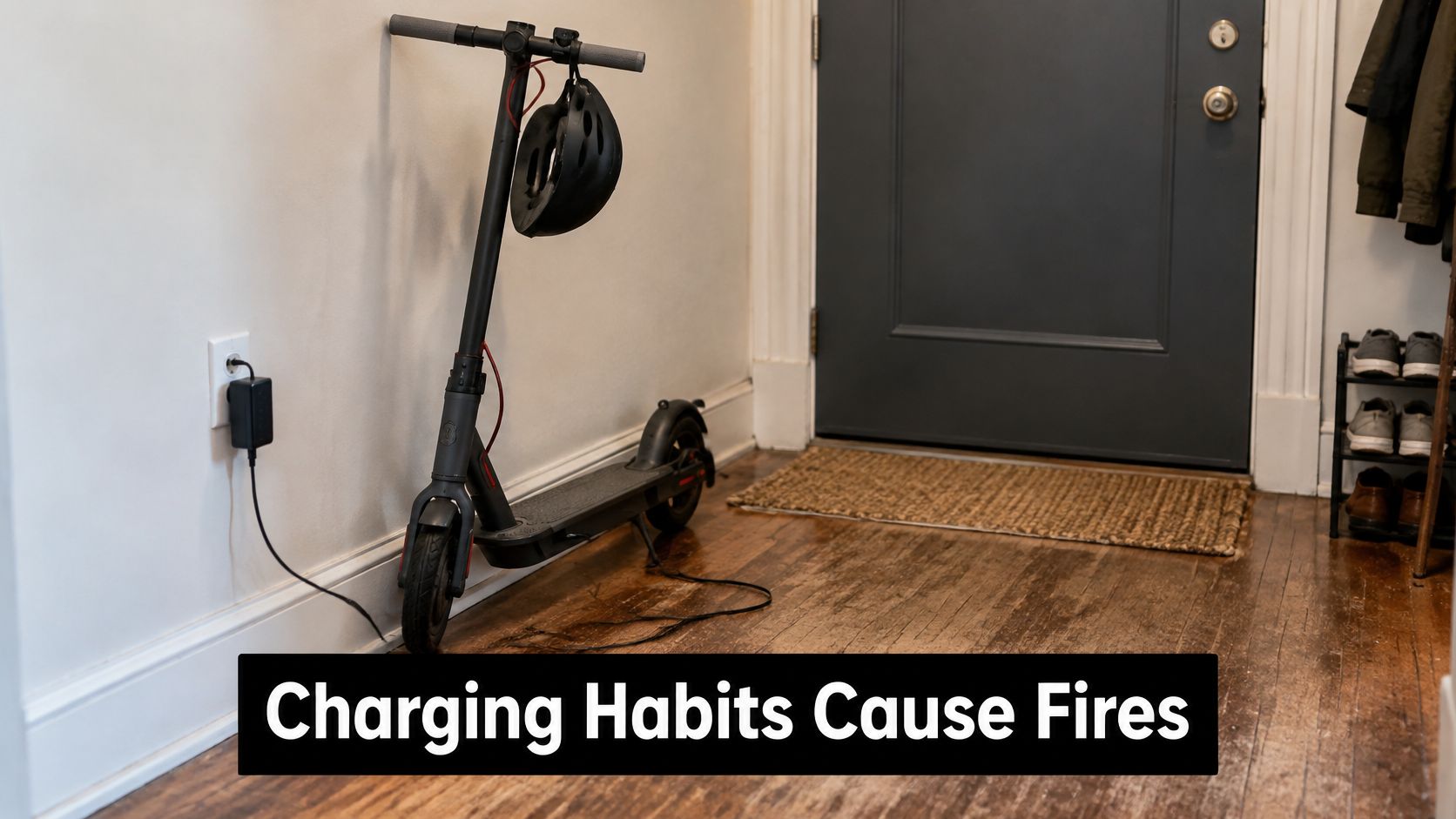
Damage and ageing
Drops, crashes and water exposure deserve a check even when the scooter powers on afterwards. Don't open the pack to investigate corrosion or straighten a dented enclosure.
Years of use and repeated deep discharges can reduce battery performance, but reduced range alone doesn't diagnose an imminent fire. Use our electric bike battery-life guide to understand ageing, while treating physical damage and abnormal heat as separate safety issues.
- After an impact: Stop and inspect the exterior before charging.
- After suspected water ingress: Don't connect power to see whether it still works.
- When replacing components: Confirm approval for the exact model, not merely a similar-looking scooter.
If you didn't buy the charger or pack for that exact scooter, treat compatibility as unconfirmed until you've checked it.
Charging and Storing Your Scooter at Home Safely
Choose the charging position by what surrounds it and how you'd escape, not just by where there's a spare socket. A hard floor helps, but it doesn't make a scooter beside a sofa or front door a good arrangement.
In NIST compartment experiments using a 281 Wh scooter battery, fire development depended on proximity to combustible furnishings, and 76% of alarm activations occurred before sustained visible flames. Those test results support two practical priorities: separation from furnishings and working smoke alarms.
Choose the room before the socket
| Location | Main trade-off | Practical decision |
|---|---|---|
| Cool utility space | Often easier to separate from furniture, but laundry and cardboard add fuel | Clear the surrounding area and keep ventilation unobstructed |
| Hallway | Convenient power access, but potentially your escape route | Don't charge there if an incident could block the only way out |
| Bedroom | Close to bedding and sleeping occupants | Choose another location |
| Garage | Can offer separation, but may contain fuels, clutter or temperature extremes | Use only a dry, suitable area clear of combustibles |
| Balcony | Weather exposure and heat can undermine an apparently open-air location | Don't treat outdoor exposure as automatically safe |
| Communal corridor or shared bike store | Other residents depend on access and building fire arrangements | Follow building rules and never obstruct escape |
Maintain working smoke alarms and follow their installation guidance, including suitable coverage for the charging area. Don't position the scooter so a fire would sit between you and the alarm or exit.
For households introducing younger riders to scooters, The Green Living Guy scooter resource provides a parent-and-child education starting point. Make the charging location and the rule against handling a suspect pack part of that conversation.
Make charging an attended task
Use the supplied or manufacturer-approved charger. Voltage matching alone isn't enough. Stay home and awake, use a reminder to check completion, and disconnect after the normal charging cycle; a timer doesn't replace supervision.
Before connecting, look for frayed insulation, bent pins, looseness, corrosion and heat marks. Store the scooter dry, away from radiators, sunny windows and hot vehicles.
Don't use a protective bag as permission to charge beside an exit or leave a damaged pack indoors. Our electric bike battery-bag guide can help you assess that accessory without treating it as a substitute for safe placement.
The housing context matters. BBC Verify's UK fire-service reporting recorded 32 battery-related fires in 2019 and 605 in 2025, with more than 2,000 across seven years, including London 793, Manchester 128, West Yorkshire 93, Merseyside 74 and Avon 73. These include e-bike, e-scooter and related battery fires, not scooters alone.
Useful habit: Keep the receipt, battery identification and charger details somewhere you can access without approaching the scooter.
Our scooter warranty is 2 years. Keep that documentation for a warranty enquiry rather than opening the pack yourself.
At your weekly check, confirm the serial-number photograph and purchase date are saved and legible. If the pack is swollen, cracked or heat-marked, stop using it and arrange assessment and an approved replacement, not an unbranded substitute.
What the Fire Numbers Say Across London and the UK
London's figures show why the category matters as much as the headline. E-scooter-only fires and combined e-bike/e-scooter fires aren't interchangeable. Neither count tells you the probability that your individual scooter will catch fire.
The following table reproduces the categories in the London Fire Brigade figures published by the London Assembly. The combined figure for the earliest row isn't stated in that series, so it's left explicitly unavailable rather than estimated.
London electric scooter fires and combined micromobility fires
| Year | London e-scooter fires | London e-bike and e-scooter fires combined |
|---|---|---|
| 2019 | 2 | Not stated |
| 2020 | 18 | 31 |
| 2021 | 30 | 78 |
| 2022 | 29 | 116 |
| 2023 | 28 | 183 |
Scooter-only incidents rose sharply at the start of the series, then fluctuated slightly. Meanwhile, the combined total continued climbing, reaching a frequency the Brigade described as approximately one e-bike or e-scooter fire every two days.
That doesn't establish whether any individual product became more dangerous. To calculate risk per scooter, you'd also need dependable information about how many scooters were in use, their condition and their exposure.
Read the categories carefully
The accompanying graphic is illustrative, but its labels need care: the documented combined category means e-bikes plus e-scooters, not converted or modified scooters. The table above is the appropriate reference for the available years and counts.
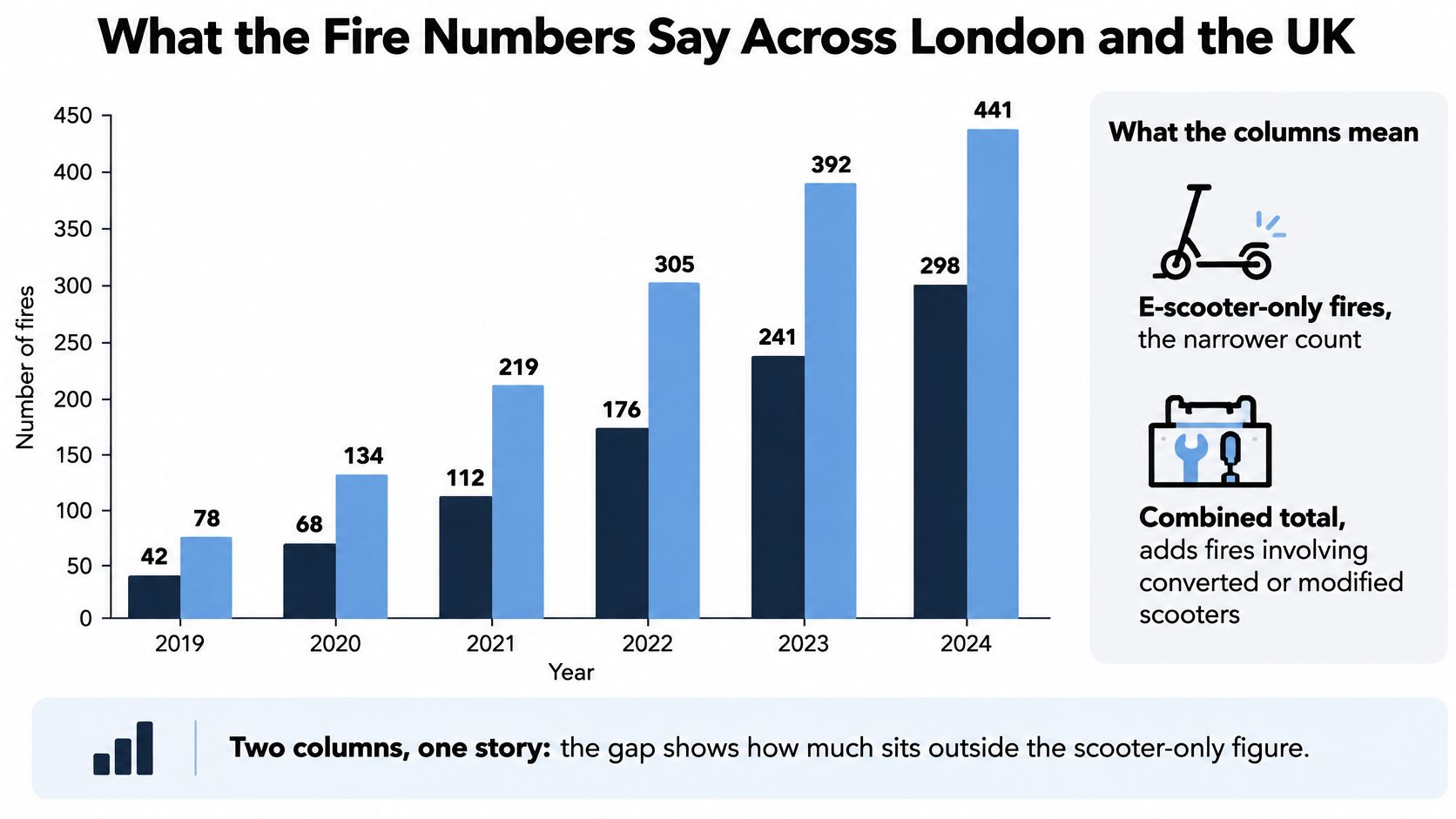
A relatively flat scooter-only line isn't a safety certificate. Equally, a rising combined count doesn't justify treating every well-maintained scooter as an emergency.
- For buyers: Prioritise traceable electrical components and model-specific compatibility.
- For flat dwellers: Judge charging arrangements by escape access, not available floor space.
- For regular riders: Act on changes in your own battery's condition rather than waiting for a dramatic warning.
The practical takeaway is proportionate: take battery faults seriously, keep charging away from escape routes and don't attempt to carry a failing pack to safety. Those decisions are more useful than treating a headline total as a prediction about your next ride.
Punk Ride LLC offers commuter, folding, fat tyre, off-road and performance electric scooters, alongside rider-maintenance and battery-safety guidance. Visit Punk Ride LLC to compare scooters for your journey and review the care guidance before setting up your charging space.

Share:
Best Class 3 Ebike with Throttle: Legal Limits to Check