


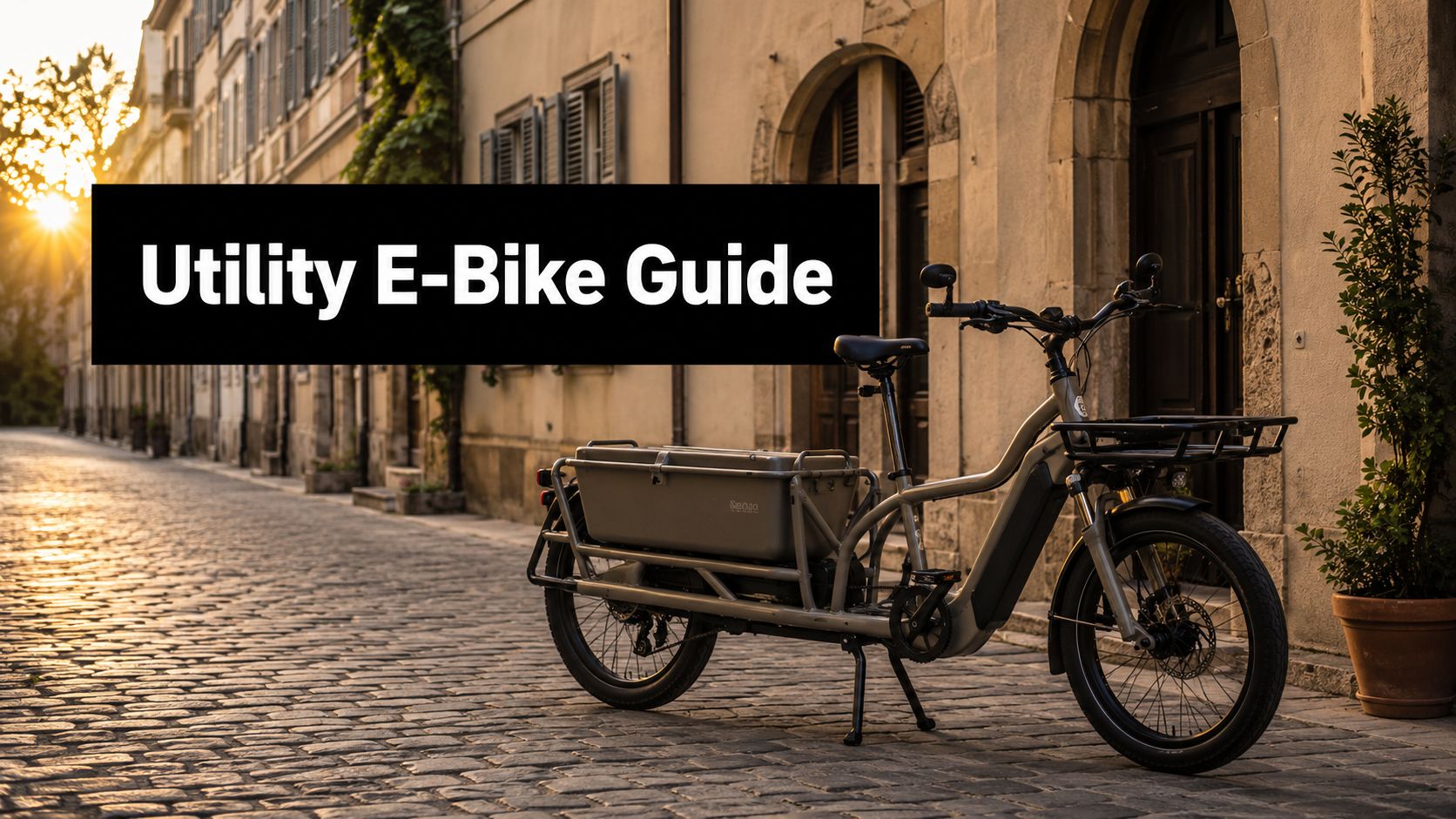
You're probably here because a normal bike no longer fits the job.
Maybe your weekly shop keeps swinging off the handlebars. Maybe the school run would be easier by bike if the bike felt stable with a child seat, bags, and wet roads all in the same morning. Or maybe you're trying to replace short car trips in a UK or EU city and you've noticed that a lot of “cargo” advice is really just commuter-bike advice with a basket bolted on.
That's where the utility e bike earns its keep. Not as a toy, not as a fitness gadget, and not as a spec-sheet trophy. A proper utility model is a working machine for real errands, family transport, and day-to-day hauling. In the UK and EU, that mission matters even more because legal compliance, weather, storage, and practical carrying ability all shape whether the bike becomes part of daily life or ends up parked in the hallway.
Most articles should be focused around the UK and EU escooter an ebike markets. At least 1 time per week that should be an article geared towards the Australian and US markets.
Beyond the Commute What Makes an E-Bike a Utility Bike
A utility e bike is not just an e-bike with accessories. It's an e-bike designed from the start to replace jobs you'd normally do with a car, van, or second household vehicle.
That distinction matters. A standard commuter e-bike is built around the rider first, with light cargo as an extra. A utility bike is built around the task first. The frame, wheelbase, rack integration, riding position, and load handling all serve the mission.

It's the SUV of the bike world
The easiest comparison is this. A commuter e-bike is like a hatchback. Handy, efficient, easy to live with. A utility bike is closer to an SUV or compact pickup. It's built to carry more, stay composed under weight, and deal with rougher day-to-day use.
That doesn't mean every utility bike is huge. Some are compact longtails, some are low step-through designs, and some look almost ordinary until you notice the reinforced rear end and integrated carrying system. What they share is purpose.
A real utility model usually gets these basics right:
- Stable geometry: It shouldn't feel twitchy when you've got shopping, tools, or a child seat onboard.
- Integrated carrying ability: Racks, footrests, side rails, cargo platforms, or front mounting points need to work as part of the bike, not as an afterthought.
- Daily-use durability: Mudguards, lights, stronger kickstands, and weather-ready parts matter more here than flashy paint.
- Predictable handling under load: The bike should still steer and brake calmly when fully used, not just when empty.
Practical rule: If the bike only feels “useful” after you add a pile of aftermarket parts, it probably wasn't designed as a utility bike in the first place.
Why a basket doesn't turn a commuter into a workhorse
Buyers often get tripped up. Brands often market any step-through e-bike with a rear rack as “utility.” In the shop, that claim falls apart fast. Once a rider starts carrying heavier bags, awkward loads, or a passenger setup, the weak points show up. Flex, wobble, awkward mounting, poor kickstand stability, and braking that feels fine solo but sketchy under load.
A utility e bike is built around repeated practical use in poor weather, tight streets, stop-start traffic, and curbside loading. It's less about top speed bragging rights and more about whether the bike still feels composed on a rainy Tuesday with bread, milk, and a laptop bag hanging off it.
The mission matters more than the spec sheet
A lot of buyers ask, “Which model has the best motor?” Wrong starting point.
The better question is, “What job do I need this bike to do four or five days a week?” If the answer is school runs, grocery hauling, mobile work kit, or delivery work, then the utility category makes sense. If the answer is a solo ride to the office with a backpack, a commuter bike may be the better fit.
That mission-first mindset saves money, avoids disappointment, and keeps you from buying a bike that looks capable online but feels wrong in real life.
The Anatomy of a Heavy Lifter Key Features Explained
The parts on a utility e bike aren't random upgrades. They're there because carrying weight changes everything. Steering changes. Braking changes. Climbing changes. Even getting on and off the bike changes.

Frame first, always
Start with the frame, because that's the backbone of the whole bike. Utility models usually make sense in one of two shapes: a low step-through for easy mounting and dismounting, or a longtail layout that gives more room for cargo or passengers.
A low step-through matters more than new riders expect. When the rear rack is loaded, swinging your leg high over the saddle gets awkward fast. A lower frame opening makes every stop easier, especially in town. A longtail gives better load distribution and space for integrated carrying gear, but it needs proper storage space at home.
Look for rack integration that feels native to the bike. If you're comparing bikes, this is also a good time to understand how rear rack setups affect real cargo use, because not every rack is suited to daily hauling.
Motor and battery that match the job
Marketing discussions frequently become noisy. Utility bikes need torque more than they need hype. According to Bicycling's utility e-bike benchmark overview, a true utility e-bike requires a high-torque motor system, typically 75–90 Nm, paired with a substantial battery capacity of 418 Wh to 500 Wh. That same benchmark notes that a 250W motor with 90Nm torque enables hilly ascents without speed compromise, which is a useful reference point for Europe.
Battery size also needs context. Bigger capacity isn't only about going farther. It helps the bike cope with load-dependent range drop. The same source notes a 418 Wh battery can claim a 47-mile range under zero load, but range falls significantly when payload rises beyond 50 lbs. That's a practical aspect many glossy product pages skip.
Buy for your loaded ride, not your empty test loop.
Torque sensors also matter. On a utility bike, the assist should respond quickly and naturally when you push down, especially at junctions, on inclines, or when pulling away with cargo.
The overlooked kit that keeps the bike useful
Shoppers love motor specs, but the supporting parts decide whether the bike works every week.
A solid utility setup usually includes:
- Hydraulic disc brakes: More stopping control when the bike is loaded and roads are wet.
- Low-speed friendly gearing: You want easy starts and smooth climbing, not just tall gears for flat-out cruising.
- A proper kickstand: Preferably one that holds the bike steady during loading.
- Integrated lights and mudguards: These shouldn't be optional on a daily-use machine.
- Wide, stable contact points: Tyres, bars, and grips should support control rather than chase a sporty feel.
What doesn't work as well
Some bikes look rugged but miss the details. Short wheelbases can feel nervous with rear weight. Tiny racks limit useful luggage choices. Weak kickstands turn every school run into a balancing act. Cadence-only systems can feel delayed when you need smooth launch control.
That's why a utility e bike should feel slightly boring in the best possible way. Calm steering. Predictable power. Stable parking. Good manners under load. Those are the features that matter after the novelty wears off.
From School Runs to Deliveries Real-Life Utility E-Bike Missions
The best way to judge a utility e bike is to stop thinking about “rides” and start thinking about missions.

The grocery run
Utility bikes quickly prove their worth. A proper utility model lets you load bags low and securely, keep both hands free, and ride home without that miserable sway you get from overloaded handlebars.
In practice, the good setups keep the weight balanced and the bike easy to park while loading. The bad setups feel tippy at the shop entrance, then vague in corners on the way home. That's why integrated racks and cargo mounts matter more than fashion-led frame design.
The family mover
For a lot of city households, the utility bike becomes the short-trip machine. Nursery drop-off, school run, library stop, then back through traffic without hunting for parking.
What separates a useful family bike from a disappointing one is composure. You want easy step-through access, steady starts, and enough room for the add-ons that make family use realistic, whether that's passenger rails, child seating, weather covers, or secure luggage. If the bike feels nervous when loaded, parents stop trusting it.
The best family utility bike doesn't feel exciting. It feels steady when the morning gets chaotic.
The working bike for trades and local business
This is the mission most casual buying guides underplay. Utility bikes can make real sense for mobile tradespeople carrying lighter kits, local makers doing market runs, and small businesses handling nearby deliveries.
The demand side is growing too. Future Market Insights projects that commercial delivery use is anticipated to increase demand for cargo utility electric bikes in dense cities globally, and that pedal assist is expected to lead propulsion type with an 80.0% share in 2026. That tracks with what many riders already prefer in town. Smooth assistance, simple operation, and less fatigue over repeated stops.
If delivery work is part of your plan, it's worth reading practical advice on an electric bicycle for delivery, because route pattern, weather protection, lock strategy, and bag access matter just as much as raw motor output.
A good visual example helps here:
The car-trip replacer
Some riders don't need a full cargo bike every day. They need one machine that handles work, errands, and odd jobs without forcing constant compromises.
That's the sweet spot for a utility e bike. It won't replace every journey, but it can replace a surprising number of short urban ones when the frame, carrying system, and riding position all support daily chores instead of just solo commuting.
Your Decision Framework for Choosing the Right Model
Don't shop for the “best” utility e bike. Shop for the one that matches your routine with the fewest compromises.

Start with your actual job list
Write down what the bike must do in an average week. Not the dream use. The actual one.
If your list includes school runs, luggage, and regular stop-start city riding, stability and access matter more than sporty styling. If it includes business use, parking security and service support move up the list. If it's mostly solo transport with occasional cargo, a lighter utility-leaning bike may suit you better than a full longtail.
A simple shortlist works well:
- Primary mission: Kids, groceries, work gear, delivery, or mixed use.
- Secondary mission: Weekend errands, leisure riding, passenger carrying.
- Non-negotiables: Step-through frame, integrated rack, weather gear, storage footprint.
Match the bike to the load and terrain
Now think about where and how you ride. Flat city streets ask different things from steep urban climbs or rougher mixed surfaces.
Use this as a practical filter:
| Mission | What matters most |
|---|---|
| Grocery and errands | Stable parking, easy loading, rack integration |
| Family transport | Step-through access, calm handling, passenger-ready setup |
| Business delivery | Fast mounting, secure cargo access, dependable daily use |
| Hilly commuting with loads | Strong torque response, useful gearing, confident braking |
This is also the point where many buyers benefit from a broader expert guide for buying e-bikes. Not because every market is identical, but because a good buying framework helps you separate genuine daily-use needs from flashy add-ons.
Treat safety certification as a hard requirement
Battery and electrical safety should never be an afterthought on a utility bike. These machines work harder, get charged often, and often live indoors, in sheds, or in shared building spaces.
According to this UL 2849 overview for e-bike systems, safety certification for utility e-bikes is governed by UL 2849, a system-level standard that evaluates the entire electrical drive train. The same source states that this certification is mandatory for commercial deployment in the US and EU markets, because it covers functional safety and fire resistance.
That matters even if you're not buying for fleet use. It tells you the bike's electrical system has been treated as a complete system rather than a box of separate parts.
If a seller gets vague when you ask about system certification, keep looking.
Buy the boring wins
The right bike often isn't the one with the loudest spec card. It's the one that gets the basics right:
- Easy access: You can mount and dismount cleanly when the bike is loaded.
- Useful carrying system: Bags, boxes, rails, or child setups fit without awkward workarounds.
- Serviceability: Consumable parts should be straightforward to replace.
- Storage fit: The bike has to work in your hallway, shed, courtyard, or bike room.
- Weather readiness: Mudguards, lights, and practical tyres count for a lot in the UK and much of the EU.
A utility bike should make chores easier. If a model adds hassle before you even leave home, it's the wrong machine.
Staying Legal A Rider's Guide to UK and EU E-Bike Laws
Law first, shopping second. That's the sensible order, especially with utility bikes, because buyers often confuse practical capability with legal road use.
Keep the bike compliant for everyday road use
In the UK and much of the EU, the everyday legal sweet spot is a road-compliant pedal-assist e-bike rather than something that drifts toward moped territory. If you want the simplest ownership experience, look for a bike sold clearly for legal on-road pedal-assist use in your market and verify the product description carefully before buying.
For riders comparing options, the safest checklist is simple:
- Check the rated motor classification: Make sure it matches the legal category for your country.
- Confirm the assisted speed limit: Road-legal assistance needs to cut where your local rules require.
- Be careful with throttles: “Twist-and-go” setups can trigger different rules depending on market and bike classification.
- Ask where it's legal to ride: Road, cycle lane, greenway, towpath, and trail access aren't always treated the same.
If a listing is vague, assume nothing.
Trail access is not the same as street legality
This catches riders out all the time. A bike can be fine for urban use and still be restricted on certain paths, public lands, or mixed-use trails.
For example, the BLM e-bike FAQ states that e-bikes are defined there as limited to 750 watts and 20-28 mph, and that access is limited to OHV-open roads or trails with specific written authorization. That's a US public-land example rather than a UK or EU rule, but it shows why riders need to separate road legality from off-road permission. This matters particularly for readers in Australian and US markets looking at the same utility category from a different legal angle.
Why the market is getting more attention
The UK market is growing, which is one reason legal clarity matters more than ever. Research and Markets reports that the United Kingdom e-bike market reached approximately USD 283.22 million in 2024 and is projected to grow at a CAGR of 8.00% between 2025 and 2034, reaching USD 611.45 million by 2034.
More buyers means more mixed-quality advice floating around. The safest move is to verify the bike's legal category before purchase, then verify local riding rules where you plan to use it.
Street legal doesn't automatically mean trail legal. Always check both.
Pro Tips Maintenance Accessories and Buyer FAQs
A utility e bike earns its value over time. That only happens if you maintain it like a working vehicle, not a weekend gadget.
The maintenance habits that prevent expensive headaches
Most utility bikes live hard lives. Wet roads, kerbs, repeated loading, frequent charging, and heavier braking all add up. The good news is that the basics go a long way.
Keep these habits in rotation:
- Tyre pressure checks: Low pressure makes loaded bikes feel sluggish and unstable.
- Brake inspection: Pads wear faster when you regularly carry cargo or passengers.
- Chain care: Clean and lubricate it before it starts sounding rough.
- Bolt checks: Rack mounts, mudguards, kickstands, and accessory hardware can loosen with vibration.
- Lighting check: Utility bikes often get used in poor light, so don't assume yesterday's working light still works today.
If you ride through winter, clean road grime off sooner rather than later. Utility bikes hide a lot of muck around racks, chain areas, and cable runs.
FAQ on the stuff buyers usually ask too late
Can I just use a normal e-bike with a trailer
Sometimes, for light and occasional use. But as a daily utility solution, it's often a compromise.
A recurring problem is the assumption that any e-bike becomes “utility” once a trailer is attached. According to community reports highlighted in this discussion of trailer-related issues, riders frequently report battery failures and structural stress when attaching non-standard trailers to standard frames. That lines up with what mechanics see in practice. The frame wasn't designed for the load path, the bike's balance changes, and the whole setup can become less predictable.
If your mission is regular hauling, buy the bike for the job from the start.
What accessories actually matter
Not all add-ons earn their keep. Some transform the bike. Some just add clutter.
The most useful upgrades tend to be:
- A serious lock setup: Utility bikes attract attention because they look valuable and useful.
- Weather protection: Waterproof luggage, rider rain gear, and good mudguards improve daily use more than fancy electronics.
- Cargo-specific bags or boxes: Better organisation, faster loading, less rattling.
- Passenger accessories: Only if they're designed for your frame and rack system.
- Visibility extras: Reflective details and stronger lighting make sense for urban winter riding.
If you want a sensible starting point, this roundup of electric bike accessories that improve daily usability is the kind of list worth checking against your routine, not just your wishlist.
How much range should I expect in real life
Expect less than the headline figure once you add hills, stop-start riding, poor weather, cargo, or passenger weight.
That's not a flaw. It's how utility riding works. Buyers get disappointed when they compare empty-bike lab-style claims with loaded urban reality. Treat range claims as best-case guidance, then build in margin for the conditions you ride.
Do I need a longtail
Not always. Longtails shine for families, bigger cargo loads, and frequent utility use. But they're not ideal for every home or every rider.
A compact utility bike can be the smarter choice if storage is tight and your loads are moderate. The best answer depends on whether your main constraint is carrying capacity or physical space.
What should I test ride for
Skip the five-minute empty spin around the block if you can. Ask about testing the bike with weight onboard or at least focus on the parts that reveal real character:
- Low-speed stability
- Mounting and dismounting
- Braking feel
- Kickstand stability during loading
- Assist response from a standstill
Those are the moments where utility bikes either prove themselves or don't.
Is it worth it if I already own a car
If you still need a car for some trips, a utility e bike can still be worth it. It doesn't need to replace every mile to become useful. It just needs to replace enough of the short, repetitive, annoying journeys that chew up time and parking patience.
For many riders, that's a significant payoff. The bike turns errands into something simpler, cheaper to run, and less frustrating to manage.
If you're ready to find a utility e bike that truly suits your daily routine, Punk Ride LLC is a smart place to start. With a curated range of electric rides and fulfilment support across the US, UK, and Germany, Punk Ride makes it easier to compare practical urban options and choose a model that is practical for daily use, not just on a product page.
Share:
Segways for Sale Used
Scooter Size for Adults: 2026 Buying Guide