


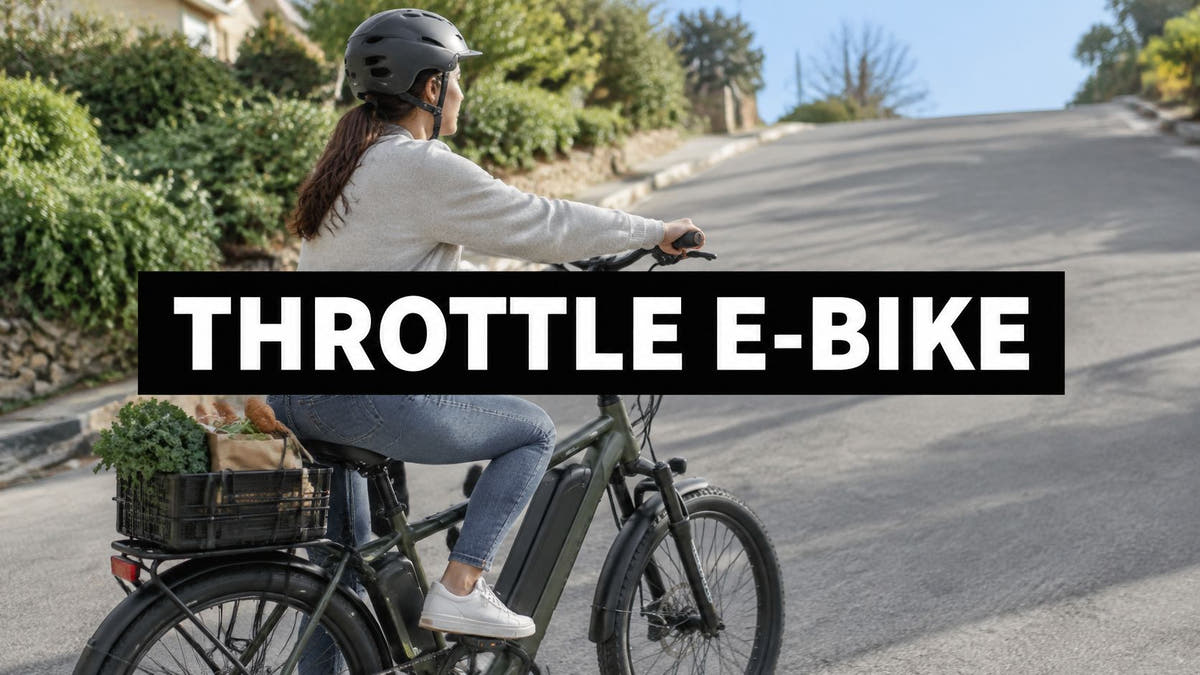
You're at the bottom of a hill with two bags of shopping on the rack, a bus behind you and a gradient that didn't look this steep on the map. On a throttle assisted electric bike you don't drop into first gear and stand on the pedals. You press the thumb lever or twist the right grip, the motor takes the load, and the bike climbs away while your feet stay still.
That single moment is what separates a throttle bike from everything else on the path, and it's also where the confusion starts. Is it still a bicycle? Can you ride it on a towpath? Why does the motor feel weaker after twenty minutes of climbing?
The answers split into two halves. One is hardware: what the throttle asks the motor to do, and what the motor does back under load. The other is paperwork: the power figure, the speed at which assistance stops, and the country you're standing in. Get both right and a throttle bike is one of the most practical machines you can own. Get either wrong and you're riding something that may be neither legal nor safe.
What a Throttle-Assisted E-Bike Actually Is
The hill is the clearest way to understand it. You're loaded with shopping, the road tilts up, and instead of turning the pedals you ask the motor for help directly. The bike moves. Your legs don't. That is the whole idea in one motion.
The hardware behind it is easy to sketch.
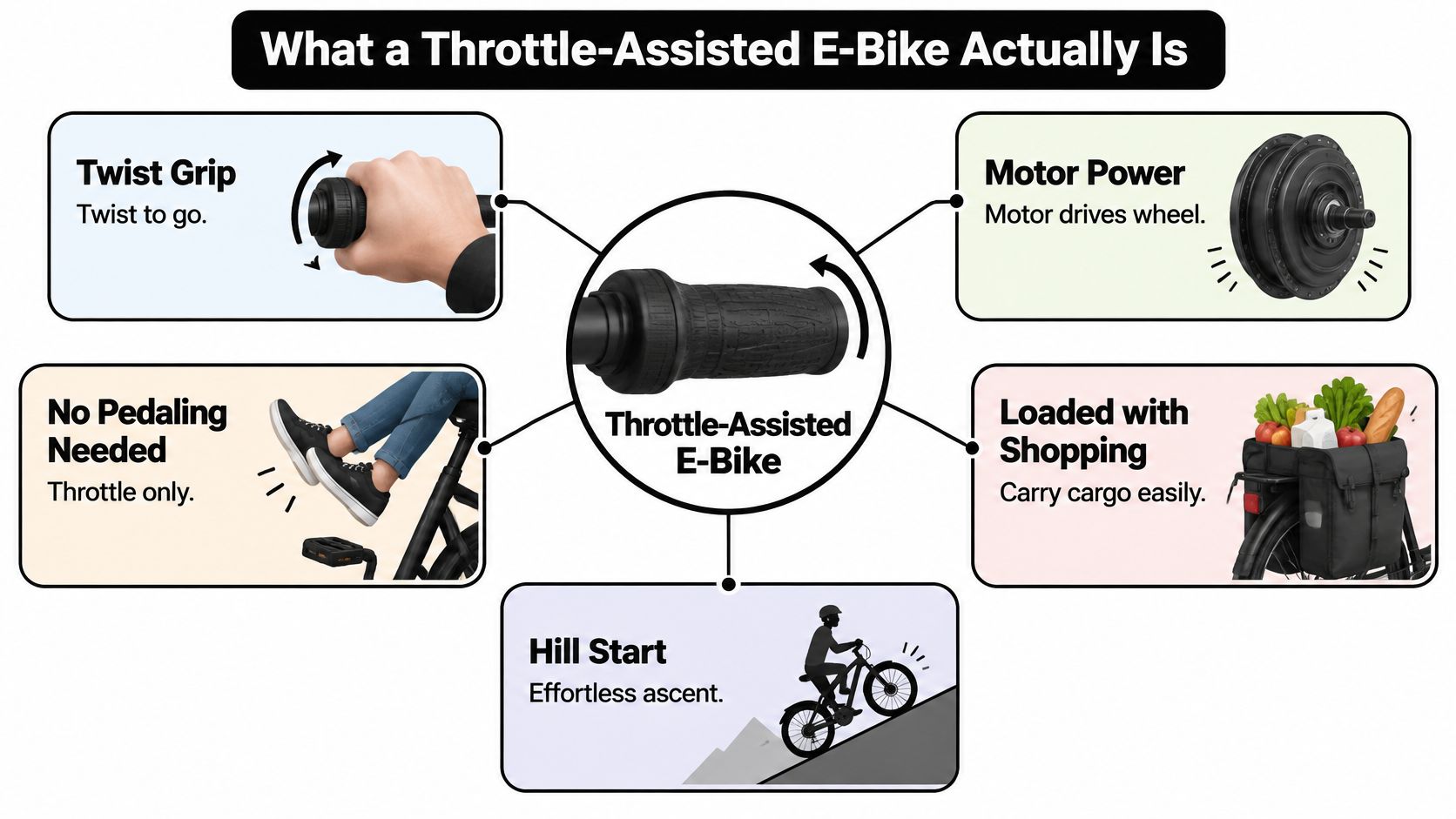
Think of the throttle as an accelerator you can press at any second, and pedal assist as a helper who only pushes while your legs are already moving. Press or twist and the motor answers immediately, whether or not you're pedalling. On a pedal-assist bike the motor waits for the cranks to turn before it contributes anything at all.
The Four Parts That Do the Work
- Battery. Stores the energy, usually on the downtube or behind the seat tube. Voltage and capacity decide how far you go and how hard the motor can pull.
- Motor. A hub motor in the rear wheel, or a mid-drive unit at the cranks. Hubs are simpler and cheaper; mid-drives use the bike's gears and climb better.
- Controller. The box that decides how much current the motor receives, based on your throttle input, the current speed and the temperature.
- Throttle. A thumb lever or twist grip, usually on the right. It's a request rather than a command, because the controller can always send less.
The category is growing fast. In the second quarter of 2024 the European Union imported 223,000 e-bike units, double the reported import volume from the comparable period, according to Bike Europe data cited by Laka.
What follows is the working knowledge you need to buy and ride one: how it differs from a pedelec at a red light, what happens inside the motor on a long climb, where the UK and EU rules draw the line, and what to check on a bike that's parked and unplugged.
Throttle vs Pedal-Assist for Daily Riding
A spec sheet can make the two systems sound identical. A red light makes them feel like different vehicles.
Throttle vs pedal-assist at a glance
| Feature | Throttle-assisted | Pedal-assist (pedelec) |
|---|---|---|
| Pedalling needed to move | No, the throttle can propel the bike alone | Yes, the motor only helps while you pedal |
| Moving off from a stop | Throttle works immediately | Assist starts once the cranks turn |
| Range on the same battery | Shorter with frequent throttle use | Longer with gentle pedal assist |
| Best for | Stop-start traffic, hills, carrying loads, resting tired legs | Long commutes, fitness riding, road use |
The throttle isn't a niche add-on either. In 2024, 98% of the direct-to-consumer e-bikes measured by PeopleForBikes were equipped with one, which tells you what buyers choose when the decision is theirs.
Moving off from a stop is where the gap shows first. A throttle shifts the bike from zero with no pedal input, which matters at a junction, on a slope, or when you're balancing a child seat behind you. A pedelec gives you nothing until the cranks rotate, so that first half-turn is always your legs.
Hills and loads favour the throttle for effort, but not for free. Every watt you ask for at the grip becomes current through the motor and heat inside it. A long climb at full throttle is the hardest thing you can ask a small hub motor to do.
The honest trade-off: the throttle buys you effortlessness at the start of every journey, then charges you for it in range and motor heat.
Range and feel pull in opposite directions too. With throttle-only riding the battery carries the whole job, so each mile costs more charge than a gentle pedal-assist cruise on the same pack. Pedal assist keeps you working, which is either the point or the obstacle depending on the rider.
- Throttle suits you if you ride stop-start traffic, haul shopping or cargo, start on hills, or need to arrive without sweating.
- Pedal assist suits you if your commute is long and flat, you want the exercise, or you ride paths that treat throttle bikes differently.
Pick pedal assist for flat roads and fitness. Pick a throttle for junctions, loads and tired legs, provided the bike is legal where you live.
How the Throttle Drives the Motor Under Load
Between your thumb and the road there's a conversation going on, and the controller holds the pen. Here's the chain of command.
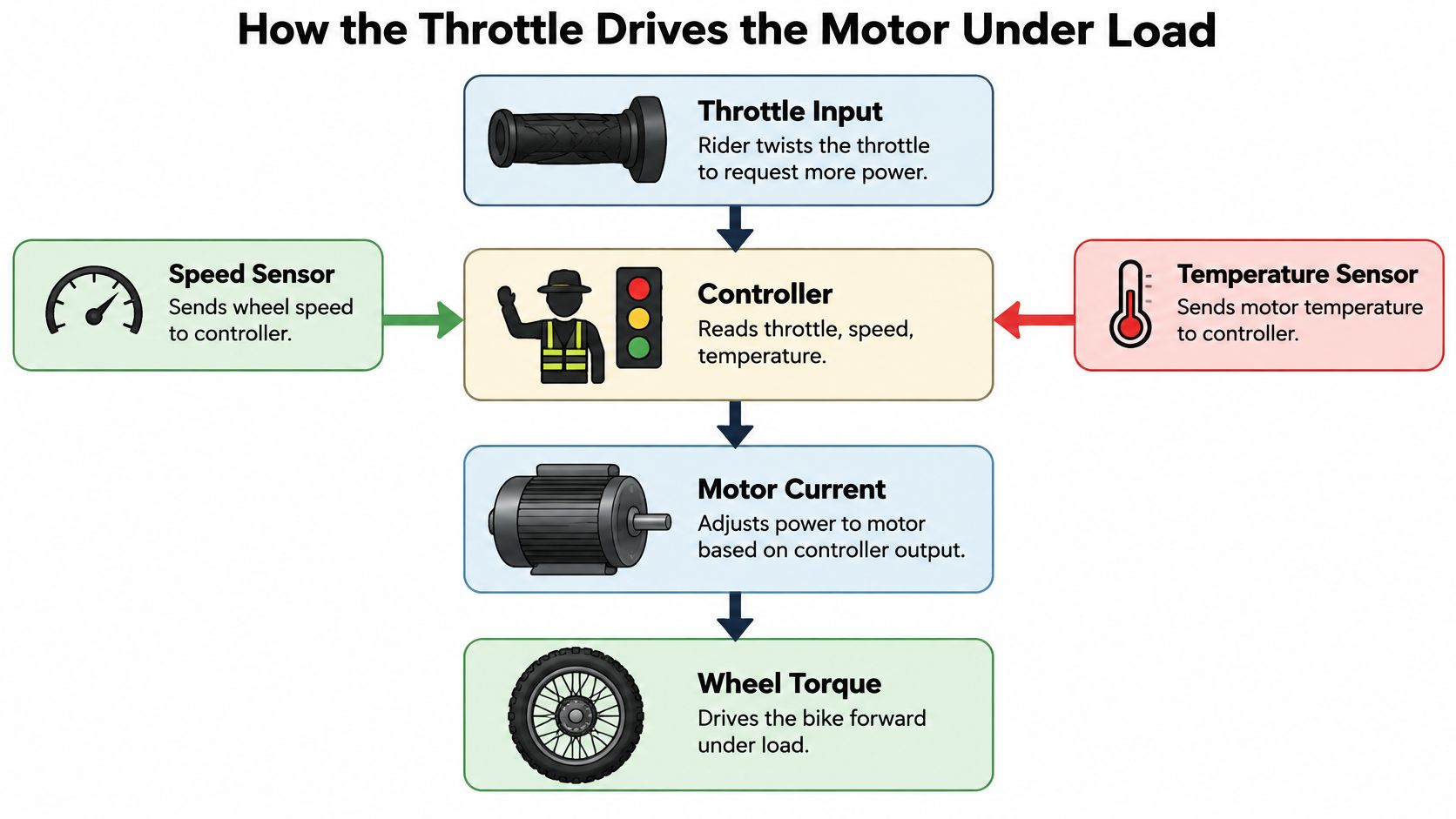
Picture the controller as a traffic manager at a junction. It watches three things at once: how far you've pushed the throttle, how fast the bike is already moving, and how warm the motor is running. Then it decides how much current gets through. Open the gate fully and you get torque now, plus heat you'll pay for in twenty minutes.
Heat Is the Real Limit
A throttle lets you demand full torque from a standstill, which is exactly the moment a motor is least able to shed heat. In an experimental e-bike system built around a 350 W brushless DC motor and a 36 V, 21 Ah battery, motor temperature climbed from 30.6°C to 56.8°C in 21 minutes under heavy load, and the motor then failed, as the drive study in the International Journal on Advanced Science, Engineering and Information Technology reports.
Three habits keep you clear of that outcome. Run a controller with current limiting and temperature sensing rather than one that hands over everything the grip asks for. Wind the throttle on progressively, especially for hill starts. And treat any sudden power reduction, hot smell or warm motor casing as a message to stop climbing and let things cool.
Ride it like a clutch, not a switch. A quarter turn gets you moving. Full throttle from a standstill is the setting that makes motors hot.
Hub motors and mid-drives handle that heat very differently, and our guide to the e-bike mid motor explains which layout suits long climbs.
If you want to see how assist cuts in and out on real roads, this walkthrough is worth four minutes.
What the Range Number Really Means
The same test system carried roughly 756 Wh of nominal stored energy before losses, and the usable distance from it swung on speed, terrain, rider weight, tyre pressure, controller efficiency and how often you accelerated. Advertised range is a test-condition estimate. No other habit eats it faster than repeated traffic-light launches on throttle.
When you read a listing, look for the programmed maximum assisted speed and the nominal motor rating rather than peak watts alone. The Congressional Research Service summary of e-bike rules makes the same point from the legal side: a bike configured for throttle propulsion above the ceiling can fall out of its category.
UK and EU Rules for Throttle E-Bikes
The UK test is short enough to recite in one breath. A throttle bike counts as an Electrically Assisted Pedal Cycle (EAPC) only if the motor's continuous rated power is 250 W or less, assistance stops at 15.5 mph (25 km/h), and any power without pedalling stays at walking pace, as the UK government's electric bike rules set out.
That walking pace is 4 mph (around 6 km/h), and it applies only to bikes approved for the function. A useful mental picture is the creep mode on an automatic car: it inches the vehicle along while you manoeuvre, and nobody would call it driving. A thumb throttle that pushes you along at 12 mph with your feet still turns the machine into something else in law, with approval, registration, licensing and insurance questions attached.
Where the Walk-Assist Line Falls
The distinction is mechanical rather than cosmetic. Walk assist exists for wheeling a loaded bike up a ramp or through a station concourse. A continuously usable throttle is for riding. One is a convenience; the other pushes the bike towards moped territory, where helmets, plates and type approval enter the picture.
Street legality and path access are separate questions, so check both before you buy. Our guide to whether electric bikes are street legal covers the points that get checked.
Australia's product-safety guidance, which reflects the EN 15194 framework used for compliant pedelecs in Europe, describes the permitted setup as no more than 250 W of maximum continuous rated power with assistance limited to 25 km/h. Transport Victoria's e-bike guidance is blunt about the throttle split: throttle power without pedalling above 6 km/h isn't allowed.
Throttle e-bike legal limits by market
| Market | Motor power limit | Speed limit with power | Throttle without pedalling |
|---|---|---|---|
| UK (EAPC) | 250 W continuous | 15.5 mph (25 km/h) | Walk mode up to 4 mph (6 km/h) on approved bikes only |
| EU (pedelec framework) | 250 W continuous | 15.5 mph (25 km/h) | Set country by country, often walk mode up to 6 km/h |
| US (federal Class 2) | Under 750 W | 20 mph (32 km/h) | Allowed up to 20 mph |
The United States runs a looser framework. Under 15 U.S.C. § 2085, a low-speed electric bicycle needs fully operable pedals, a motor under 750 W (1 horsepower) and a motor-only top speed under 20 mph on a paved, level surface with a 170 lb rider. Throttle propulsion is legal right up to that ceiling, which is why a bike sold happily in Florida can fail the UK test completely.
Three Checks That Settle It
- Read the motor rating and the programmed cutoff, not the peak wattage on the box.
- Ask for the approval documentation if you ride in the UK and the bike has any throttle function.
- Check the rules for the surface, because cycle paths, towpaths and land-managed trails often add their own restrictions.
Rules move as well. New South Wales permits 500 W today, and Transport for NSW has signalled a planned reduction to 250 W, which would leave some currently legal bikes on the wrong side of the line. Software limiting won't rescue a bike whose motor is rated above the limit either, because the rating on the motor is what gets checked.
One last point tends to get missed. The classification follows the bike everywhere, including where you park it overnight, and the insurance questions raised by a non-compliant machine don't switch off when you do. Check current government guidance for where you ride before you spend anything.
Battery Safety When the Bike Is Parked
Most battery advice stops at the wall socket. Don't charge overnight, don't use a cheap charger, don't leave the pack on the bike. Useful rules, but they treat unplugging as the end of the risk, and the numbers say otherwise.
UK government figures report 217 e-bike fires in 2025, with 88% of all reported e-bike and e-scooter fires involving the battery or generator as the ignition source. More telling still, 34% of incidents happened when the bike wasn't charging, against 32% during charging, according to the Home Office report on fires in e-bikes and e-scooters. A pack can fail while sitting in a hallway, which is why the parked bike deserves its own routine.
Run this after every ride.
- Store the pack at room temperature, away from doorways and direct sun, on a hard surface rather than carpet or a pile of coats. A hallway floor sounds convenient until you remember it is also your escape route.
- Inspect after any crash, drop or soaking. Look for cracks, dents, a swollen casing or a solvent smell around the seams. A battery works like a bruised phone battery: damage inside does not always show outside.
- Stop riding if something changes. Swelling, warmth when idle, a burning smell or sudden power loss are reasons to get the pack checked, not to keep commuting.
- Use only the charger matched to that battery. Voltage and chemistry have to line up, and a borrowed charger from a different bike is a gamble.
- Take the battery off for transport where the design allows it, and carry it upright and cool rather than in a hot boot.
The question worth asking before you plug in: what condition is this pack in, and who built it?
Conversions carry their own weight. A converted bike usually means an aftermarket controller or a non-standard pack, and the two were often never designed to work together. If you've upgraded the controller for more throttle current, the battery and wiring deserve the same scrutiny as the motor.
None of this is a reason to fear the bike in your hallway. Treat the battery as a component with a condition, something you look at, rather than a sealed box you never question. Our guide to electric bike battery life covers the charging habits that hold capacity up over the years.
Pros, Cons and Who Each Bike Suits
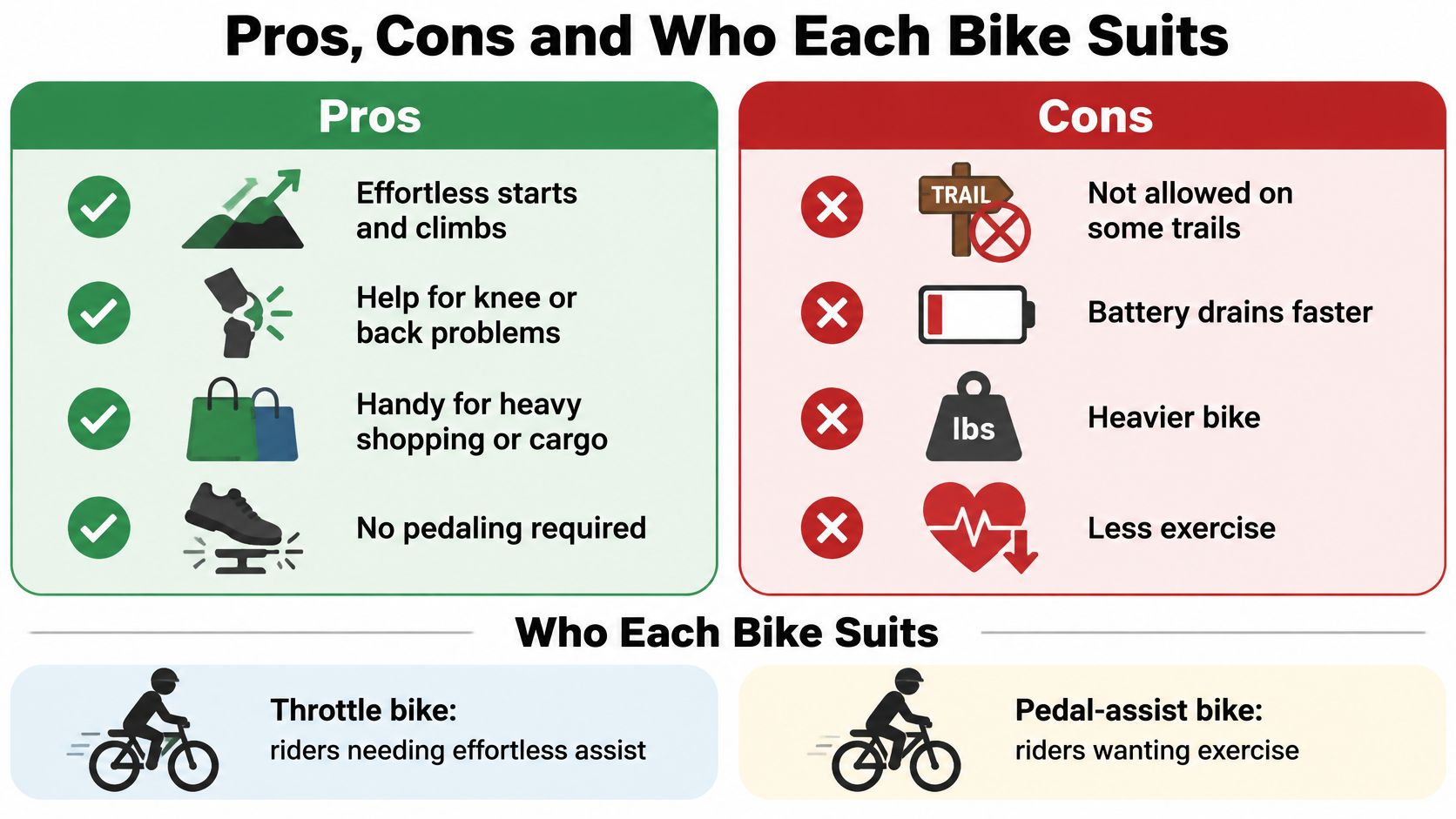
A delivery rider at a red light feels the trade-off in one squeeze: the throttle gets a loaded bike moving with no drama, and the battery pays for that ease later in the shift. That is the choice in miniature. The help is immediate, while the cost shows up as heat, charge and paperwork.
Where a throttle earns its place
- Effortless starts and climbs. Every junction and every ramp stops being a negotiation with your legs.
- Relief for knees and backs. Riders returning from injury or surgery can ride without loading a joint through every pedal stroke.
- Cargo made practical. Shopping, a child seat, tools or a delivery box all get heavier to start, and the throttle takes that weight.
- City riding in stop-start traffic. The most useful 3 mph of any journey is the pull away from the kerb.
Where it costs you
- Battery drains faster. The motor carries the whole job, so each mile costs more charge.
- More heat on long climbs. Sustained full-throttle climbing is the condition that damages small motors.
- Stricter legal treatment in the UK once throttle propulsion goes past walking pace.
- Weight and money. Bigger packs and stronger controllers add both.
- Less workout. If you bought the bike for fitness, the throttle will take it.
The delivery rider in a dense city spends the day pulling away from kerbs with a loaded bag. A throttle turns that into the easiest part of the shift, so the right answer is an approved model with a low step-through frame and a controller that limits current. Verdict: throttle, bought with the paperwork in hand.
The commuter covering 12 flat miles wants to arrive awake rather than exhausted, and a pedelec usually stretches range further than throttle-only riding on the same battery, because the motor is doing less of the work. Verdict: pedal assist, with a throttle only if the route has real climbs.
The grandparent with knee pain needs to mount without swinging a leg over a saddle, and needs power available before the first pedal stroke. A step-through frame and a legal walk mode matter more here than motor size. Verdict: throttle and low step-through together, plus a recovery habit, and advice on how to ease post-ride knee soreness is a sensible place to start.
If you remember one thing: match the frame to the rider first, then the drive system. A bike that's hard to get on gets left in the shed.
Check Your Bike Before You Buy or Ride
Five checks catch almost every problem, whether you're reading a listing or standing in your hallway with a torch.
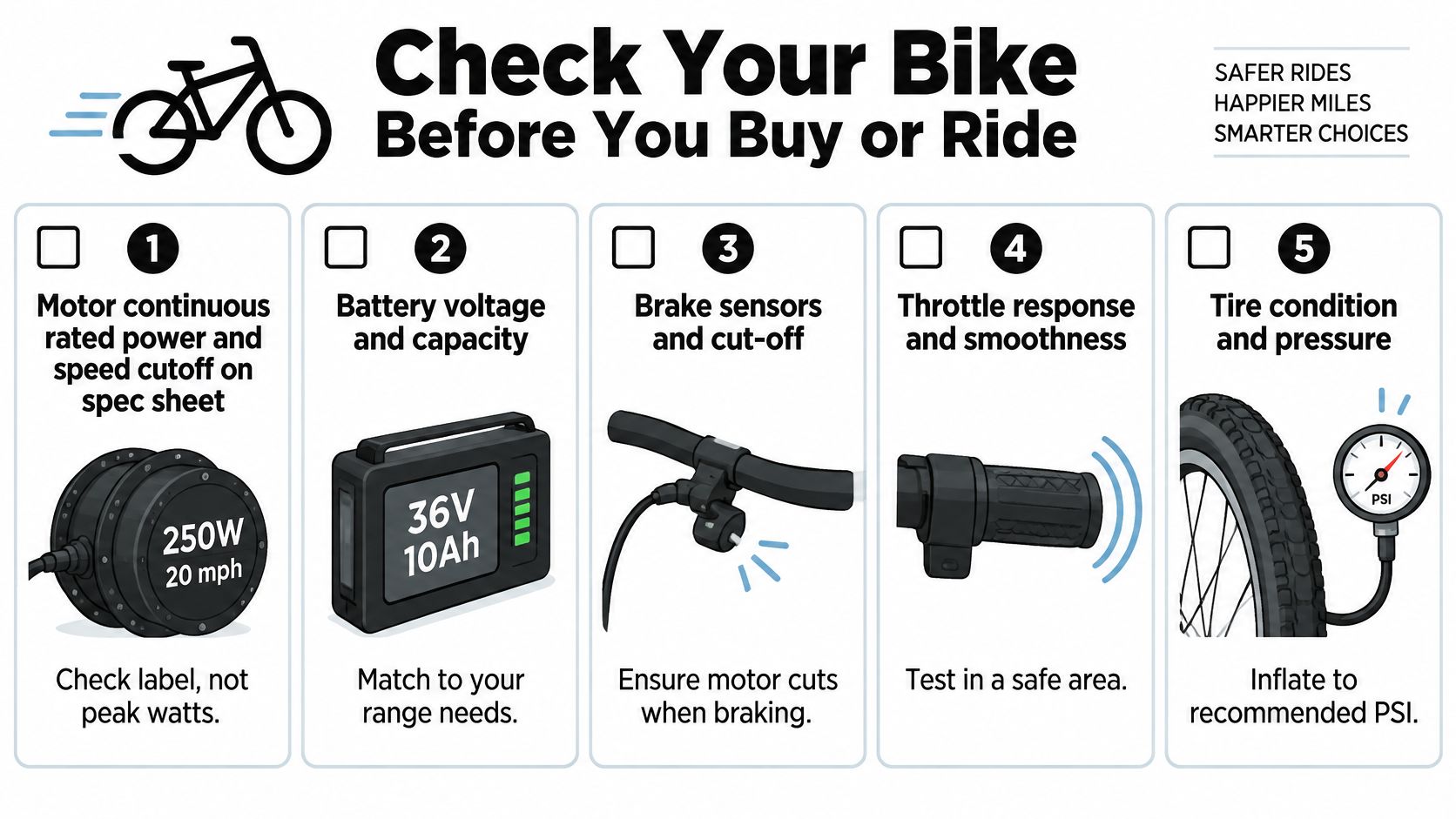
- Continuous rated power and speed cutoff. Both belong on the frame label or in the listing. If the seller quotes only peak watts, ask for the continuous figure in writing.
- Battery voltage and capacity. Match it to your real journey rather than the biggest number in the range, because a heavier pack is also a heavier bike to lift.
- Brake sensors and cut-off. Hold the throttle slightly open and squeeze each lever in turn. The motor should stop at once.
- Throttle response. Test it at walking speed in an empty car park before you ride in traffic, starting in the lowest assist level.
- Tyres and pressure. Inflate to the pressure on the sidewall and check for cuts after any ride on glass or gravel.
Add one parked-bike check while the bike is still: look along the battery casing for swelling, cracks, loose mounts or a damaged charge port, then store the bike somewhere dry and out of direct heat. A pack that gets knocked in a hallway can fail later even if it rides fine today.
Then filter by use case before comparing models. Our e-bikes are offered in the categories Adult Bikes, City & Commuter Bikes, Folding Bikes, Fat Tyre Bikes, Off-Road Bikes and Cargo Bikes, so the first decision is where you'll ride rather than which motor looks biggest.
Riders who need a low frame have a straightforward option in the ENGWE L20 Boost Step-Thru Electric Bike, at £1,099.00 in Green and Black. Ask about the warranty and whether the battery carries a recognised certification mark, and confirm the charger that ships with the bike is the one the pack was designed for.
Pick your use case, confirm the legal category for the country you'll ride in, then compare two or three models against the same checklist.
Punk Ride LLC sells electric bikes and scooters across city, commuter, folding, fat tyre, cargo and step-through designs, shipped from warehouses in the UK and Germany with headquarters in Florida. Visit Punk Ride LLC to compare models and find the one that matches your riding style.
Share:
Ebikes Under $1500: What You Get for the Money