


You've checked the distance to work, looked at a few scooters and started imagining a commute without the packed bus or the parking hunt. Then the awkward questions arrive: will it get home without charging, can you carry it up the station stairs, and what happens when the forecast turns wet?
The right scooter for commuting is the one that works from your front door to wherever you leave it at work. Top speed won't fix an unsafe junction, an awkward folding mechanism or a route you can't legally ride. Start with the journey, then choose the machine.
Calculate the Range You Actually Need
Your morning ride might look straightforward on a map, but the return journey deserves equal attention. A quieter route home, a shopping stop or a diversion around roadworks can change what you need from the battery.
Open your preferred map app and trace the route you can ride, not the shortest line between home and work. Record the outward and return distances separately, and mark any sections where you'll walk or use public transport. Don't count the train journey as scooter mileage, but do include the ride between the station and your workplace.
Build your shortlist around tested range
Advertised range is an upper-bound claim, not a promise for your commute. In a controlled laboratory evaluation published by MDPI, a scooter with an approximately 25 km declared range covered approximately 16.5 km under an urban driving cycle, about 66% of the claim.
That's a useful warning, not a universal conversion factor. Another scooter, rider or route could produce a different result.
For a practical starting point, require tested range equal to at least 1.5 times your daily round trip, then assess whether the test conditions resemble yours. The following planning values are calculated using that reserve rule, rather than presented as measured performance for any particular model.
Minimum tested range by commute length
| Commute length (one way) | Daily round trip | Minimum tested range | What to check |
|---|---|---|---|
| 2 km | 4 km | 6 km | Confirm rider weight and hills |
| 5 km | 10 km | 15 km | Confirm tested range, not the box figure |
| 8 km | 16 km | 24 km | Check for the kind of shortfall seen in urban-cycle testing |
| 12 km | 24 km | 36 km | Plan a larger battery or a confirmed charging point |
| 15 km | 30 km | 45 km | Limit the shortlist to long-range models |
A verified test needs context. Look for rider weight, route elevation, riding mode, temperature and whether the scooter maintained useful performance near the end. A distance achieved while crawling along flat ground isn't necessarily useful for your uphill ride home.
Don't buy by watt-hours alone
Battery watt-hours describe stored energy, not how efficiently the scooter will use it. Acceleration, gradient, rolling resistance and voltage sag can change the distance you get from otherwise similar battery capacities.
Ask whether the test included repeated starts and hills. Consider your laptop, lock and shopping alongside your own weight, and don't assume workplace charging exists until you have permission to use it.
Practical rule: Buy enough independently demonstrated range for an ordinary difficult day, not just a warm, calm ride with an empty bag.
Our electric scooter range guide provides more context for comparing range claims. To make the shortlist manageable, write down your round-trip distance, find the relevant planning row and retain only models whose tested capability clears your requirement.
Match Your Scooter to Your Route and Weather
The smooth road outside the showroom tells you little about the cobbles beside your office. Start with the worst recurring surface on your commute, because that's where an unsuitable scooter becomes tiring or difficult to control.
This is the kind of everyday obstacle worth inspecting before you buy.
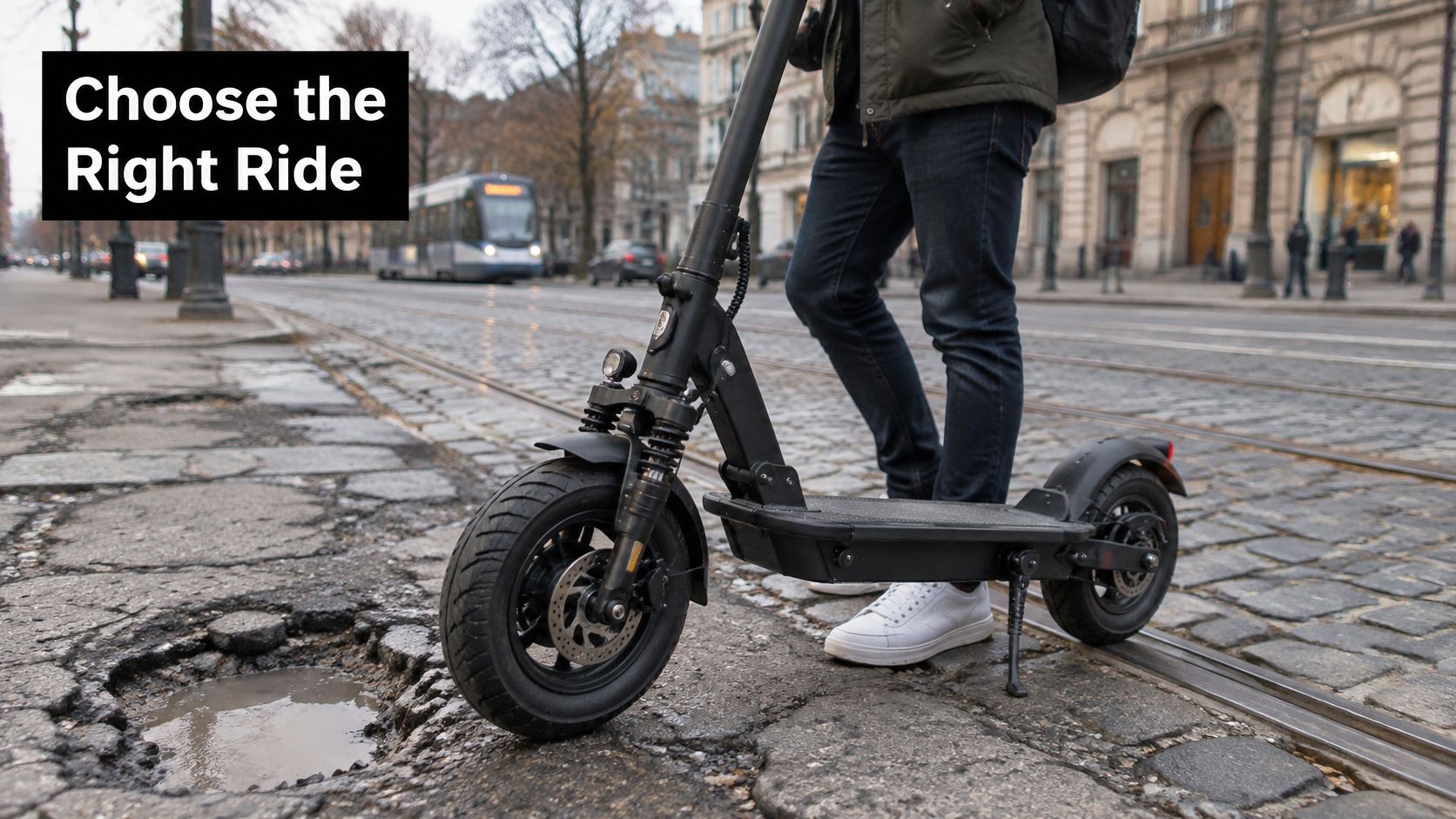
Larger pneumatic tyres are a sensible starting point for broken surfaces. Suspension can improve comfort, but test how the scooter settles after a bump, rather than assuming that visible springs mean good control. Excessive bouncing is no improvement over a harsh ride.
Match the hardware to the difficult bits
Wet roads require more judgement than a waterproofing badge suggests. Check the manufacturer's permitted conditions, the braking arrangement and the tyres, but remember that water resistance doesn't describe grip. No tyre tread makes wet tram rails predictable.
Route and weather conditions and the spec to check
| Condition | Spec to check | Why it matters |
|---|---|---|
| Potholes and cobbles | Larger pneumatic tyres and controlled suspension | Small wheels are more easily disrupted by abrupt surface changes |
| Wet roads and tram rails | Dual brakes and suitable tyre tread | Braking control matters, but neither feature makes wet metal safe |
| Hills | Continuous motor power and loaded climbing tests | Rider weight and steep gradients increase demand on the drivetrain |
| Coastal or bridge wind | Stable steering, usable deck space and manageable frame weight | Gusts can disturb your line; extra weight alone isn't a solution |
| Mixed transit trip | Carrying weight and quick folding | Platforms and stairs turn bulk into a daily inconvenience |
On hills, continuous motor power is more useful than a dramatic peak-power headline, though neither replaces a loaded climbing test. Look for evidence that the scooter can restart on an incline, not merely reach the summit after a fast approach.
Wind deserves its own route assessment. An exposed bridge may be comfortable in calm weather and unsuitable during gusts; buying a heavier scooter doesn't remove that problem. It can also leave you carrying more weight when you decide not to ride.
Use the video alongside your inspection, without treating a demonstration as proof of suitability for your own streets.
Run a route-readiness test
Where riding is legal and a suitable test ride is available, try the exact route during a typical weekday commute. Carry your normal bag and pay attention to junction approaches, damaged surfaces, pedestrian pinch points and places where you'd need to dismount.
- Record the awkward spots. Mark where you felt rushed, unstable or unable to see approaching traffic.
- Try the alternative. A quieter parallel street can be more useful than additional motor power.
- Reject recurring problems. If the scooter repeatedly struggles with an unavoidable section, choose another model or another travel plan.
Don't deliberately test dangerous weather. A route that only works in ideal conditions needs a backup, not a more optimistic specification.
Check Portability, Load and Storage at Both Ends
Carrying a scooter into an office feels different when you're also holding a laptop bag and opening a heavy door. A folding mechanism solves its length, but it doesn't make an awkward machine comfortable to lift.
Test portability with your actual clothing and luggage. Lift the folded scooter one-handed, carry it along a corridor and try the stairs you expect to use, provided you can do so safely. Notice whether the stem locks securely for carrying and whether the deck knocks against your leg.
Test the complete transfer
Use this checklist to assess the physical movements, not just the folded dimensions.
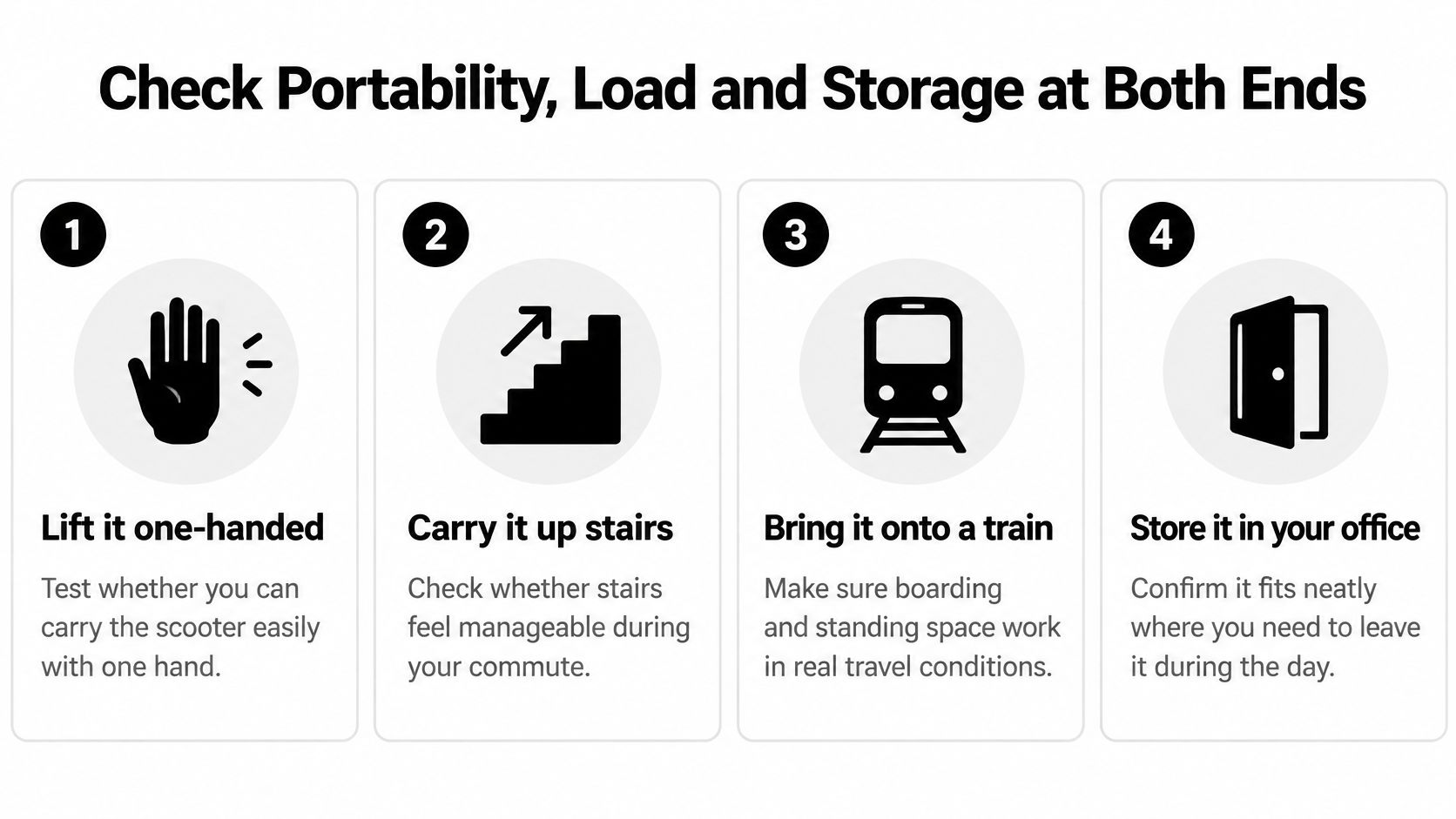
A folding scooter isn't automatically accepted on a train or bus. Check your operator's current policy before planning around it, including any battery-related restrictions.
In Chalmers' publication on shared scooters and public transport in Gothenburg, only about 20% of shared e-scooter trips were functionally integrated with public transit, although commuters were generally willing to walk up to 1 km when connections were convenient and reliable. Treat the connection as something to verify, not an automatic benefit.
Your bag also affects the transfer. Urban Totes' guide to choosing a laptop-friendly work tote can help organise work essentials, but make sure your chosen bag stays secure and doesn't interfere with steering. Never hang a loaded tote from the handlebars.
Check load before celebrating low weight
A lightweight product can be entirely wrong for an adult commute. Our compact children's scooter has a lightweight aluminium frame, weighs approximately 2.5 kg, uses a quick-fold system and has a maximum load of 50 kg. Those specifications illustrate why portability must never be separated from intended rider size and use.
For an adult, compare the load rating against rider plus everything carried. Our guide to electric scooters for heavier adult riders helps frame that comparison.
Before committing, confirm:
- Carrying comfort. You can lift it without twisting or straining.
- Folding practicality. You can operate the latch without blocking a doorway.
- Load suitability. Your complete travelling load is within the rating.
- Secure storage. The office, home or station has an approved place for it.
- Charging permission. Any destination charging is explicitly allowed and suitably located.
A bike shed is only useful if the scooter fits and you can secure its frame to a fixed anchor. An app lock isn't a substitute for physical security.
Know the Rules Where You Ride
In England, buying an e-scooter and being allowed to commute on it are separate matters. The government's e-scooter trial guidance permits approved rental scooters on public roads except motorways and in cycle lanes within official trial areas. Riders need a provisional or full UK driving licence with category Q entitlement. The trial speed limit is 15.5 mph, with lower local limits possible.
That permission applies to approved trial rentals. Privately owned scooters do not gain general public-road access, and a retailer's “commuter” label does not change their legal status.
Separate vehicle specifications from riding permission
A scooter may meet a product specification without being authorised for your route. Check the vehicle category, rider requirements and access rules separately.
In Victoria, the Transport Accident Commission's e-scooter guidance permits qualifying devices capable of no more than 25 km/h. The riding speed limit is 20 km/h. Riders must be at least 16 and wear a fitted helmet. Shared-use paths, bicycle paths and roads limited to 60 km/h or below are permitted; footpaths are not.
The US comparison has a narrower scope. The federal low-speed electric bicycle statute covers vehicles with fully operable pedals and motors below 750 W, with motor-only speed below 20 mph under its specified test conditions. It is not a nationwide rule for riding standing e-scooters.
Where and how you can ride by region
| Region | Where you can ride | Rider age and licence | Speed rule |
|---|---|---|---|
| England, rental trials | Public roads except motorways; cycle lanes within official trial areas | Provisional or full UK licence with category Q | Government trial cap, subject to lower scheme limits |
| Victoria, Australia | Shared-use paths, bicycle paths and qualifying roads; not footpaths | Minimum age and fitted helmet required under state guidance | Separate device-capability and riding-speed limits |
| United States, federal low-speed e-bike | Access determined by state, city and land manager | Check state and city requirements | Federal product definition applies to qualifying pedal-equipped e-bikes |
EU member states set their own access, licence, age and helmet rules for privately owned e-scooters. Confirm the requirements with the national transport authority and local municipality before riding.
The table compares regulatory approaches, not permission to ride. In particular, the US e-bike definition does not apply to a scooter without pedals.
Check the exact route before paying
For travel in the EU, consult the relevant national transport authority and the municipality responsible for your route. Confirm whether privately owned scooters are permitted, which vehicle specifications qualify and whether your intended cycle paths or roads allow them.
A legal purchase is not the same thing as a legal commute.
Keep the applicable official guidance handy. Check restrictions for parks, stations and private workplace grounds separately, and verify any rental scheme boundary before assuming you can complete the whole journey.
Ride Safely in Rain, Wind and Traffic
It's raining when you open the front door, the road is shiny and your usual junction already looks busy. Make the travel decision before you're late and tempted to force it.
If rain is heavy, gusts affect your balance or conditions exceed the scooter's permitted use, take transit or another suitable alternative. A bicycle is only an alternative if it's appropriate for the conditions and you can ride it safely. Don't treat any vehicle as a compulsory all-weather solution.
Build a wet-morning routine
These habits address common hazards, but they can't guarantee a fall-free commute.
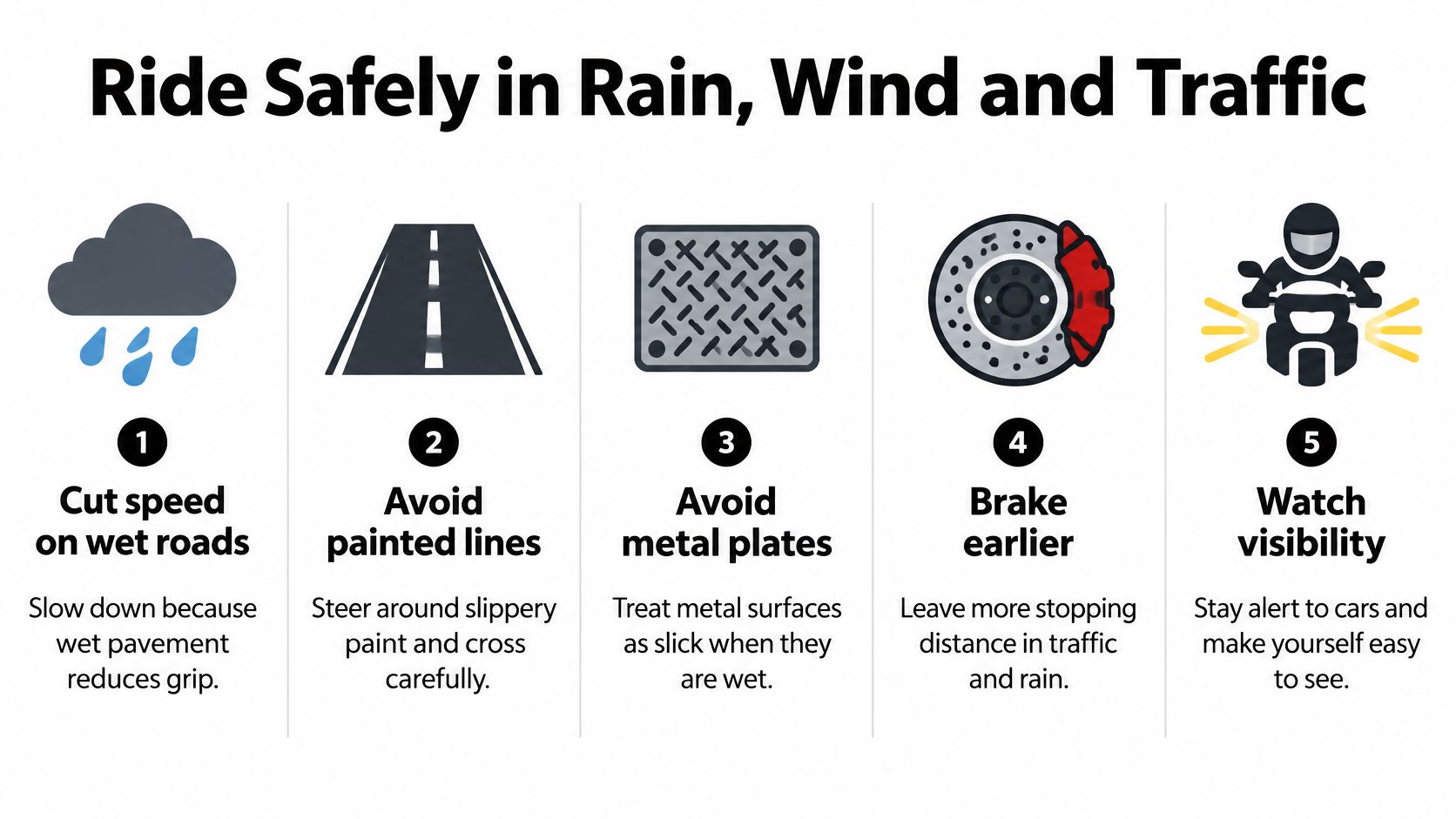
- Cut speed on wet roads. Leave enough space to slow smoothly without abrupt steering.
- Avoid painted lines where practical. Don't swerve into traffic to miss a marking; adjust your line early.
- Treat metal cautiously. Approach covers and plates upright, and avoid braking sharply on them.
- Brake earlier. Create stopping space before a queue, crossing or junction rather than discovering the available grip at the last moment.
- Watch visibility. Use functioning front and rear lights, wear reflective details and avoid lingering beside vehicles where the driver may not see you.
Wear a properly fitted helmet and keep both hands available for control. Make turns predictable, stay clear of opening car doors and avoid passing close to pedestrians.
Remove avoidable pressure
Don't start a journey when the remaining charge leaves no useful margin for a diversion. A low-battery warning halfway through a busy junction is a poor time to begin revising your route.
Check the tyres for visible damage before leaving, and use a pressure gauge during your regular servicing rather than relying on a thumb squeeze. Our electric scooter tyre guide explains the tyre choices and checks that matter for everyday use.
For a workplace commuting programme, keep consistent records of hazards and incidents. The National Transportation Safety Board's micromobility safety study highlights limitations in injury identification and data collection, so raw incident totals shouldn't be mistaken for comparable risk rates.
Your own routine can stay simple: check conditions, inspect the scooter, switch on the lights and choose the quieter legal route. If a near miss reveals a recurring conflict, change the journey rather than accepting it as normal.
Plan Maintenance and Battery Care
A commuter scooter needs a routine you'll follow. Keep a pressure gauge, suitable pump and the correct tools together, and use the manufacturer's service instructions for pressures, adjustments and torque settings.
Put checks on the calendar
Set recurring reminders for the following tasks. Treat these as a practical starting schedule, not a replacement for a shorter interval specified by the manufacturer.
- Weekly tyre check. Measure pressure when the tyres are cold, inspect the tread and sidewalls, and remove embedded debris carefully. Investigate repeated pressure loss rather than continually topping up.
- Monthly brake inspection. Check pad wear where applicable, lever travel and cable condition. Keep lubricants away from braking surfaces and arrange servicing if adjustment doesn't restore predictable operation.
- Monthly folding and stem inspection. Look for play, damaged fasteners and latch wear. Tighten only to the specified torque; blindly tightening everything can damage components.
Test the brakes and folding latch before each ride as well. If the stem moves unexpectedly or the latch won't hold securely, stop using the scooter until the fault is resolved.
Workshop habit: A new rattle is a reason to inspect the scooter, not a reason to turn up your headphones.
Protect the battery and record changes
Charge with the approved charger in a dry, suitable place away from escape routes. Follow the manufacturer's charging instructions, don't charge a damaged or wet battery, and stop using equipment that shows swelling, unusual heat or damaged cables.
For extended breaks, follow the specified storage charge level and keep the scooter somewhere cool and dry. Avoid leaving the battery fully discharged for a long period.
Seasonally, compare a normal commute with your previous experience under similar conditions. Note unusual charge consumption, reduced climbing ability or unexpected shutdowns, but don't deliberately run the battery flat to obtain a range figure.
Keep a simple service log containing the purchase receipt, warranty documents, inspection dates and replaced parts. Before buying, check whether tyres, brake components, folding latches and approved electrical parts are obtainable; an inexpensive scooter is poor value if a routine repair leaves it unusable.
Confirm Your Pick Before You Buy
A shortlist becomes useful when every candidate has to pass the same checks. Don't give an unsuitable scooter extra chances because you like its styling or the seller's speed claim.
Make the decision in the right order
- Range evidence. Does the tested capability cover your full journey with a sensible reserve under relevant conditions?
- Route suitability. Can it handle the unavoidable surfaces and climbs without making your ordinary journey uncomfortable or difficult?
- Portability and storage. Can you carry, fold and secure it wherever the journey requires?
- Legal access. Are the vehicle and rider permitted on every riding section?
A failed legal-access check ends the public-route shortlist, regardless of how well the scooter performs elsewhere. Likewise, a model you can't safely carry isn't a good station companion.
Use the storefront to compare relevant categories, then examine the individual specification and supporting documents.

Compare support as carefully as hardware
Read warranty coverage, exclusions and the repair process before placing an order. For the compact scooter described earlier, we provide a 2-year warranty, it has an average rating of 4.6 from 15 reviews, and we dispatch it from our UK regional warehouse network. Those details support a purchasing decision, but they don't turn a children's scooter into an adult commuting model.
For your own candidate, request the tested range and its conditions rather than accepting the headline distance. Compare independent test evidence, replacement-part availability and the practical arrangements for servicing.
Keep the receipt, route permissions and maintenance schedule in the same folder. Choose the model that clears every essential check, and confirm the range evidence before ordering, not after the first difficult journey home.
Punk Ride LLC offers commuter and folding scooters alongside electric bikes, giving you options to compare against your complete journey. Visit Punk Ride LLC with your route distance, carrying requirements and local rules ready, then choose a suitable model based on documented capability rather than the biggest number on the page.

Share:
Best Ebikes Under $3000: How to Choose in 2026