


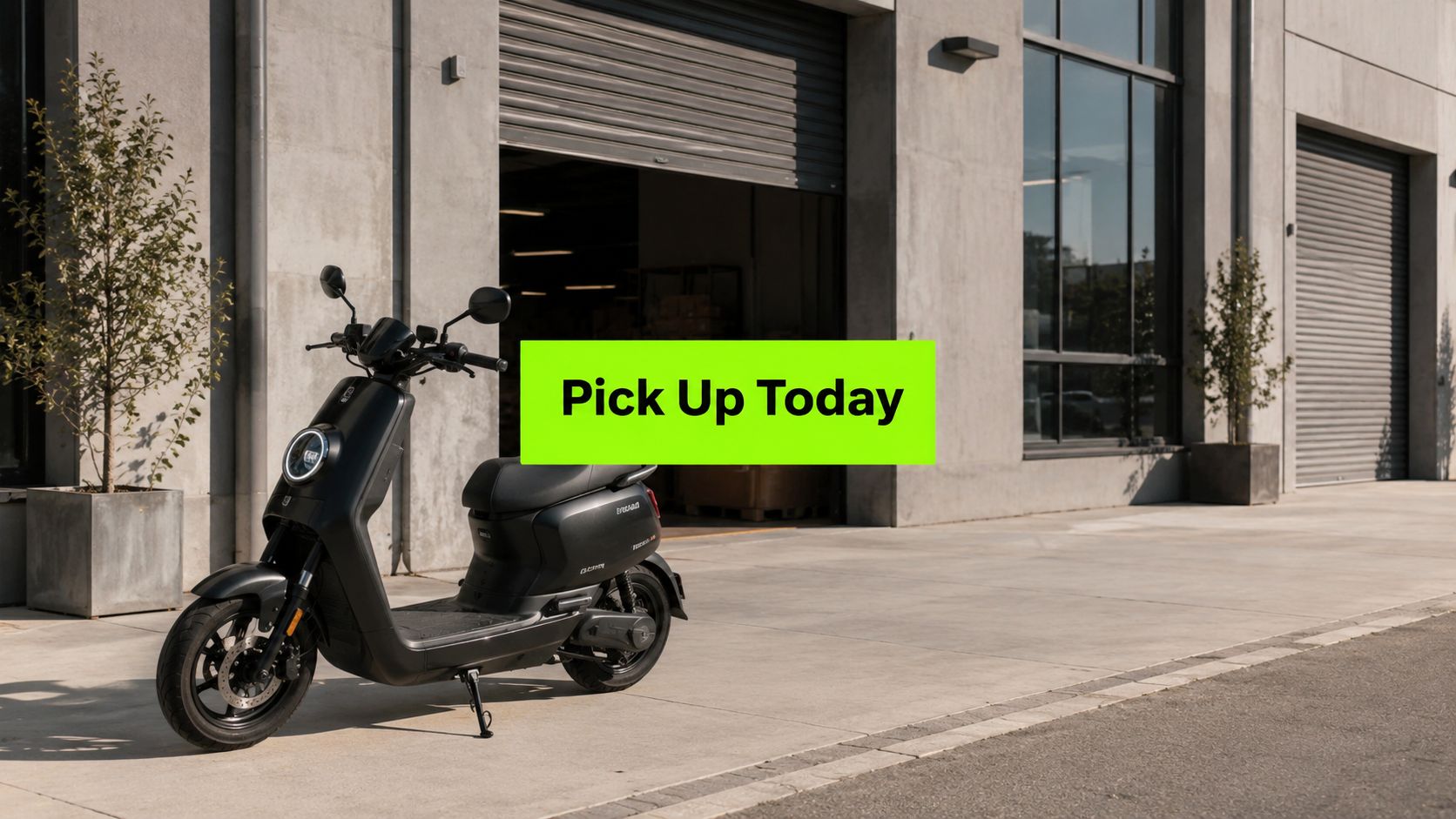
You woke up today wanting a scooter, not a research project. Fair enough. Maybe the weather's good, your commute finally annoyed you enough, or you're just done waiting on buses and parking apps. You want to find an electric scooter, inspect it properly, pay for it, and ride or haul it home without making a dumb mistake.
That's completely doable if you treat same-day pickup like a small mission, not an impulse purchase. The category is big and getting bigger. The global electric scooter market hit USD 21.46 billion in 2025 and is projected to reach USD 62.75 billion by 2034, with a 12.80% CAGR from 2026 to 2034, according to Fortune Business Insights on the electric scooter market. That matters for one reason. There are more models, more warehouses, and more fast-moving stock than ever, but also more junk listings, vague “available now” claims, and sloppy pickup experiences.
If you're shopping in the UK or EU, legal rules matter as much as the scooter itself. If you're in the US, the rules are often looser, but pickup logistics still trip people up. And if same-day stock isn't there, fast shipping from a nearby warehouse is usually the smarter move than settling for the wrong ride.
That 'I Need a Scooter Now' Feeling
You're not overthinking it. Most buyers don't decide on a scooter six weeks in advance. They hit a point where walking feels slow, driving feels stupid for short trips, and they want something they can use now.
I've seen the pattern plenty of times. Someone starts the morning looking at an iScooter commuter model, an AOVO daily rider, or a more serious dual-motor option from a brand like DUOTTS or iENYRID. By lunch, they're checking if any local shop has one boxed and ready. By late afternoon, they're wondering whether they can trust a warehouse pickup, whether the battery is charged enough to test, and whether the box will even fit in the car.
That's the right mindset, as long as you add structure.
Fast decisions work when the process is tight
A same-day scooter pickup only works if you stop browsing like a casual shopper and start acting like a buyer. Check nearby stock. Call a real person. Reserve the unit. Ask what condition it's in. Ask whether it's factory sealed, floor assembled, or customer-return stock. Then go.
Practical rule: If the seller won't clearly confirm the exact model, exact color, and whether the unit is boxed or built, don't drive there.
The emotional part of buying a scooter is easy. The practical part is where people mess it up. They show up with the wrong vehicle, forget ID for a test ride, or buy based on a claimed range number that sounds great on paper and disappoints by day two.
Why this feels more normal than ever
You're not buying into a niche hobby anymore. Electric scooters are part of a large mobility shift. That's why local stock moves quickly and why warehouse-backed fulfillment matters. Same-day pickup is possible, but only if the seller has their inventory and handoff process under control.
If they don't, take that as a warning sign before you hand over your money.
Your Game Plan for Same-Day Scooting
Start online, but don't stop there. Website stock indicators help, but they're not enough on their own. If you want an electric scooter pick up today, you need a confirmation chain, not a hopeful guess.
Search narrow, then call
Look for sellers that let you filter by region, stock status, and model type. If you're comparing commuter scooters against heavier off-road or long-range options, it helps to review the differences first. A quick skim through this electric scooter comparison guide can save you from chasing a model that doesn't fit your actual use.
Then pick up the phone.
Ask these questions in one call:
- Do you physically have this exact scooter on site today
- Is it boxed, assembled, or a floor unit
- Can you hold it under my name until a specific time
- Can I inspect it before paying
- Can I do a short test ride if local rules and space allow
That five-question call saves wasted miles and wasted mood.

Don't trust “pickup available” without human confirmation
A lot of pickup delays come from bad last-mile coordination, not from the scooter being unavailable in the broader network. Research on dockless e-scooter logistics and pickup bottlenecks notes that poor logistics optimization for individual scooter pick-ups can cause delays, and that smart lockers and direct warehouse shipping are emerging as solutions.
That applies to consumer purchases too. “Available” sometimes means “in the system,” not “sitting by the door with your name on it.”
Call the warehouse, not just the front desk, when possible. The warehouse team usually knows whether a scooter is actually reachable for same-day handoff.
If same-day fails, fast shipping is the smart fallback
A good warehouse network matters. If you're shopping across the US, UK, or Germany, a nearby warehouse can be almost as good as local pickup. If same-day stock isn't there, fast shipping from the closest warehouse is usually better than grabbing whatever random model is physically nearest.
Don't buy the wrong scooter just because it's available today. Buy the right scooter, and if needed, let shipping do the work.
The Pre-Pickup Headquarters Checklist
Before you leave home, get your basics sorted. This is the boring part that saves the day.
Bring the right stuff
You don't need much, but what you bring matters:
- Photo ID: Some shops want it for test rides or order verification.
- Payment method: Card is easiest, but ask first if there are limits or deposit rules.
- Your phone and charger: You may need order emails, maps, or setup instructions.
- Tie-downs or a blanket: Helpful if the scooter rides home in a boot, hatch, or back seat.
- A helmet: If you're hoping to roll away from the store, bring your own.
If you're new to ownership, also brush up on security before you buy. This guide on how to lock an electric scooter is worth reading before your first stop at a café or train station.
Check your car before your scooter
A boxed scooter can be awkward even when the scooter itself folds neatly. Hatchbacks are usually fine. Sedans can be hit or miss. Small city cars often force you to fold seats and clear the boot completely.
Ask the seller one practical question before you leave:
“What are the boxed dimensions, and do I need two people to lift it?”
That's a better question than “Will it fit?” because staff often guess.
Questions to ask at the counter
When you arrive, don't go straight to payment. Ask:
- What counts as a return issue for in-store pickup
- When does the warranty start
- Who handles warranty claims, the shop or the brand
- Is the charger included in the box
- Has this unit been updated, assembled, or test-ridden already
A pre-assembled scooter isn't automatically bad. Sometimes it's better because the staff already checked the controls and setup. But you need to know what you're taking home.
Inspecting Your New Ride Like a Pro
This is the part most buyers rush, then regret. Slow down and inspect the actual unit in front of you. Not the display tag. Not the website photos. The scooter.

Start with the frame and folding points
Run your hand along the stem, deck, hinge area, and rear fender. You're checking for dents, scratches, cracks, loose bolts, and badly aligned panels. Cosmetic marks on a warehouse item might be harmless, but damage around the folding mechanism isn't something to shrug off.
Fold it once if the staff allows it. Unfold it. Lock it again. It should feel positive and stable, not vague or crunchy.
If you've ever transported a car or bought one from a distance, you know why physical condition records matter. The same mindset applies here. A quick look at essential car shipping paperwork is useful because it shows how professionals document condition before handoff. Use that same habit with a scooter. Check it before the receipt becomes your problem.
Check tires, brakes, and controls by feel
Don't just look. Squeeze, spin, and press.
- Tires: Inspect tread, sidewalls, and inflation. Low pressure on pickup day is lazy prep.
- Brake levers: They should engage smoothly, not pull to the grip with no resistance.
- Throttle: It should move cleanly and return properly.
- Bars and grips: Twist lightly and make sure nothing rotates loose.
- Cables: Look for pinching, exposed sections, or messy routing near the fold point.
A scooter can look new and still feel wrong in the hands. Trust what the controls tell you.
Treat range claims as marketing, not reality
Buyers are often misled. Real-world testing shows riders typically get 71% of claimed range, and a scooter advertised at 39.3 miles will realistically deliver about 28 miles, according to Rider Guide's electric scooter statistics and range testing.
That doesn't mean the scooter is bad. It means you need to buy for your real use, not brochure optimism. Hills, stop-start riding, rider weight, and hard acceleration all eat range.
So if your daily round trip is close to the claimed maximum, that scooter is too small for your life.
Check battery status and electronics
You're not trying to perform a lab test in the shop. You just need confidence.
Use this quick review:
| Check point | What you want |
|---|---|
| Battery display | Powers on cleanly, no flashing errors |
| Charger fit | Secure connection, no damage to port |
| Lights | Front and rear lights work immediately |
| Horn or bell | Functional and audible |
| Display buttons | No sticking or lag |
A partly charged scooter at pickup is normal. A dead one with no explanation isn't.
The All-Important Test Ride and Purchase
If the seller allows a test ride, do it. No debate. A spec sheet won't tell you whether the deck feels cramped, whether the bars suit your height, or whether the throttle comes on too sharply for city use.

What to feel in the first minute
A short ride in a car park or loading area tells you a lot. Pay attention to launch smoothness, steering stability, brake bite, and foot position. If the scooter feels twitchy at low speed, too narrow underfoot, or awkward to balance, don't talk yourself into it.
A scooter you plan to ride often should feel easy immediately. Not perfect, but easy.
Here's a decent visual primer before you decide what “normal” should feel like on a first ride:
Use price as a reality check
Price tells you roughly what class of scooter you're buying. In 2026, the average electric scooter costs $1,113. Budget scooters average $335, mid-range models average $934, and premium units average $2,107, based on GM Insights market data for electric motorcycles and scooters.
That's useful for one reason. It stops you from expecting premium performance from a bargain scooter, or overpaying for basic hardware dressed up with flashy lighting.
Buying rule: If the ride feel matches your needs and the build looks solid, pay for function first and branding second.
Boxed unit or assembled floor model
If both are available, ask for the boxed unit unless the floor model has a clear advantage and the condition is spotless. A sealed unit lowers the chance of hidden knocks, missing charger parts, or mystery setup changes.
If you do take the assembled one, get the staff to note any visible marks on the receipt or order record.
Navigating Local Laws and Getting It Home
You've bought the scooter. Good. Now don't ruin the day with a bad first ride or a transport mess.
UK, Germany, and the US are not the same game
If you're in the UK, this is the big one. The current legal situation has been messy. Privately owned e-scooters remain illegal on public roads, cycle lanes, and pavements in the UK as of 2026, while rental trial scooters are legal only in designated trial areas, according to OKAI's summary of UK e-scooter legality. At the same time, the UK government has confirmed plans to create a new vehicle category to legalize private e-scooters on public roads by 2026, with national safety rules for speed and hardware, as covered in this UK government legalization discussion on YouTube.
In Germany, rules are stricter and more formal than many US buyers expect. You need to check local compliance, insurance expectations, and road-use rules before riding anywhere public.
In the US, laws vary by state and city. Start with a state-by-state reference like this guide to electric scooter laws by state. If you're buying or riding in New Jersey, a focused legal summary like Mattiacci Law on New Jersey scooter laws is useful because local details can change how and where you ride.

Getting it home without drama
If you can't legally ride it home, don't. Transport it properly.
Try this:
- Use a hatch or fold-flat rear seats: That's the easiest setup for most boxed scooters.
- Protect the interior: A blanket or cargo mat stops grease, rub marks, and sharp box corners.
- Secure the load: Don't let the scooter or box slide around in turns.
- Bring help if needed: Heavier models are awkward, especially with wide decks and large batteries.
If your car is too small, ask whether the seller can hold the scooter for collection later, or switch to fast delivery from the nearest warehouse instead of forcing a risky transport plan.
The last bad decision in a scooter purchase usually happens after payment. Buyers rush the trip home, skip the law check, and turn a good buy into a stupid afternoon.
If you want the shortest route to the right scooter, shop with a seller that understands stock, warehouse logistics, and regional delivery. Punk Ride LLC serves riders through its Florida headquarters and warehouse network in the UK and Germany, which makes same-day pickup possible in some cases and fast shipping the smart backup when it isn't. If you need a scooter now, start with what fits your ride, your laws, and your pickup options. Then buy with confidence.
Share:
Brake Pads for Hydraulic Brakes: A 2026 E-Ride Guide
Uncovering if Are E Bikes Good for Fitness: The Full Guide