


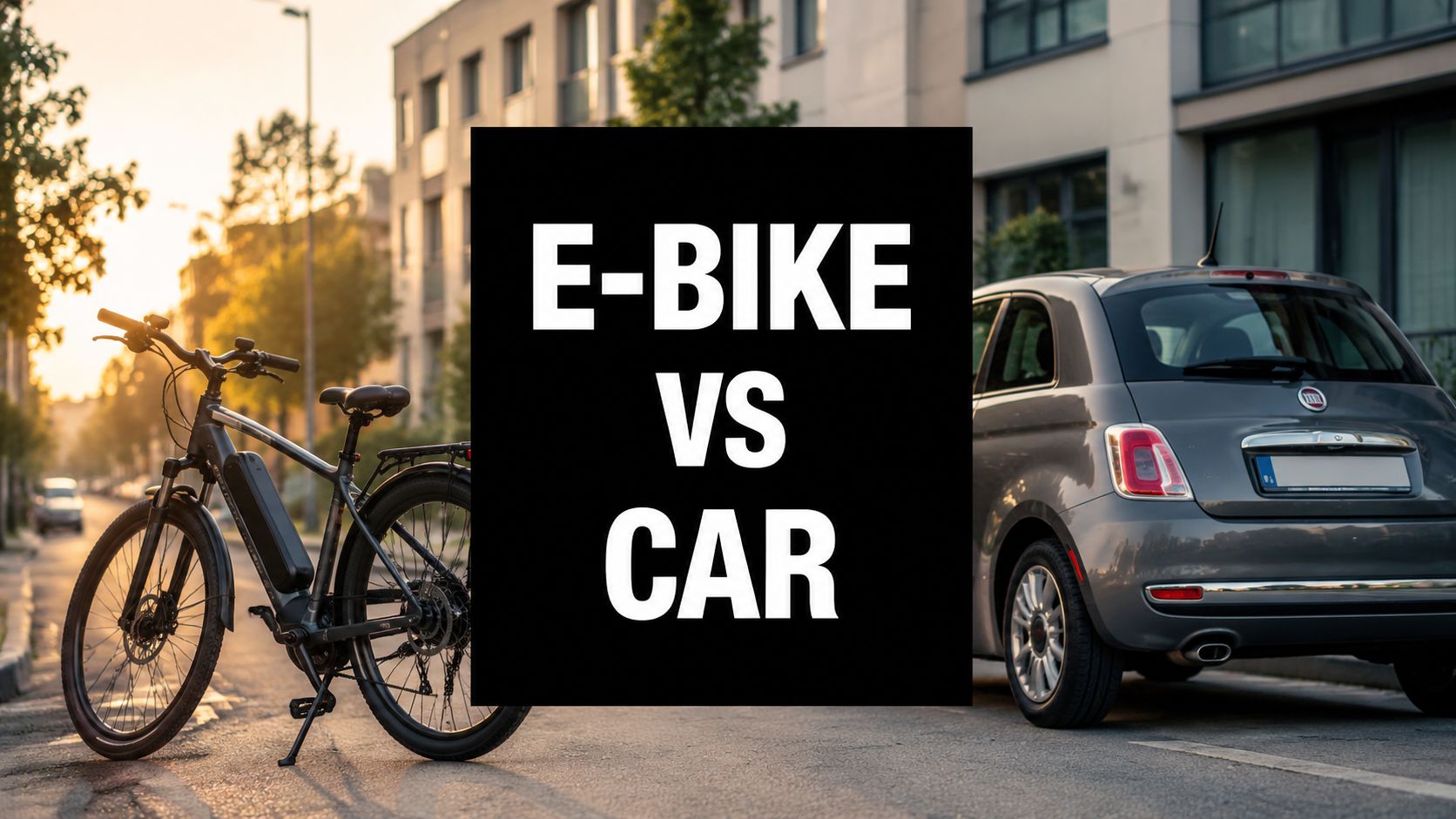
You're probably in the same spot a lot of city commuters hit sooner or later. The car still feels like the default, but every week it asks for more. More fuel. More parking money. More patience. More tolerance for traffic that turns a short trip into a sour start and an even worse ride home.
That's where the electric bike stops looking like a weekend gadget and starts looking like a serious transport tool. For many riders in US and Australian cities, the core question isn't “Is an e-bike cooler than a car?” It's much more practical. Which one makes daily life easier, cheaper, and less draining?
This is the version of the electric bike vs car debate that matters in everyday life. Not fantasy spec sheets. Not lifestyle marketing. Just the things that shape your morning and your bank balance.
Here's the quick view before we dig in:
| Commuter factor | Electric bike | Car |
|---|---|---|
| Urban trip flow | Usually smoother in dense areas with bike lanes and shortcuts | Strong on longer suburban and cross-city routes |
| Parking | Simple if secure bike parking exists | Often the biggest daily annoyance in busy districts |
| Carrying capacity | Fine for a backpack, groceries, laptop, and some cargo setups | Better for family duties, large shopping runs, and gear-heavy trips |
| Weather comfort | Exposed to heat, wind, and rain | Protected cabin, climate control |
| Running costs | Usually much lighter day to day | Usually broader ongoing costs and more surprise bills |
| Stress level in congestion | Often lower on short city routes | Often higher in traffic-heavy corridors |
| Long-distance flexibility | Limited by range, battery planning, and comfort | Far better for road trips and regional travel |
| Fitness effect | Adds light activity to the day | Mostly sedentary |
A lot of buyers in the UK and EU already treat e-bikes and scooters as normal urban transport, not novelty purchases. But for readers in the US and Australia, the conversation lands a little differently because city layouts, heat, distances, and driving habits can be tougher on bike-first commuting. That doesn't make the e-bike a weaker option. It just means you need a more honest filter.
The Daily Commute Dilemma
The daily car commute usually breaks down in the same way. You leave with just enough time, hit a slow stretch earlier than expected, crawl through traffic lights, then spend the final leg scanning for parking. By the time you walk into work, you haven't done anything dramatic. You're just already irritated.

That pattern shows up in very different places. In a US city, it might be the short drive that somehow feels longer because every other driver has made the same choice. In an Australian city, it might be a commute that looks manageable on a map but gets dragged out by bottlenecks, school traffic, and expensive parking near the destination.
Why the car stops feeling automatic
Cars still do some jobs brilliantly. They shield you from weather, carry people and stuff easily, and make regional travel simple. The problem is that commuters often use a car for every trip because that's what they already own, not because it's the best tool for each route.
That's where the electric bike earns attention. It handles a narrow but important slice of modern travel extremely well. Short to medium city trips. Office commutes. Train-station connectors. Grocery runs that don't require a boot full of shopping. School drop-offs for families using cargo setups.
Practical rule: If your regular trip is too short to justify the hassle of driving but too long or sweaty on a normal bike, an e-bike sits right in the sweet spot.
The better question to ask
Electric bike vs car is often framed as a winner-takes-all choice. That's usually the wrong starting point. A better question is whether your car has become an expensive solution to a problem that only shows up part of the time.
If that sounds familiar, it's worth looking at broader alternatives to car ownership, especially if most of your miles come from repeat city trips rather than long highway drives.
The biggest shift happens when you stop asking which machine is superior in theory and start asking what your week looks like. Commute. Coffee run. Grocery pickup. Gym. School. Station. Friend's place. Once you break life into those trips, the answer gets much clearer.
The Real Cost of Ownership A US & Aussie Breakdown
The sticker price is where most comparisons go wrong. A car can look manageable when you focus on the purchase or finance payment. An electric bike can look pricey when you compare it to a regular bicycle. Daily commuting doesn't care about either of those half-truths. What matters is the full ownership picture.
This infographic helps frame the categories that hit your wallet over time.
What a car really asks from you
Car ownership spreads costs across so many buckets that people stop seeing the whole stack. In the US and Australia, that stack usually includes:
- Insurance: This can swing sharply by state, city, age, driving history, and vehicle type.
- Registration and compliance fees: These differ across states and territories and don't disappear just because you drove less this month.
- Fuel: The price moves around, but the habit stays expensive if you drive often.
- Servicing: Oil changes, tyres, brake work, filters, fluids, and scheduled maintenance all add up.
- Repairs: The annoying kind. Sensors, batteries, air conditioning faults, suspension issues, and random workshop visits.
- Parking: Daily paid parking can turn a modest commute into an expensive routine.
- Depreciation: You may not feel it each week, but it matters if you sell, trade in, or upgrade.
For drivers comparing policies, local insurance context can be useful. If you're trying to understand how coverage choices affect total car costs, Mai & Associates California vehicle plans is a practical example of the kind of breakdown worth reviewing before you assume the car is the cheaper long-term option.
What an e-bike actually costs after purchase
An electric bike has ongoing costs too, just far fewer of them and usually with less financial sting. A commuter setup from brands such as ENGWE or CYSUM still needs a realistic budget for ownership.
| Cost area | Electric bike reality | Car reality |
|---|---|---|
| Energy | Home charging is usually simple and light on the bill | Fuel is a recurring expense you notice constantly |
| Maintenance | Tyres, brake pads, chain care, tune-ups, occasional parts | More systems, more fluids, more workshop labour |
| Repairs | Usually narrower in scope, but battery and electrical issues matter | Repairs can become major and sudden |
| Storage | Often free at home, but secure storage matters | Needs a driveway, garage, street permit, or paid parking |
| Insurance | Optional or limited in some cases, depending on location and rider preference | Usually essential and often substantial |
Most riders charge from a standard household outlet, which is one reason e-bikes stay relatively easy to live with. Routine care is closer to a bicycle than a car, though the battery, motor system, and braking setup deserve proper attention. A useful overview of the broader ownership picture sits in this guide to electric vehicle maintenance costs.
The hidden win with an e-bike isn't just that each cost category tends to be smaller. It's that there are fewer categories waiting to surprise you.
For a visual walk-through of the ownership comparison, this explainer is worth a look:
Where people underestimate both options
Buyers often underestimate e-bike setup costs at the start. You may need a helmet, lock, lights, wet-weather gear, panniers, and maybe a rack. If you live in an apartment, storage can be a bigger issue than charging.
Car owners underestimate friction costs. A quick errand can become a paid parking event. A basic service becomes more expensive once the workshop spots two more jobs. A “cheap” older car can soak up money through repeated fixes.
When people say the electric bike vs car decision is mostly about lifestyle, they're only half right. It's also about whether your transport budget is going toward movement or toward overhead.
Your Time and Sanity Travel & Convenience Compared
Cars win on maximum flexibility. E-bikes often win on usable convenience. Those aren't the same thing.
A car can theoretically go almost anywhere, in any weather, with a boot full of gear. But on a weekday city commute, you don't drive in theory. You drive through intersections, queue at lights, wait behind turning traffic, and hunt for parking after the hard part should already be over.
Where the e-bike saves more than minutes
On short urban trips, the e-bike advantage usually comes from consistency. You're not the fastest thing on the road, but you're often moving while drivers are waiting. Protected lanes, side streets, shared paths, and cut-through routes change the shape of a commute.
That matters more than people expect. Predictability is calming. When you know your trip time won't swing wildly because of a minor traffic snarl, your whole day gets easier.
A closer look at electric bikes for urban commuting shows why city riders often stick with them once the habit forms.
The parking problem is often the whole problem
I've seen plenty of people blame the “drive” when what they hate is everything attached to the final ten minutes. Parking garages. Meters. Tight spaces. Walking back in bad weather. Moving the car before a time limit expires.
An e-bike usually turns that into a simple lock-and-go routine, assuming your destination has decent bike racks or secure parking. That caveat matters. Bad bike parking can ruin an otherwise excellent setup.
Here's the side-by-side reality:
- Door-to-door friction: E-bikes usually involve less waiting and less circling.
- Errand chaining: Cars make sense when you're loading multiple stops with bulky items.
- Last-mile convenience: E-bikes shine when the destination is awkward for cars but easy to roll up to.
- Mental load: Many riders find cycling less aggravating than inching through congestion.
A calm commute has value even when you can't put a clean dollar figure on it.
What doesn't work so well on an e-bike
Many overly cheerful articles lose credibility when they fail to acknowledge this. Some commutes are better in a car.
If you need to carry children without the right setup, haul tools, drive long arterial roads with poor cycling infrastructure, or arrive in formal clothes during a humid Australian summer, the car starts to make a stronger case. The same goes for trips with multiple passengers or days when your schedule changes constantly.
The joy factor is real, though. Even with trade-offs, many riders feel better after a pedal-assist trip than after a car commute. You're more awake. Less boxed in. Less likely to start work already annoyed. That doesn't mean the bike wins every route. It means convenience is bigger than speed alone.
Performance Range and The Elements
The cleanest way to judge performance is to ignore marketing and look at your route. Not your dream route. Your actual week.

Start with your daily distance
For commuting, range anxiety on an e-bike is often overstated, but it isn't fake. Battery range changes with assist level, rider weight, cargo, hills, stop-start riding, tyre pressure, and wind. Background research in the brief notes that most e-bikes can travel 20 to 70 miles on a single charge according to Better Energy. That's a wide band, which tells you something important. Manufacturer range claims only help if you match them to your terrain and riding style.
Cars are far easier for long-distance travel. If your regular life includes regional drives, airport runs, or scattered suburban stops in one outing, the car remains the easier machine.
Use this checklist:
- Map the round trip rather than the one-way distance.
- Add buffer for weather and hills because both can cut practical e-bike range.
- Think about charging access at home first. Workplace charging is a bonus, not a plan.
- Be honest about speed needs because legal limits and path conditions shape real-world pace.
Speed is less simple than people think
Electric bikes feel quick because they get up to useful urban speed without much effort, especially from traffic lights and on rolling terrain. They also make hills much more manageable than a regular bike. But they are still governed by local rules, and those rules vary across the US and Australia.
That matters because an e-bike's “speed” advantage often comes from bypassing choke points, not from outright velocity. A car may be faster on an open road. In a city center, it may spend more of the trip standing still.
Weather, heat, and rough conditions
Cars dominate bad-weather comfort. That's obvious, and it shouldn't be glossed over. Cold rain, strong headwinds, peak-summer heat, and poorly maintained roads all weigh against the e-bike.
Still, most weather problems are partly a gear problem:
- Light rain: Manageable with fenders, waterproof layers, and a bag cover.
- Heat: More challenging in Australia and warmer US states, especially if there's no shower at work.
- Wind: One of the most underrated commute killers on a bike.
- Hills: Usually manageable on a decent pedal-assist setup, but battery draw increases.
If your area has frequent storms, long exposed roads, or unsafe cycling infrastructure, performance on paper won't save the experience. A car is bulkier and costlier, but it's also much more forgiving when conditions turn ugly.
Environmental and Health Impacts
This part often gets framed in moral language, but it's more useful to keep it practical. Your commute changes more than your budget. It changes what kind of energy you use, how much space you take up, and whether your travel time includes any movement at all.
The visual below sums up the broad contrast.

Why the difference feels bigger in cities
An e-bike uses less material, needs less space, and creates less local noise than a car during everyday use. In city environments, those differences feel immediate. Fewer fumes at curb level. Less road space occupied. Less engine noise in areas that are already overloaded.
That doesn't mean e-bikes are impact-free. Batteries still need responsible handling, and manufacturing still has a footprint. But for short urban trips, they're usually a lighter solution than moving a full car for one person and a backpack.
The health side is easy to underrate
Driving is comfortable, but it turns travel into seated time. An e-bike adds low-intensity to moderate movement without demanding the effort of a road-cycling workout. For many commuters, that's the whole appeal. You arrive more alert without needing a change of clothes every time.
One useful lens: an e-bike can turn dead commute time into active transport without requiring athlete-level motivation.
There's also the mood factor. A ride home can act like a buffer between work and the rest of the evening. That matters more than people think, especially if your job already keeps you indoors and seated.
The broader effect of one swapped trip
One person switching some short car trips to an e-bike won't transform a whole city overnight. But the personal effect is still meaningful. Less idling. Less parking stress. More movement built into the week.
In background material for this brief, Washington State's Department of Ecology described bike-centered projects as a way to reduce barriers and help people replace some car trips with bike trips in communities where pollution and access matter. The same principle applies at the individual level. Short, routine trips are where the electric bike vs car decision can have the biggest practical ripple effect.
Making the Right Choice Your Decision Framework
A lot of people don't need a verdict. They need a filter.
The best choice depends less on identity and more on trip pattern. If you treat this like a purity test, you'll make the wrong call. Very few households need to be “car only” or “e-bike only” across every situation.
Choose the e-bike when these conditions line up
The electric bike is the strongest option when several of these are true:
- Your commute is short to moderate: Especially if it stays inside a city or inner suburb.
- You have usable infrastructure: Bike lanes, calmer streets, or paths matter a lot.
- Parking is painful: This alone can swing the decision.
- You usually travel solo: One rider, one bag, maybe some groceries.
- You want lower ongoing costs: Not theoretical savings. Everyday savings.
- You can store it securely: At home and ideally near work.
If theft risk is one of the things holding you back, add security planning from day one. A strong lock is the baseline, and riders in areas with higher theft concern may also want reliable electric bike tracking as part of a layered security setup.
Keep the car as the main tool when life demands it
The car still makes more sense if your routine includes family transport, long highway segments, heavy cargo, poor cycling routes, or weather exposure that would make regular riding miserable. The same applies if your workday requires multiple unpredictable stops or if you're often driving other people.
This isn't a failure of the e-bike. It's just honest matching of tool to task.
The hybrid approach is the smart middle ground
For many households, the strongest answer in the electric bike vs car debate is both, but used differently.
Think of the e-bike as the everyday machine and the car as the specialist. The e-bike handles commuting, café runs, station trips, and quick errands. The car handles family duties, hardware-store loads, long drives, and weather-heavy days.
Some of the biggest wins happen when an e-bike replaces a household's second car or absorbs most of the repetitive local trips.
That setup works especially well for people who feel stuck between convenience and cost. You don't need to prove total loyalty to one option. You just need to stop using the expensive one for jobs the lighter one can do better.
Frequently Asked Questions
Are e-bikes legal and safe for commuting in the US and Australia
Yes, but the details vary by state and territory. Helmet rules, power limits, speed caps, and where you can ride all depend on local law. Some places are bike-friendly and clear. Others are patchy and frustrating.
Before buying, check three things with your local transport authority:
- Where you can ride: Road, bike lane, shared path, or trail access can differ.
- Helmet rules: In Australia especially, this is not something to guess.
- Class or power limits: Some e-bikes fit normal bicycle rules, others don't.
Safety comes down to route choice as much as equipment. A modestly powered commuter bike on a protected route is often safer and more pleasant than a faster bike mixed into hostile traffic.
Is e-bike maintenance difficult
Not really. If you can stay on top of a normal bike's basic care, you're already most of the way there. Tyres, chain lubrication, brake checks, bolt checks, and keeping the drivetrain clean do most of the heavy lifting.
Battery care matters too. Avoid rough charging habits, use the proper charger, and store the battery sensibly if your climate swings hot or cold. If something electrical goes wrong, use a shop that knows e-bike systems instead of a general bike mechanic who doesn't.
A simple rhythm works well:
- Weekly: Check tyre feel, brakes, lights, and chain condition.
- Monthly: Look over bolts, cables, wear items, and charging contacts.
- Seasonally: Book a tune-up if you ride often.
Can an e-bike really replace a second car
For a lot of households, yes. Not for every trip, and not in every suburb, but often for a surprising share of weekly travel. That's especially true when one adult mainly uses the second car for commuting, errands, station runs, and solo trips.
The replacement works best when you have:
- Secure storage at home
- A rideable route most days
- Some carrying solution like panniers or a rack
- A backup plan for bad weather or heavy-load days
If your second car mostly exists for local repetition rather than essential heavy-duty work, an e-bike can take over far more of that job than is often realized.
If you're weighing your options and want a commuter setup that fits city life, Punk Ride LLC is a solid place to start. Punk Ride focuses on practical urban mobility, with a wide range of electric rides and commuter-friendly models from brands like ENGWE, CYSUM, ISCOOTER, HITWAY, DUOTTS, AOVO, and more. Whether you're replacing short car trips or building a hybrid commute, it's worth browsing their lineup with your real routes, storage situation, and daily needs in mind.
Share:
How to Bleed Hydraulic Brakes on E-Bikes & Scooters
Best Ultra Lightweight Folding Scooter for Adults