


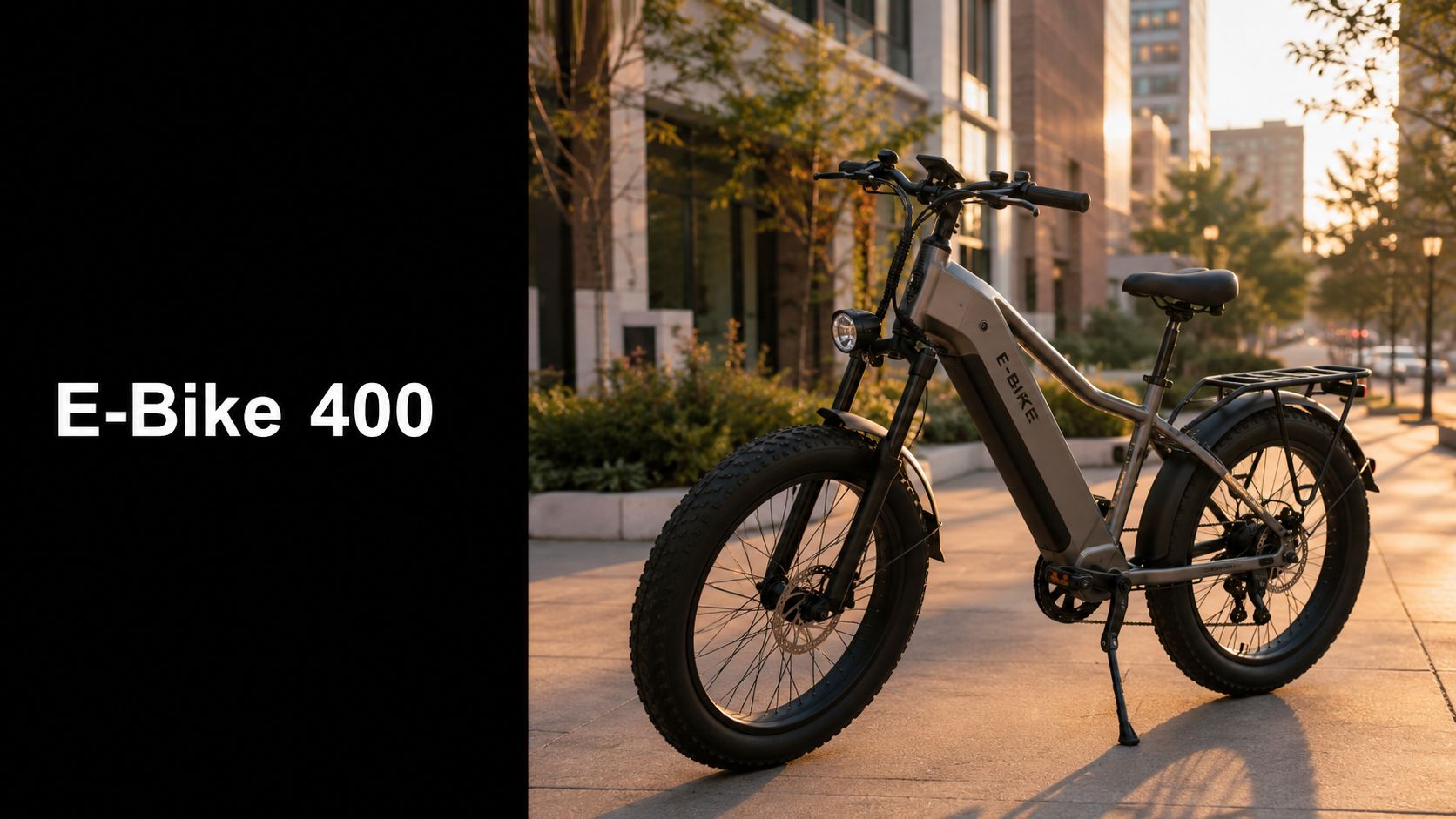
What does electric bike 400 mean when one listing is talking about power, another is talking about battery size, a third is really about price, and a fourth is about load capacity? That's the trap a lot of shoppers fall into, because the number 400 looks simple until you realize it can point to four very different bikes, four very different riding experiences, and four very different buying mistakes.

The global e-bike market was valued at USD 57.50 billion in 2025 and is projected to reach USD 193.23 billion by 2034, with a 14.40% CAGR, and Asia Pacific accounted for 56.50% of the market in 2025 Fortune Business Insights. That scale matters, because it explains why a single phrase like electric bike 400 can mean something totally different depending on whether you're shopping in the UK, EU, Australia, or the US.
What Does Electric Bike 400 Actually Mean
Four different meanings hiding behind one search
The phrase electric bike 400 usually points to one of four things, 400W motor, 400Wh battery, $400 price point, or 400 lb capacity. Those aren't interchangeable, and treating them like they are is how riders end up with a bike that's underpowered, underbuilt, or wrong for their commute.
A 400W motor is about power output. A 400Wh battery is about stored energy. A $400 bike is about budget. A 400 lb-capacity bike is about structural strength and safe payload. If you mix those up, you can buy a bike that sounds right on paper and feels wrong the moment you load it up, climb a hill, or try to ride it daily.
Practical rule: always ask whether the seller is talking about motor power, battery size, purchase price, or weight capacity before you compare models.
Why the confusion matters in real buying
This ambiguity exists because e-bike listings often lean on the easiest number to market. A model number can look like a spec, a battery label can look like a class name, and a budget search can pull up bikes that have almost nothing in common beyond the word “400.” The result is a lot of overlap between products that are not competitors.
There's also a gap in the market around the user question itself. People often ask whether they need a cheap bike near $400 or a stronger bike for a 400 lb rider, but many pages treat those as separate worlds. That makes the decision harder than it needs to be, because the choice is usually about system fit, not the number alone.

If you're scanning a listing, the fastest way to sort it out is to ask four questions, what does 400 mean here, what does it control on the bike, what's the total rider-and-cargo load, and what terrain will you ride? Once you can answer those, the number stops being a marketing trick and starts becoming a useful spec.
Breaking Down the Four Types of 400 E-Bikes
400W motor, 400Wh battery, $400 price, and 400 lb capacity
A 400W motor sits in a middle zone. It's stronger than the common 250W commuter class used across much of the UK and EU, but it's not in the same power bracket as the bigger 750W systems often sold in the US. In practical terms, that means smoother acceleration and better hill support than a basic commuter setup, but not the same punch you'd expect from a higher-output ride.
A 400Wh battery is a different conversation. One concrete example is the Deliver-E Freedom 400, which uses an integrated 460Wh lithium-ion pack, a direct-drive hub motor, 3-level pedal assist, a claimed 45–90 mile range, 2–4 hours charging time, 21.9 kg total weight including the battery, and 130 kg load capacity Deliver-E datasheet. That kind of spec tells you far more about commuting potential than a motor label alone.
A $400 bike is usually a budget machine. At that price, buyers should expect compromises in component quality, battery sophistication, frame refinement, and warranty depth. The problem is that low-cost listings often focus on headline speed or range instead of the parts that decide whether the bike holds up after daily use.
A 400 lb-capacity bike is the opposite of a budget story. Heavy-duty builds focus on reinforced frames, stronger wheelsets, wider tires, and braking hardware that can handle higher kinetic energy. Brands targeting heavy riders consistently push buyers to check the combined rider-plus-cargo limit, not just rider weight, because payload is what decides whether the bike stays inside its safe operating envelope Himiway heavy rider guidance.
| Type of 400 | What it really controls | What to watch |
|---|---|---|
| 400W motor | Hill help, acceleration, sustained effort | Heat build-up, terrain, legal class |
| 400Wh battery | Range and charging frequency | Assist level, rider load, route profile |
| $400 price | Entry cost and component compromise | Durability, warranty, real-world value |
| 400 lb capacity | Structural safety and payload | Frame, wheels, brakes, rack limits |
How 400W Motors Compare to Other Power Classes
Where a 400W motor fits between 250W and 750W
In UK and EU commuting, 250W is the familiar baseline because that class aligns with common road-legal e-bike categories. A 400W motor gives you more assist headroom without jumping into the more aggressive feel of a 750W setup. That makes it appealing for riders who want a calmer urban bike that still handles bridges, stop-start traffic, and moderate hills without feeling strained.
A 750W motor, by contrast, tends to be the choice for riders who want stronger launch behavior, heavier loads, or more aggressive acceleration. It can also drain the battery faster if you ride hard all the time. That's the tradeoff many shoppers miss, more power usually means more consumption when you use it.
| Metric | 250W Motor | 400W Motor | 750W Motor |
|---|---|---|---|
| Typical use | EU/UK urban commuting | Balanced city riding | Heavier loads, stronger acceleration |
| Hill support | Adequate on mild grades | Better on moderate climbs | Strongest of the three |
| Battery draw | Lowest | Moderate | Highest under hard use |
| Ride feel | Conservative | Middle ground | More forceful |
| Legal fit | Commonly accepted in many UK/EU-style e-bikes | Depends on local rules | More likely to face restrictions in some regions |
If you're comparing 400W against a higher-output option, it helps to look at the legal and product context together. The earlier guide on a 500W electric bicycle is useful if you're deciding whether a small step up in power is worth the extra battery demand and compliance questions.
Shop-floor rule: buy the least power that still handles your steepest regular hill with cargo on board. Anything above that is extra weight, extra cost, or extra battery drain.
Understanding Real-World Range and Battery Performance
Why watt-hours tell only part of the story
A 400Wh battery is a starting point, not a promise. Range changes when rider weight, terrain, assist level, wind, cargo, and cadence change, which is why two people on the same bike can get very different results. The battery hasn't changed, the energy demand has.
A useful way to think about it is simple. Range equals battery energy divided by how much energy the bike burns per mile. A flatter route with light pedal assist uses less energy per mile than a hilly route with hard assist or throttle-heavy riding, so the same battery lasts longer for one rider and runs down faster for another.
For a broader look at distance planning, the linked guide on how far electric bikes can go is a helpful companion. If you're planning charging around home or work, a proper installation matters too, and EV charger installation shows how riders think about safe, reliable charging infrastructure in the same way commuters should think about e-bike charging access.
A simple way to judge range claims
Start with your route. Flat city streets, steady pedaling, and light assist stretch range further than stop-start traffic or steep climbs. Then factor in your load, because a heavier rider or a loaded rack makes the motor work harder on every acceleration and hill.
Range claims are most trustworthy when they describe a riding style that matches yours. If the seller's number assumes gentle use and your commute includes hills, treat the claim as optimistic, not wrong.
The Deliver-E example above is a good reminder that claimed range often comes from controlled conditions, not your actual week of commuting. The same battery can feel generous on low assist and much shorter when you ask it to do more work. That's why battery size should be read alongside motor behavior, route profile, and total load, not alone.
Why Total System Design Matters More Than Motor Specs
Frames, wheels, and brakes carry the real risk
A strong motor doesn't fix a weak bike. When riders exceed a bike's intended envelope, the first stress points are usually the frame, wheels, spokes, tires, and brakes, not the motor label. That's why heavy-duty and cargo e-bikes are built with reinforced structure and stronger braking hardware, because the whole system has to survive the load.
This matters most for a 400 lb-capacity setup. Brands that build for larger riders emphasize reinforced frames, higher-spoke-count wheels, stronger tires, and more serious brakes because those parts carry the load path. Motor wattage can help you move the bike, but it doesn't magically make the frame safer or the wheels tougher.
The internal breakdown on electric bike motor types is useful if you want to understand why a hub motor can feel different from a mid-drive once you add real-world weight. The motor choice affects ride feel, but it still doesn't override the structural limits of the bike.
What heavy riders should check first
For riders near the top of the payload range, the question isn't “How fast will it go?” The better question is “Will it stay stable, stop predictably, and hold alignment after repeated use?” Braking distance gets longer when the bike is carrying more mass, and brake heat rises faster on descents or in stop-and-go traffic.
Safety-first rule: if a listing talks mostly about speed and barely mentions brakes, wheel construction, or load rating, keep looking.
A complete bike should be judged as a system. That means looking at frame geometry, tire width, wheel build, brake quality, and battery stress under load, not just the watt number stamped beside the motor. Once you do that, the “400” label stops being a shortcut and starts being one clue among several.
Choosing the Right 400 E-Bike for Your Needs
A quick decision rule for each rider type
If your main concern is budget, a $400 bike might be enough for short, light commuting, but only if you accept basic components and modest durability. If you need a bike that you can trust every day, budget alone shouldn't be the only filter, because a cheap bike that needs replacing quickly can cost more in the long run.
If your commute includes hills, start with the 400W motor question. If you carry groceries, a child seat, or a heavy backpack, the 400 lb-capacity question comes first. If your ride is longer and charging access matters, focus on the 400Wh battery instead.

Here's the shortest useful checklist:
- Budget under control, short commute: look at a $400 entry bike, then verify brakes and battery honesty.
- Regular hills: prioritize a 400W motor before chasing top speed.
- Longer daily distance: lean toward a 400Wh battery or larger.
- Heavier rider or cargo use: choose a 400 lb-capacity frame and ignore flashy watt claims.
- Unsure between two options: pick the bike with better brakes, stronger wheels, and clearer load specs.
Real Rider Scenarios and Which 400 Type Fits Best
Sarah is a student who needs a cheap way to get across town. She doesn't need a heavy-duty frame or a long-range battery, she needs a bike that stays usable on a tight budget and doesn't collapse into constant repair costs. For her, the $400 interpretation makes sense, as long as she keeps expectations realistic.
Mike weighs 350 lb and rides a hilly commute. He doesn't care much about top speed, but he does care about stability, braking, and whether the bike still feels composed after a climb. For him, a 400 lb-capacity bike is the right lane, because structural strength matters more than headline power.
Emma rides a longer daily route and wants fewer charging stops. She isn't shopping for the cheapest bike or the heaviest-duty frame, she wants dependable distance and predictable battery behavior. For her, a 400Wh battery is the spec to focus on, because range is what shapes her daily routine.
The right answer isn't universal. It depends on which 400 matches your body, your route, and your budget.
Punk Ride LLC curates electric bikes for riders who want urban mobility that's practical, stylish, and easier to live with every day. If you're comparing a 400W motor, a 400Wh battery, a $400 budget, or a 400 lb-capacity setup, visit Punk Ride LLC to browse e-bikes that fit real commuting needs and check which specs match your ride.
Share:
How to Improve Braking Performance: Expert Tips for 2026
Electric Things to Ride: The Complete Urban Mobility Guide