


Buying advice for a bike trailer for electric bike use usually starts backwards. You're told to get the biggest motor you can afford, pick a trailer with the highest load rating, and you're set.
That advice gets people into trouble. A strong motor doesn't make a safe tow vehicle. Propulsion and braking are separate limits, and the trailer doesn't care how easily you climbed the hill if you can't stop on the way down. Start with your bike's gross capacity, brakes, axle and legal class. Then pick a hitch that fits that bike, then a trailer that fits inside all of those limits, and test the whole thing loaded before you trust it.
Check Your E-Bike Before You Buy a Trailer
Run this table in about ten minutes, before you look at a single trailer.
| Check | Where to find it | Red flag |
|---|---|---|
| Gross payload (rider, bike and load) | Manufacturer spec, stated as gross capacity | Only empty weight is listed |
| Motor rating and assist cut-off | Spec sheet or motor label | Motor or assist limits unknown or altered |
| Rear axle and wheel retention | Hub or axle type on the bike | Quick-release axle with a heavy tow |
| Rack or hitch rating | Rack label or hitch manual | No stated maximum load |
| Brake type and rotor size | Brake caliper and rotor | Rim brakes only on a heavy load |
Why Gross Payload Is the First Number
Adding a trailer changes total mass, braking demand, cornering behaviour and stability, so the trailer's advertised rating on its own means little. The Cycling Electric cargo bike loading guide states that manufacturers should disclose the permissible total payload, including the rider, bicycle, and luggage, and distinguish the e-bike's empty weight from its gross carrying capacity.
That same guide puts a modest short-tail cargo-bike setup at approximately 25 kg of additional load, while a higher-capacity configuration used with a trailer can reach 150 kg or more. Those are illustrations of how wide the range is, not universal legal limits. There's no general legal weight limit for what may be pulled in the referenced European context, which makes your specific manufacturer ratings the actual limit.
The Other Four Checks
Check the rear axle next. A quick-release axle is weaker under a heavy tow, and a hitch that clamps or loads that axle needs to be rated for the job. Then look for a rack or hitch rating in writing. If there's no stated maximum, walk away.
Brakes matter just as much. Cheap rim brakes on a heavy combination overheat and fade on descents, while disc brakes in good condition give you far more margin. Note your rotor size and pad condition now, not after the first loaded hill.
Cargo and tricycle layouts also differ from a standard two-wheel bike, with load carried in a different place and different mount points. A trailer and hitch that suit one layout may not fit the other at all.
Practical rule: Add your weight to the trailer's fully loaded weight, then compare that total with what the bike carries on top of its own empty weight. If you're over the gross capacity, choose a different bike or a lighter trailer.
Payload isn't the only constraint you'll hit. Battery range, riding speed, terrain and service access all shrink once you're towing, so be honest about your hills and distances before you buy.
UK and EU Rules for Towing a Trailer
| Rule | UK | EU |
|---|---|---|
| Continuous rated motor output | 250 W maximum | 250 W maximum for the exemption |
| Assistance cut-off | 15.5 mph (25 km/h) | Before 25 km/h |
| Motor output when pedalling stops | Assistance is pedal-based, except approved throttle models | Must stop when the rider stops pedalling |
| Minimum rider age | 14 | Set by each EU country, not by the exemption |
| Registration, insurance and tax | Not required for a compliant EAPC | Exempt from type approval when within limits |
| Throttle-driven propulsion | Must be approved by manufacturer or importer before purchase | Propulsion without pedalling takes it outside the pedal-assist exemption |
| Higher-power towing bikes | Treated as a motor vehicle if over limits | Above 250 W up to 4 kW and 45 km/h falls under the approval framework |
The UK Line
A trailer doesn't change the law for the bike pulling it. The London Fire Brigade summary of UK e-bike law sets the EAPC line at pedals capable of propelling the bike, a maximum continuous rated motor output of 250 watts, and assistance that cuts out at 15.5 mph (25 km/h). Riders must be at least 14 years old, and a compliant EAPC needs no registration, vehicle tax, insurance or driving licence.
Go over those limits and the bike may be treated as a motor vehicle, with registration, insurance, taxation, an appropriate licence and an approved motorcycle helmet. The load on the trailer doesn't move the threshold in either direction. If you want the wider picture, read our guide to whether electric bikes are street legal before you assume a powerful import is fine for UK roads.
Control type matters too. The government electric bike rules state that an e-bike capable of being propelled to 15.5 mph without pedalling must be approved by the manufacturer or importer before purchase. A twist-and-go throttle, a derestricted controller or a modification can change legal status even when the motor is labelled 250 watts.
The EU Line
EU rules draw a similar line. The European Parliament answer on e-bike categorisation describes pedal-assisted cycles as exempt from type approval when the motor has a maximum continuous rated output of 250 watts, assistance cuts off before 25 km/h, and output stops when the rider stops pedalling. Bikes above 250 watts up to 4 kW with speeds up to 45 km/h sit inside the approval framework for two and three-wheel vehicles.
For trailers that carry passengers, also check the carrier trailer standard BS EN 17860 alongside the e-bike standard BS EN 15194. Ask the seller for the bike's approval or manufacturer declaration, and keep it with the trailer paperwork so you can prove the towing bike's class if you're ever asked.
Hitch Types and Which Ones Fit Your Bike
| Hitch type | Best for | Bike it needs | Main weakness |
|---|---|---|---|
| Seat-post hitch | Light single trailer | Clear seat post and rated mount | Side play and seat post overload |
| Rack-mounted hitch | Light to medium cargo or tow | Rack with a stated load rating | Rack rated only for panniers |
| Axle quick-release hitch | Lightweight one-wheel trailer | Quick-release rear axle | Wheel slip under heavy load |
| Frame or tow-bar hitch | Heavier loads and passengers | Frame with rated tow points | Needs professional fitting and checks |
Seat-Post and Rack Mounts
A seat-post hitch is the simplest option and suits a light single trailer. Watch for lateral play when you push the trailer side to side, and don't exceed what the seat post and mount are rated for. If it twists or slips when you lean on it by hand, it won't behave better at speed.
A rack-mounted hitch spreads the load further back and works for light to medium cargo. The trap is the rack itself. Plenty of racks are rated only for panniers, not for towing forces pulling backwards and sideways, so the rack label has to match the job.
Axle and Frame Mounts
An axle quick-release hitch keeps the connection low, which helps stability on a lightweight one-wheel trailer. Under a heavy tow, though, a quick-release can let the wheel slip in the dropout. Check the wheel is fully seated and the release is properly tight before every ride.
A frame or tow-bar hitch is the right call for heavier loads and passengers because it ties into a rigid, rated tow point. It isn't a five-minute bolt-on. Get a qualified fitter to install it and check alignment.
Whatever you choose, every hitch needs to pass the same basics.
- Secure lock or pin: It must engage positively, not just feel tight.
- Safety strap: Attach it to the bike frame, not to the hitch itself.
- No slack: Push the bike backwards and forwards. Looseness now becomes a shove later.
Folding bikes and step-through frames rule out some mounts because of hinges and frame shape, and cargo and tricycle models need their own rated mount. I would match the hitch's rated load to the trailer's real loaded weight, not its empty weight. If the hitch has no stated rating, don't use it.
Choosing the Trailer Itself
Choose by job first. A passenger trailer must state rated occupant age, height and mass, its harness type and its maximum load. A cargo trailer states a maximum load and volume. If either is vague about numbers, that's your answer.
Wheel count changes behaviour. A two-wheel trailer resists tipping and sits level when you park. A single-wheel trailer is lighter, narrower and easier to store, but it leans with the bike and depends on the rollover behaviour tested by ASTM F1975 with a static and a dynamic check. Ask the maker for that result instead of taking stability on faith.
Write down these five details before you pay.
- Empty weight: It counts against gross payload before you load anything.
- Rated maximum load: Add it to the empty weight for your real total.
- Wheel count: It affects parking, storage and how the trailer tracks.
- Coupler type: It must match the hitch you already confirmed fits your bike.
- Brake status: Many trailers have no brake, so your bike's brakes carry the full combined load.
Check the trailer axle is held by a secure fastening you can inspect, and look for a rear light and reflectors for UK and EU roads. A bike trailer for electric bike use only makes sense when it sits inside your bike's gross capacity, hitch rating and legal class. If it fails any one of the three, it isn't the right trailer, whatever the volume looks like in the listing.
Braking and Stopping Distance With a Trailer
A strong motor can pull a heavy trailer, but it cannot make the brakes stop it. When you slow down, the trailer's momentum pushes against the bike, especially on descents. The safe limit comes from the loaded combination's braking, not the motor's power.
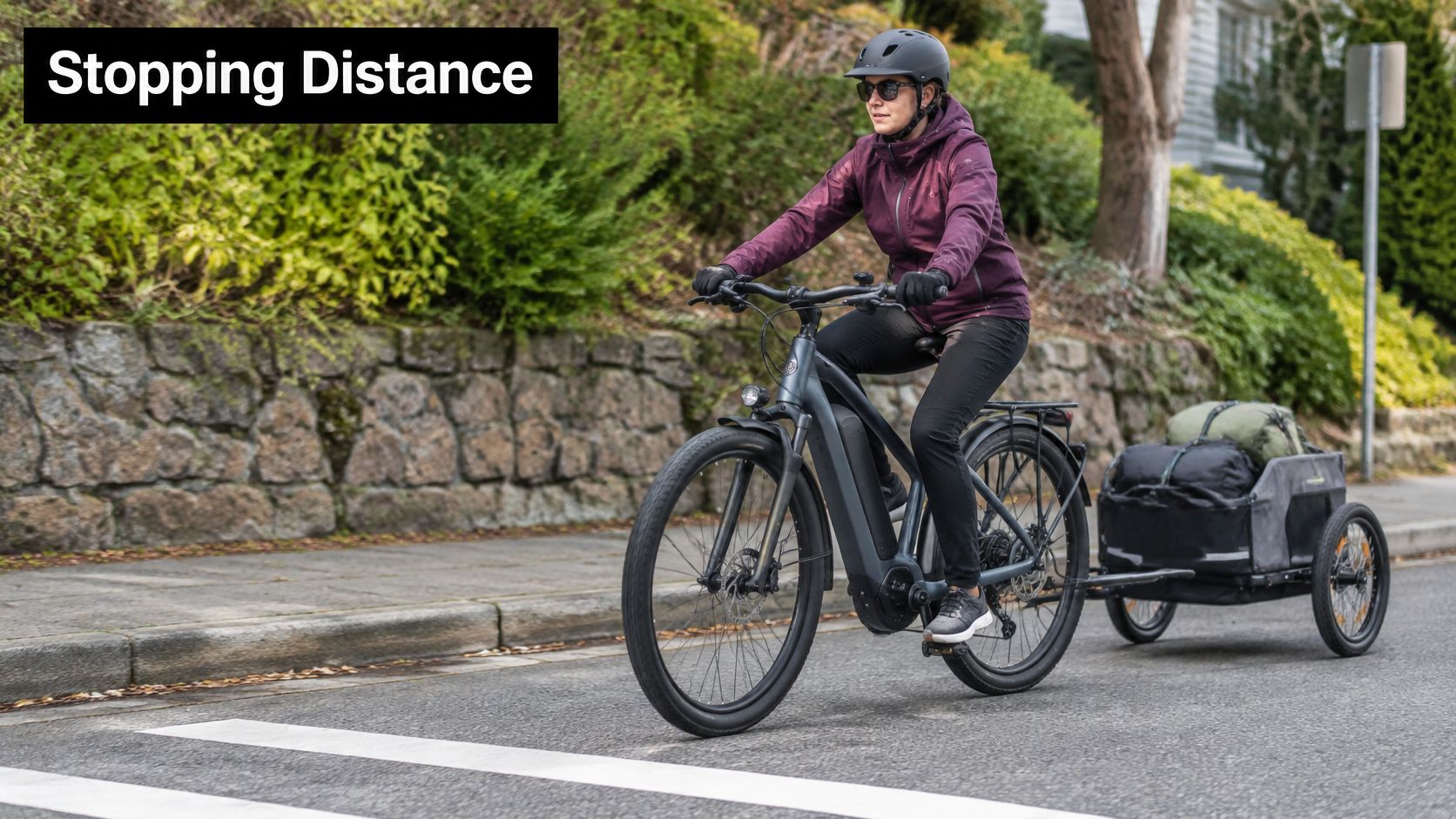
Bicycle braking tests assess the bicycle, not necessarily a bicycle towing a trailer. A result for the bike alone does not show how safely your loaded setup stops. Use your own route and load to judge the margin you have.
Run the Worksheet Before You Trust It
Check these five factors against the roads you ride:
- Total system mass: Add the bike, rider, trailer and load. Greater mass takes more effort to slow, so reduce the load if the setup feels reluctant to stop.
- Downhill grade: A descent keeps feeding speed into the combination. Brake early and leave more room before turns and junctions.
- Speed: Tow below your usual cruising pace, particularly as you approach corners or traffic.
- Brake type and condition: Worn pads or weak braking reduce your margin. If the brakes squeal or bite poorly, use this guide to diagnosing bike brake squeal and sort out the cause before towing.
- Wet or cold weather: Reduced grip makes controlled braking harder. Allow more room, or leave the trailer at home if conditions make stopping uncertain.
On a quiet road, compare an unloaded stop with a loaded stop, using the same starting speed and braking effort. Record the distances. Do not rely on regenerative braking alone. It slows the driven wheel, but it does not replace the bike's friction brakes in an emergency.
Treat the comparison as a go-or-no-go check. If the loaded stop takes more room than your usual route gives you, slow down, reduce the load or choose another route. A powerful motor cannot compensate for brakes that cannot control the full loaded weight.
How to Fit and Test a Trailer Step by Step
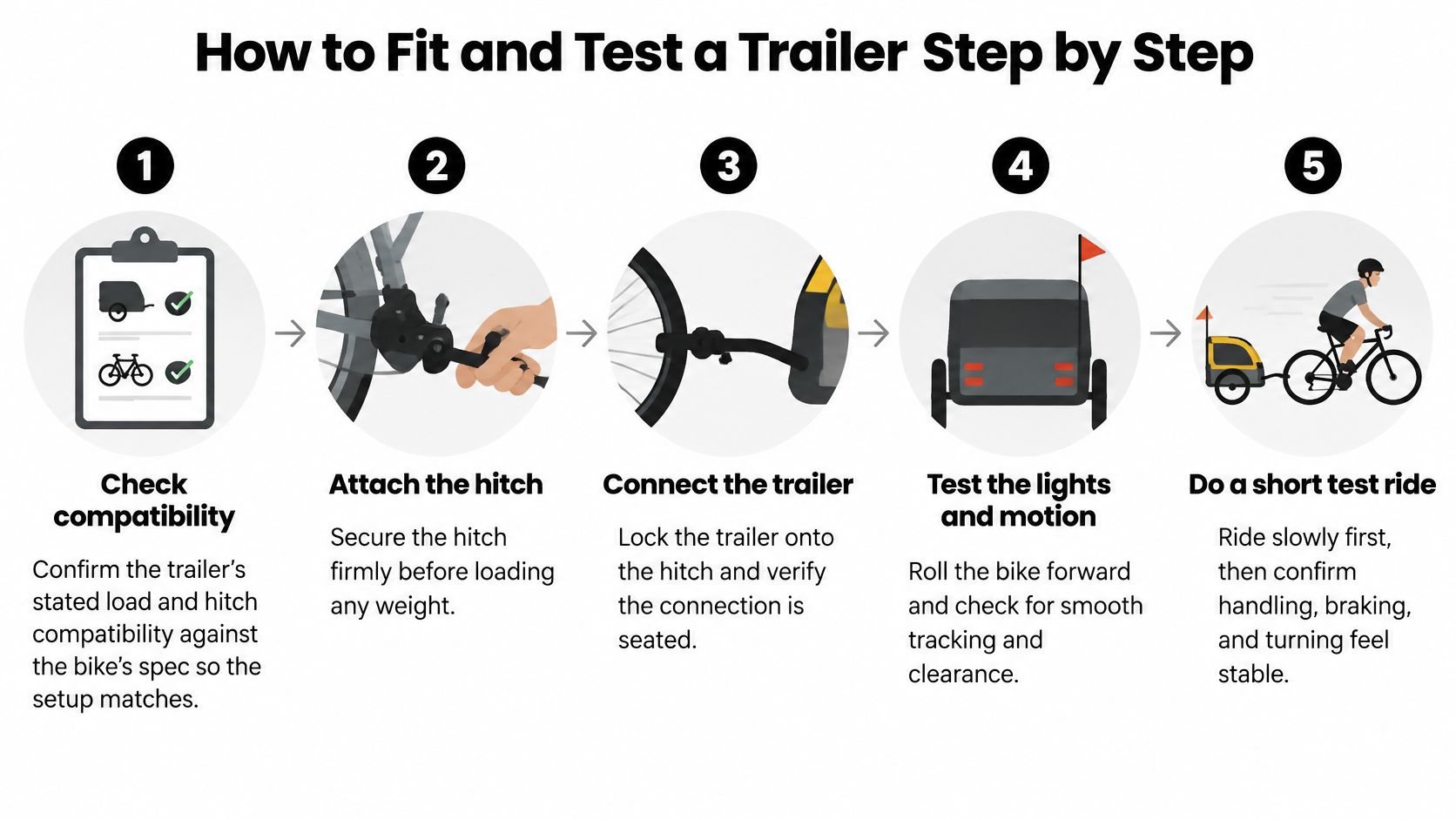
- Confirm load and hitch compatibility. Check the trailer's stated load and hitch against the bike's spec before you touch a tool. A mismatch here is the most common fitting error, and no amount of careful tightening fixes the wrong pairing.
- Fit the hitch and inspect everything. Work through hitch locking, safety strap attachment, wheel retention, tyre pressure, reflectors and brake operation, and record each result. The Bicycle Helmet Safety Institute guide to taking your baby along describes ASTM F1975 as covering bicycle-trailer rollover with a static test and a dynamic test where one wheel is towed over an obstacle. That inspection mindset applies to cargo trailers too.
- Run an unloaded road test. Use a quiet street, make tight turns both ways, and run the unloaded braking trial at a modest speed. You're learning how wide the trailer swings and how it tracks before weight complicates things.
- Run a low-speed obstacle test. Tow one trailer wheel over a small obstacle at walking pace. This copies the dynamic rollover check and shows you whether one-sided bumps lift a wheel or twist the hitch.
- Repeat at progressively higher speeds. Motor assistance raises achievable speed and towing momentum, so step up gradually. Measure stopping distance, hitch deflection, wheel lift and trailer yaw at each speed, and stop stepping up if any of them gets ugly.
- Repeat with the intended payload. Load it the way you'll ride, low and centred over the trailer axle, then redo the braking and cornering trials using your worksheet numbers. An empty trailer passing tells you almost nothing.
- Log everything and re-check. Write down every result, then re-check hitch bolts and the safety strap after the first short ride. Fasteners settling in is normal, loose ones left alone aren't.
The pitfall is validating only on smooth pavement. Smooth tarmac hides asymmetric wheel loading, and potholes, kerb edges and speed bumps are exactly where trailers misbehave. Local rules can also add equipment, helmet, passenger or route requirements even where towing is permitted, so check yours before the first real trip.
A documented pass on all seven steps, with the loaded braking distance recorded, is the point where the trailer is ready for use. Anything less is a guess.
Carrying Children Safely Behind an E-Bike
A powerful motor can get a loaded trailer moving. It cannot make the brakes stronger. With a child aboard, choose routes and speeds that leave room to stop, and never treat smooth test results as proof that every trip is safe.
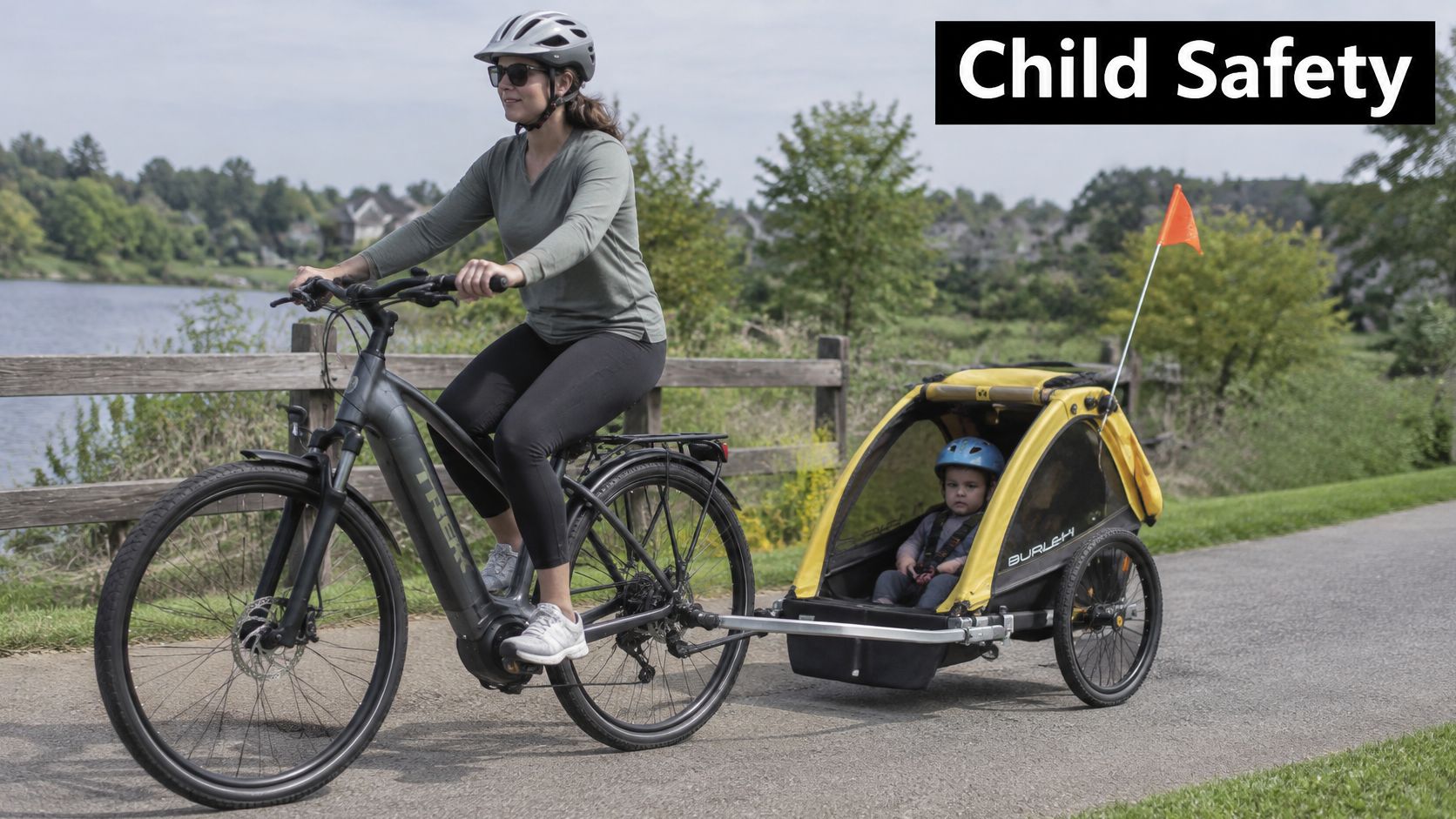
The German insurers' UDV crash test report on carrying children by e-bike found that bicycle trailers offered good overall protection in several scenarios. A simulated side collision with a vehicle turning across the trailer, however, produced high dummy loads because the child's low seat height aligned poorly with the impact point. The report also discusses a controlled ride study measuring infant-dummy head and torso motion across 11 combinations of bump type and trailer speed. Its results do not establish safe injury thresholds for infants, so a smooth ride is no guarantee of safety.
Route Choice Comes First
Choose a route with fewer turning conflicts and use separated paths where local rules allow. Slow before junctions, and make the trailer easy to see with rear lighting, reflectors and a tall flag. Avoid routes where poor visibility or tight traffic leaves little room to react.
If your family may be better served by carrying children on the bike itself, our guide to cargo e-bikes for families explains that option.
Towing rules differ by country and region. Check local rules for carrying children behind an e-bike before the first trip, including any requirements for passengers, equipment or routes.
Avoid these common mistakes:
- Carrying a child below the trailer's minimum age: Follow the age limit set by the trailer maker.
- Skipping the restraint: Fit and fasten the harness properly, even for a short ride.
- Exceeding payload: Count the child, trailer and bags against the stated limit.
- Relying on a helmet alone: A helmet does not replace a correctly fitted five-point harness or the trailer's roll-protective structure.
Before buying, check that the listing states the permitted age, height and mass, harness type, maximum load and hitch limits. If those details are missing, choose a trailer with clear specifications.
Maintenance and the Go or No-Go Decision
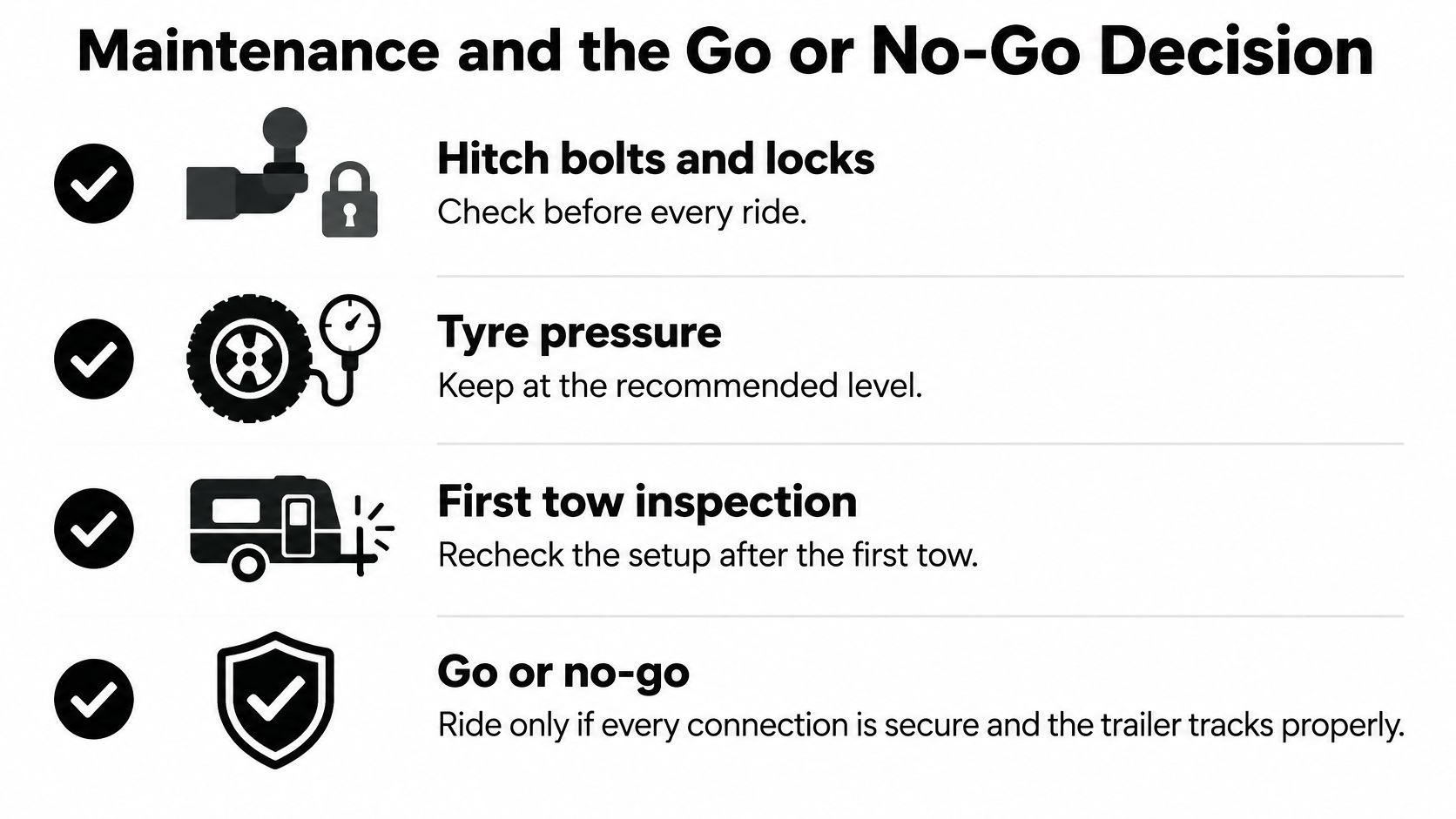
A trailer setup that's safe in week one goes slack if you stop checking it. Keep this short list on rotation.
- Hitch bolts and locks: Check before every ride, by hand, not by eyeball.
- Tyre pressure: Check bike and trailer tyres before every ride.
- Brake pads and rotor wear: Inspect each month, sooner if you're towing on hills.
- Wheel bearings and axle nut torque: Check at each service.
- Reflectors and rear light: Confirm they work before riding at dusk.
- Safety strap: Inspect for fraying, stretched holes and cracked buckles.
Remember that cargo and tricycle models have different load layouts and dimensions from a conventional two-wheel bike, so their checks and mounts differ too. We offer e-bikes in the categories Adult Bikes, City & Commuter Bikes, Folding Bikes, Fat Tyre Bikes, Off-Road Bikes and Cargo Bikes, and each category suits a different towing setup. If your current bike fails the compatibility table, a rated cargo model is a better base than forcing a trailer onto the wrong frame.
This week: Write down your bike's gross capacity, hitch rating and legal class, choose a trailer that fits inside all three, and book the first tow only once your fitting log is complete.
That's the whole decision. Numbers on paper, a trailer inside them, a tested stop. Skip any one and you're hoping, not towing.
If your current bike fails the capacity, braking or legal checks, Punk Ride LLC stocks e-bikes across Adult, City and Commuter, Folding, Fat Tyre, Off-Road and Cargo categories, so you can start from a rated tow-ready base instead of forcing a trailer onto the wrong frame. Browse the range, note the gross payload and brake spec for any model you're considering, and bring those numbers back to the tables above before you buy a trailer.


Share:
Lightest Folding Electric Scooter: Weights Compared 2026