


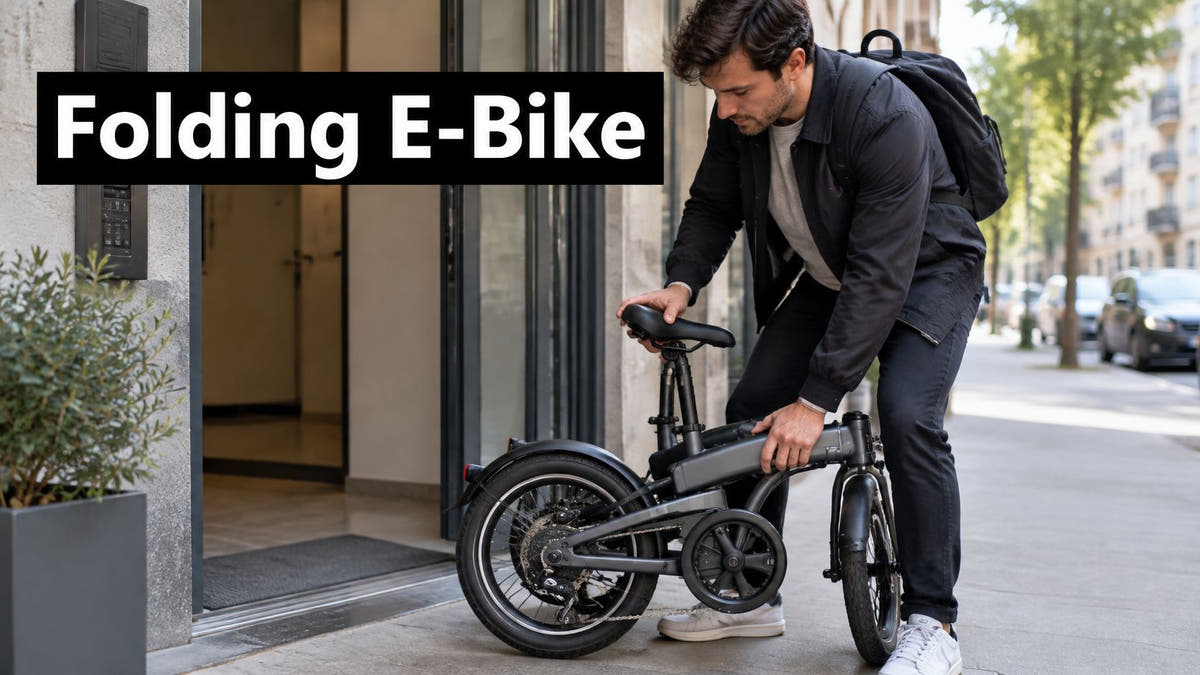
You live on the third floor. The station is a ten minute walk and a four minute ride, and there's nowhere at either end where you'd leave a decent machine locked up overnight. So the bike comes inside with you, folded, behind the door in the hallway.
That's the job of a folding electric bike for adults. Not the brochure fantasy of a bike that goes anywhere, but the specific daily problem of something that has to live in a hallway, fit in a lift, and still drag you up the last hill home after a shift. Every judgement in this guide follows from that constraint.
The order matters. Legal line first, because a bike that fails it is a motorbike in the eyes of the law. Then the hinge, because that's the part that breaks. Then the ride, the fit and the carry.
Why Adults Want a Bike That Folds
A four-mile commute includes a steep hill, a laptop bag, and a train ride. At home, the bike has to fit in a rented flat's hallway. A folding electric bike lets an adult ride to the station, fold the bike for the train, then unfold it for the last leg to work.
The fold solves a storage and transport problem; electric assistance makes the ride easier to manage. Together, they can suit trips that mix cycling with public transport, stairs, or limited indoor space. Demand for electric bikes has grown quickly in recent years, and folding models serve riders who need that flexibility.
Adults need to check more than whether a bike folds. It has to fit the rider and carry everyday items, while the hinge must lock securely for riding and release without a struggle. The battery routine matters too: if it comes indoors for charging, consider where it will live and whether it is practical to remove and carry.
The test that matters: if you can't carry the folded bike up your own stairs on a difficult day, the fold may not suit your routine.
A smaller fold often comes with a trade-off. Compact wheels and a folding frame can mean a less comfortable or stable ride than a full-size bike, especially over longer distances. If you want motorbike pace or a full-size tourer for long rides, a folding e-bike may be the wrong tool.
Legal Power and Speed Limits by Market
Circle one line before you look at brands. For UK and EU roads, a road legal adult folder is normally a 250 W continuous motor that stops assisting at 25 km/h, written as 15.5 mph in Britain. A listing that leads with 500 W or 750 W is telling you something, and it usually isn't good news for legality.
In Great Britain, a folding electric bike qualifies as an electrically assisted pedal cycle only if it has usable pedals, a motor with no more than 250 watts of maximum continuous rated power, and electrical assistance that cuts out at 15.5 mph, according to GOV.UK's electric bike rules. Riders must be at least 14, and a compliant machine needs no driving licence, vehicle registration, road tax or motor insurance. A bike that exceeds those requirements is treated as a motor vehicle, which can mean registration, insurance, taxation, an appropriate licence and an approved motorcycle helmet.
Run every listing through the same filter.
| Market | Continuous motor | Assist cut-off | Pedals and throttle | If it complies |
|---|---|---|---|---|
| Great Britain | 250 W maximum continuous | 15.5 mph (25 km/h) | Usable pedals; a no-pedal throttle is generally not an EAPC unless sold before 1 Jan 2016 or type-approved; walk-assist cuts out at 3.7 mph | No licence, registration, road tax or motor insurance; rider at least 14 |
| European Union EPAC pattern | 250 W continuous | 25 km/h | Pedal assistance; local path rules still vary | Ridden as a bicycle when it meets EPAC limits |
| Australia national guidance | 250 W maximum continuous | 25 km/h | Victoria: assist only while pedalling; throttle only as walk mode to 6 km/h | Over-limit bikes restricted to private property in Victoria |
| United States CPSC low-speed bicycle | Motor under 750 W | Motor-only under 20 mph with a 170 lb rider on level ground | Fully operable pedals | State rules still vary for class, helmet, age and paths |
Reading Each Row as a Pass or Fail
Across the EU, the same 250 W and 25 km/h pattern is the default for the cities most folders are sold into, so that figure travels with the bike rather than with the country. Path rules can still differ town to town, and a folder ridden on a promenade is a different question from the same folder on a road.
Australian national product safety guidance sets the common bicycle threshold at 250 W maximum continuous rated power and assistance limited to 25 km/h, per Product Safety Australia's e-micromobility guidance. Victoria adds detail that matters to commuters: assistance only while you're pedalling, throttle only as walk mode up to 6 km/h, and anything over the limits is private property only.
The United States is the outlier. The CPSC definition covers a bicycle with fully operable pedals, an electric motor below 750 watts, and motor-only speed below 20 mph tested with a 170 lb rider on level pavement, as set out in the CPSC bicycle standards summary. States then layer on helmet, age, class labelling and path rules of their own.
Peak Watts Are a Sticker, Not a Rating
Continuous rated power is what the motor can sustain. Peak is what it can pull for a moment on a climb. Sellers quote peak because it's a bigger number, and buyers then assume a 250 W motor is weak and a 750 W motor must be better.
That confusion costs you. If the continuous rating is above the legal threshold, the bike isn't a bicycle any more, however the listing is worded.
Throttles are the other trap. In the UK, throttle-operated bikes that can propel the rider without pedalling are generally not legal as ordinary EAPCs unless they were sold before 1 January 2016 or have the required type approval, and walk-assist must cut out at 3.7 mph (6 km/h), per GOV.UK's conversion kit and product safety guidance. Ask whether the throttle works from a standstill with your feet still, and get the answer in writing.
Match the manual to the country you'll ride in, not the warehouse it shipped from. For the wider version of this, our guide to whether electric bikes are street legal covers the rules beyond folder frames.
How the Fold and Hinge Actually Work
A frame hinge is a door. You wouldn't drive a car whose door swung open when you hit a pothole, and you shouldn't ride a bike whose frame latch does the same. The difference is that on a folder the door sits in the middle of the frame, holding the front half to the back half while you bounce it off kerbs at 15 mph.
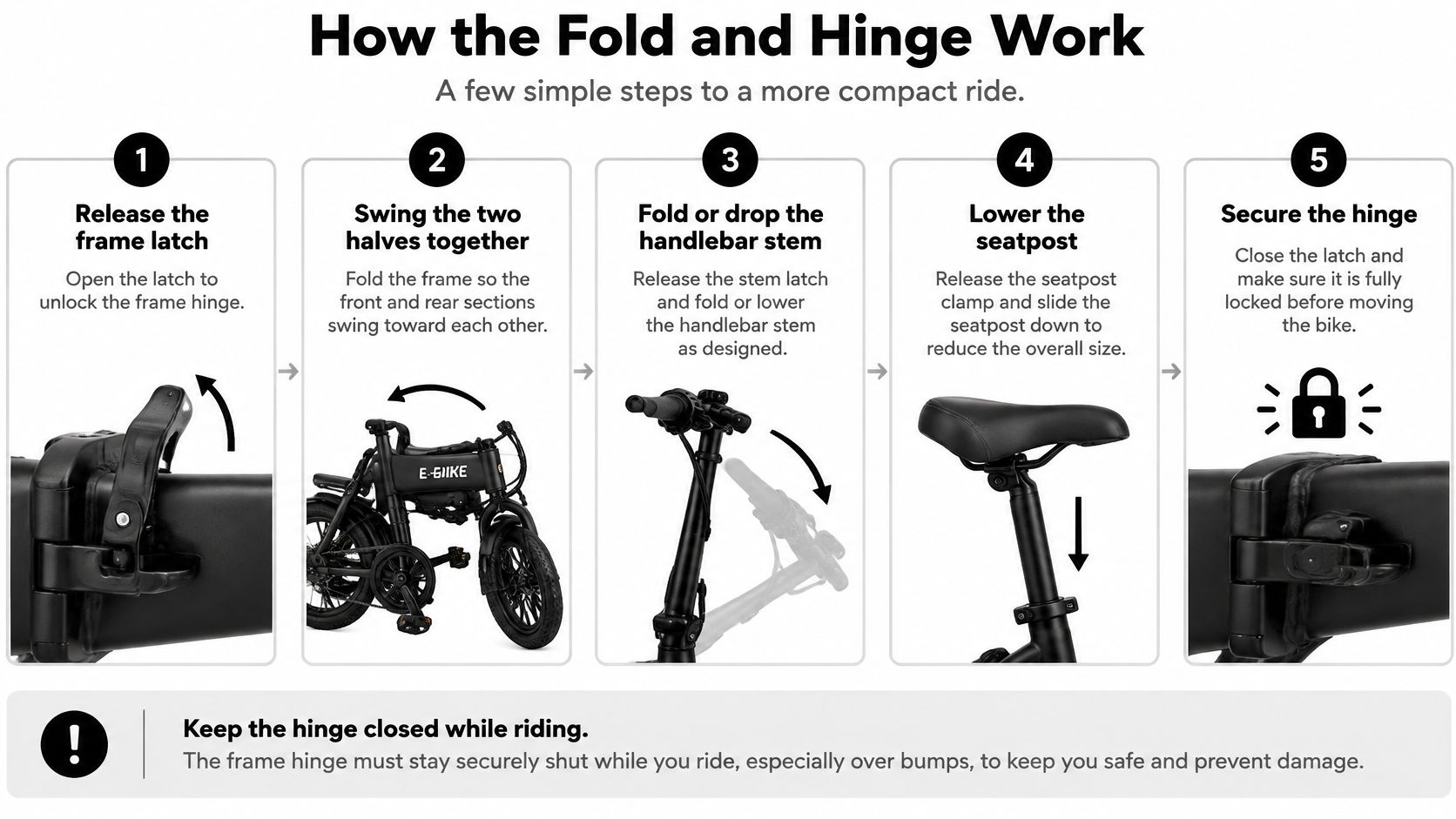
Most adult folders follow the same sequence of moves, and the final one is the one people skip.
The Fold, in Five Moves
- Release the frame latch and open the safety catch first, never the other way round.
- Swing the two halves together until they meet, keeping cables clear of the gap.
- Fold or drop the handlebar stem so the bars sit alongside the frame rather than sticking out.
- Lower the seatpost if the fold needs the saddle out of the way, and drop a pedal if your model rests on one.
- Secure the hinge with the frame's own catch or strap so the package stays shut while you carry it.
The hinge does the structural work, so hardware quality isn't a marketing detail. U.S. regulators have flagged structural integrity as a specific concern for folding e-bikes, including the effect of greater product mass and foreseeable use on the frame, and the relevant bicycle tests run from brake heat resistance and handlebar and stem bending through to frame impact and frame fatigue under horizontal forces, as set out in the Federal Register notice on e-bike rulemaking. Electrification raises the load further: battery, motor and controller add mass, and every acceleration and brake works the hinge, latch, stem and fork.
What Adult Grade Hardware Looks Like
A positive lock with a visible second catch: if you need a fingernail to find the safety mechanism, it isn't one.
A published rider-plus-cargo limit: a number on the frame plate or in the manual, not a guess from the marketing copy.
Evidence of testing: some documentation that the frame and hinge went through fatigue testing, not just a claim that it's "strong".
A latch that closes with a firm click: and takes about the same force every time you close it.
A Five Minute Check Once a Month
Look for hinge play by holding the front wheel between your knees and rocking the bars. Run a thumb along the frame welds for cracks, check every fastener you can reach, and listen for a new creak that wasn't there last month. Notice whether the latch now needs more force to close than it did when new. That creeping stiffness is the earliest sign of wear you'll get.
Here's the difference between a fold that works and one that doesn't, in practice.
Two certification labels are worth finding on the spec sheet. UL 2849 covers the e-bike electrical system as a whole, and UL 2271 covers the battery pack in nationally recognised laboratory testing. They're labels to look for, not a promise about how you charge the thing, and we'll get to that.
If you can't see how the latch locks, and there's no second catch behind it, don't buy it as a daily commuter. It's a storage bike, not a commuter.
Wheels Motor and Battery That Matter
Scan the table before the prose. The middle column is the adult commute, and the right column is what you hand over to get it.
| Choice | Compact | Everyday adult commute | What you give up |
|---|---|---|---|
| Wheel size | 14-16 inch | 20 inch | Smaller wheels feel twitchier and harsher on poor tarmac |
| Motor on UK and EU roads | 250 W continuous | 250 W continuous, ignore a higher peak sticker | A 500-750 W claim can take it outside bicycle rules |
| Battery capacity | Smallest pack that covers a short hop | Sized to your longest normal weekday trip | Extra range is extra mass on stairs |
| Fold hardware | Single hinge and folding stem | Hinge plus visible secondary catch | Extra latches slow the fold but stop a surprise unfold |
Wheels Decide How the Bike Feels
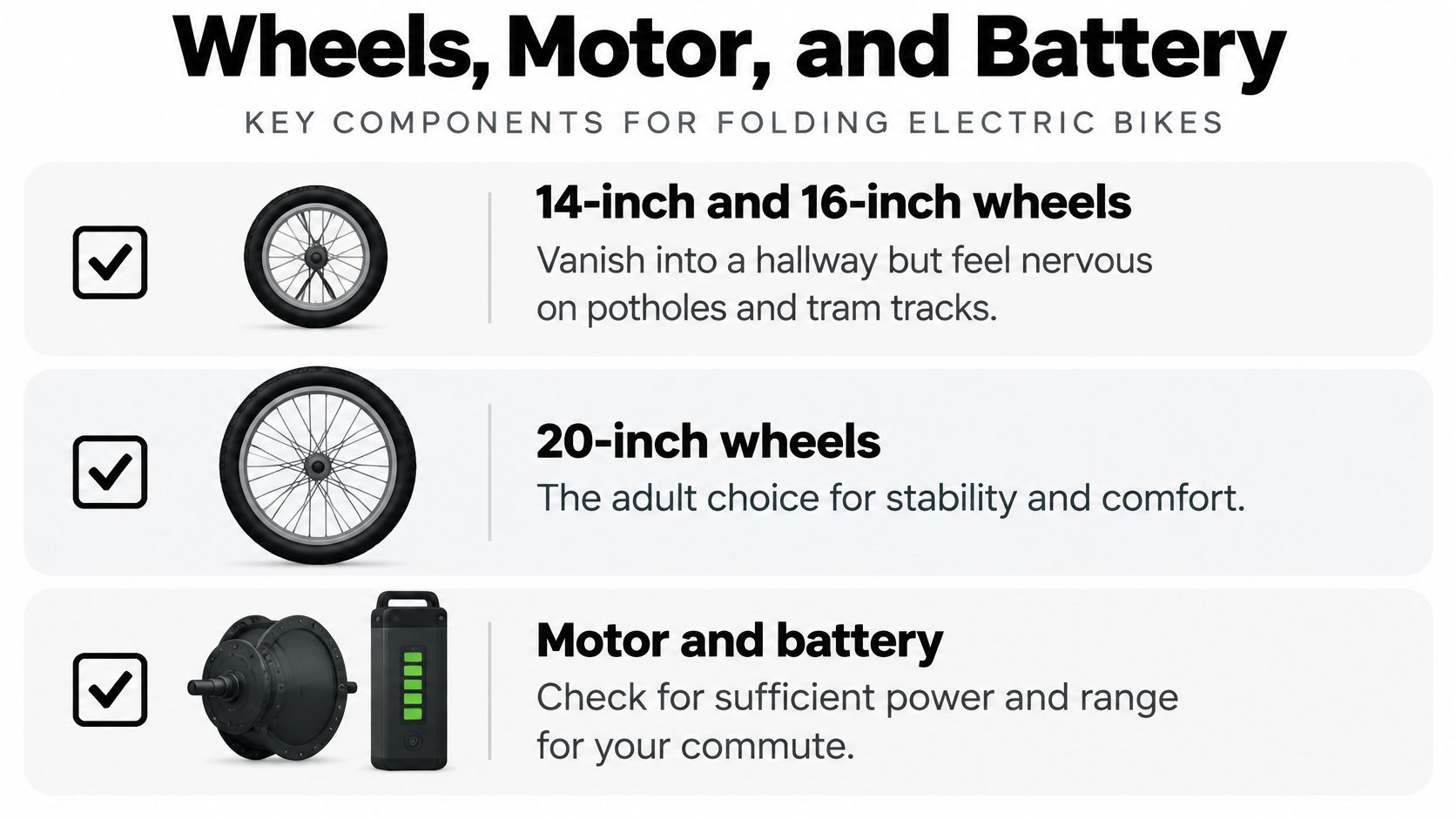
A 14 or 16 inch wheel package disappears into a hallway and turns through a doorway without a second attempt. It also transmits every pothole and tram track straight into your wrists, and it steers sharply enough that a wet drain cover can catch you out.
Twenty inch wheels are the adult commuting sweet spot. There's more air between you and the road, the bike tracks straighter at speed, and the fold is a few centimetres taller as a result. If the bike has to be carried up two flights, the smaller wheel earns its keep; if it gets ridden four miles each way, the bigger one does.
The Motor Number You Actually Need
On a British or EU road, stay with 250 W continuous and check that the assistance cuts out where the law says it does. A 500 W or 750 W figure on the page is usually peak, and even when it isn't, it moves the bike out of bicycle treatment.
Ask the seller two questions in writing: what's the continuous rating, and can the bike exceed the cut-off speed on motor power alone.
Battery and the Indoor Routine
Battery capacity is measured in watt-hours, which is volts multiplied by amp-hours. The number that matters isn't the biggest one on the page, it's whether the pack covers your longest normal weekday trip with something left over for a headwind.
Brochure range is measured under friendly conditions. Add hills, a rider over 80 kg, cold weather and lights on, and real distance lands well below the claim. Plan around the worst Tuesday in February, not the best Saturday in June.
Then there's the part listings never mention. A folder wheels indoors easily, so it ends up charging next to a sofa, a bed or the front door.
Practical rule: use only the charger supplied with that exact pack, refuse a random replacement, and charge on a hard clear surface away from bedding and away from your only exit.
Check the pack for swelling, dents or a hot smell before every charge, unplug when it's full, and don't keep topping up a pack that's been crashed or soaked. CPSC staff identified 227 micromobility lithium-ion battery incidents from 2019 to 2023, with some e-bike fires beginning while charging and some involving aftermarket batteries or chargers, per the CPSC package for the lithium-ion battery safety rule.
A pack you can lift out and carry to a socket beats 200 extra watt-hours you have to haul up the stairs. Our notes on an electric bicycle with a removable battery explain what to check on the latch and the contacts.
The lightest folder isn't automatically the most usable, either. Low centre of gravity, a compact folded profile, a secure latch and balanced carry points often matter more than a kilo on the spec sheet, and safety researchers themselves note that inconsistent national data makes e-bike risk hard to evaluate as ridership grows, as recorded in a specialist study filed in the NTSB docket. Pick the smallest battery that still covers the longest trip you make.
Fit for Adult Riders and Everyday Loads
Most folders are one frame with a long seatpost and an adjustable stem, not a sized road bike with five frame options. That works surprisingly well for a lot of adults, and it fails badly at both ends of the height range.
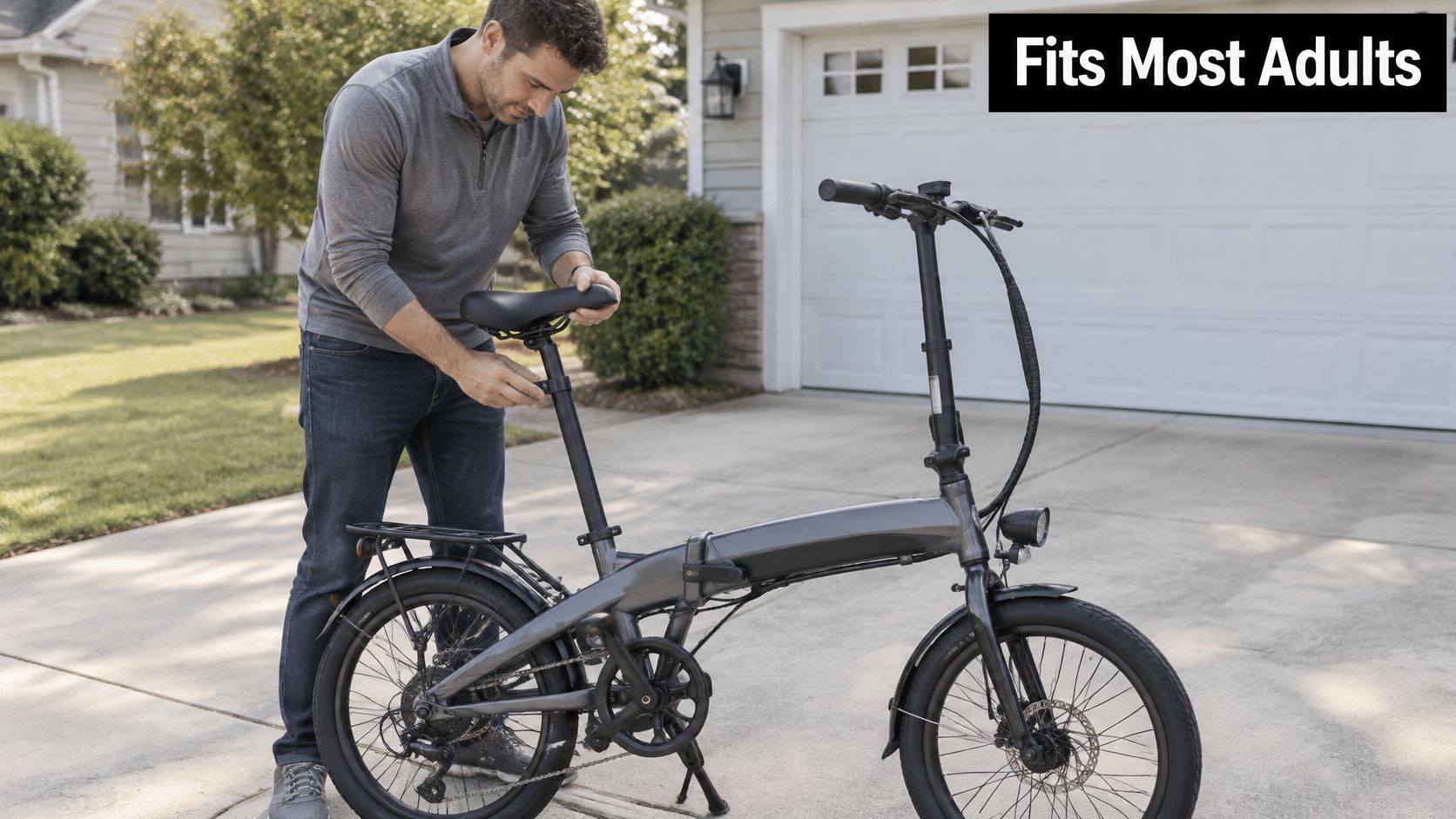
A step-through frame helps anyone in work clothes, and it stops mattering whether you can swing a leg over a high top tube once a rear rack and a bag are fitted. What it doesn't fix is reach: if the bars end up in your lap, no amount of saddle adjustment rescues the ride.
| Rider height | Suggested wheel | Fit check |
|---|---|---|
| About 5 ft 2 in to 5 ft 10 in | 20 inch, or 14-16 inch if the post reaches | Confirm the saddle minimum and the 14 inch cramp limit |
| About 5 ft 10 in to 6 ft 2 in | 20 inch with a longer wheelbase | Bars must not sit in the lap; confirm the post maximum |
| Over 6 ft 2 in | Check the published saddle and stem limits | Often outside a folder's range; compare the model plate |
Three Numbers to Find Before the Colour
Saddle height range: the minimum and maximum, not the middle. If the minimum is above your inseam, the bike doesn't fit, however small it folds.
Handlebar height: an adjustable stem with real travel covers more riders than a fixed one, and it's the first thing to check if you're tall.
Maximum rider-plus-luggage mass: this varies widely between models, so take it from that model's plate or manual rather than from a review or a guess.
That mass limit is about the frame and the hinge, not the rear rack. If your loads run past what a rack and panniers can take, a bike trailer for an electric bike moves the weight off the hinge and lets you keep the folder itself inside its plate.
A 20 inch wheel and a slightly longer wheelbase feel calmer under a heavier adult. A 14 inch bike starts to feel cramped above about 5 ft 10 in, mostly because your weight sits further behind the front wheel than the geometry wants. Tyre pressure and a suspension seatpost change comfort more than another 50 watts of peak power ever will.
A Two Minute Fit Check at Home
Stand over the frame in the shoes you commute in and check there's clearance. Then sit, put a heel on the pedal at the bottom of the stroke, and look for a slight knee bend rather than a locked leg or a knee that's obviously bent.
If the seatpost is already at its limit mark, the bike doesn't fit you, no matter how neatly it folds.
Commute Scenarios and Final Buying Check
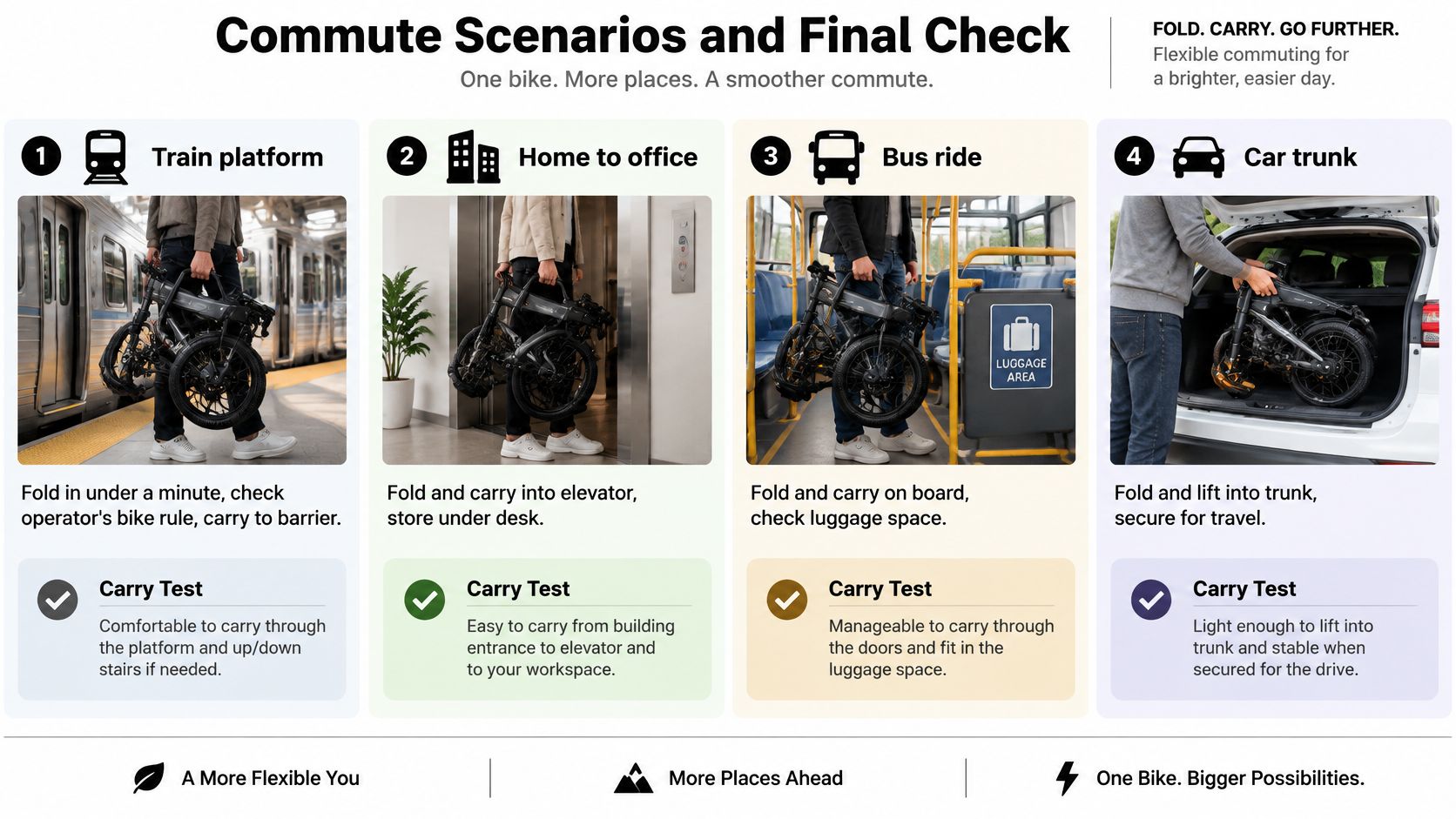
A folding bike can suit a train commute and still be awkward on stairs. Match the bike to the trip you make most often, then check the details that can turn a convenient fold into a daily nuisance.
Train Platform and Stairs
Practise folding and unfolding the bike at home. Check that the hinge locks securely, that you can operate its catch with gloves on, and that cables stay clear of moving parts. Then check the train operator's rules for bikes and luggage, including any cover requirements or peak-time restrictions. For an unfamiliar city, find a free UK navigation app with cycling routes before setting off.
Try the stair carry with the battery fitted, then with it removed if the design allows. A handle that gives you a secure grip and a balanced load can make more difference than a small reduction in the bike's listed weight.
Car Boot and Office Storage
Measure the boot you use day to day, then compare it with the bike's folded dimensions. Check that the hinge does not trap a brake cable or put pressure on the derailleur when the bike rests on its side. Try lifting it in and out with the battery fitted.
At work or at home, check whether the folded bike can stand securely and pass through your doorways. A very compact fold may be harder to roll or less stable when parked, so test the folded bike rather than judging by dimensions alone.
Three Checks, in Order
One, the legal line. For a standard electrically assisted pedal cycle in Britain or the EU, check for a motor rated at 250 W continuous, assistance that cuts out at 25 km/h or 15.5 mph, working pedals and a throttle limited to walk assist. Continuous power matters more for this check than a peak-power sticker.
Two, the carry test. Make sure you can lift or roll the folded bike up your stairs and secure the hinge without fumbling. A hinge lock should hold the frame firmly together when the bike is folded.
Three, the charging routine. Use the battery and charger supplied for the bike. Choose a clear, hard surface away from bedrooms and exit routes, and make sure the battery can be removed and stored as part of your normal routine.
Start by comparing continuous motor power and wheel size, then consider price and colour. Punk Ride's folding range includes the HIDOES C5 Folding Electric Bike at £269.00 and the ENGWE Engine X Foldable Electric Bike at £1,049.00, offered in Black, White and Red. ENGWE also has folding models such as the T14 and Engine Pro 2.0, alongside the step-through L20.
Count the trips you make in a typical week. If train travel and office storage dominate, prioritise a secure, manageable fold and a battery routine that fits your day. A bike that does not meet the legal requirements or that you cannot carry safely is the wrong choice, however small it looks folded.
Punk Ride sells folding bikes alongside adult, city and commuter, fat tyre, off-road and cargo e-bikes. Compare the details that matter for your route, then check the hinge and carry routine before choosing a model.

Teilen:
Roller für den Arbeitsweg: So findest du den richtigen