The usual advice on are pedal assist bikes worth it is "buy one and you'll ride more." That skips the only test that matters. A motor on a bicycle pays you back when it deletes trips you already pay for: the drive to work, the bus, the taxi, the car park. If it lives beside a car you still use five days a week, you've bought a heavy toy.
UK and EU buyers sit inside a tight legal box, a 250-watt motor and assistance that stops at 25 km/h. US class rules and Australian state rules are different, and a model that's fine in one place can be a motor vehicle in another. The bargain question is the same everywhere. How many car, bus, taxi or parking trips does this bike replace on your streets, in your weather?
Who Gets Real Value From a Pedal-Assist Bike
A commuter with a lockable bike store at work gets more from a pedal-assist bike than a fit rider who only rides for fun. The difference is repeat trips, not watts.
| Rider or use | Worth it? | Why | Watch for |
|---|---|---|---|
| Daily commuter with a car, bus or train trip | Usually yes | Replaces fares, fuel and parking every week | A protected route and secure storage at work |
| Short-trip errand runner | Often yes | Replaces repeated car trips to shops and services | Cargo capacity and wet-weather use |
| Older adult or someone returning to exercise | Yes, for activity | Makes hills and distance manageable | Choose a lower assist level to keep effort up |
| Fit rider training for performance | Maybe | Less workout per ride than a regular bike | Keep a conventional bike for hard sessions |
| Weekend recreational rider with a car | Usually no | Replaces very few car trips | Test ride or rent before buying |
| Rider with no safe cycle route | Not yet | Infrastructure barriers outweigh ownership benefits | Wait for a safer route or plan for a different mode |
A 2025 North Carolina Department of Transportation evaluation found that more than 82% of e-bike voucher recipients purchased a bike, compared with fewer than 8% of the control group. That jump in ownership did not produce statistically significant cuts in driving or vehicle mileage. Riders named unsafe roads, weather, time, awkward errands and old driving habits. Buying the bike is easy. Replacing the trip is the hard part.
Score the week, not the brochure
The riders who come out ahead have a trip that repeats. Liking the idea doesn't change a fuel bill.
Practical rule: List every trip you'd take by bike this week, then count how many you currently make by car, bus or taxi. That count is the purchase case.
Do it in two minutes. Write Monday to Sunday. Mark the school run, the station, the shop, the late taxi. If the bike only wins on a dry Sunday, leave it in the shop. Rebate surveys tend to show the same pattern: modest car-trip replacement, with weather and unprotected lanes doing the limiting. Match that to your road, not to a stranger's suburb.
How Pedal Assist Works in Plain Terms
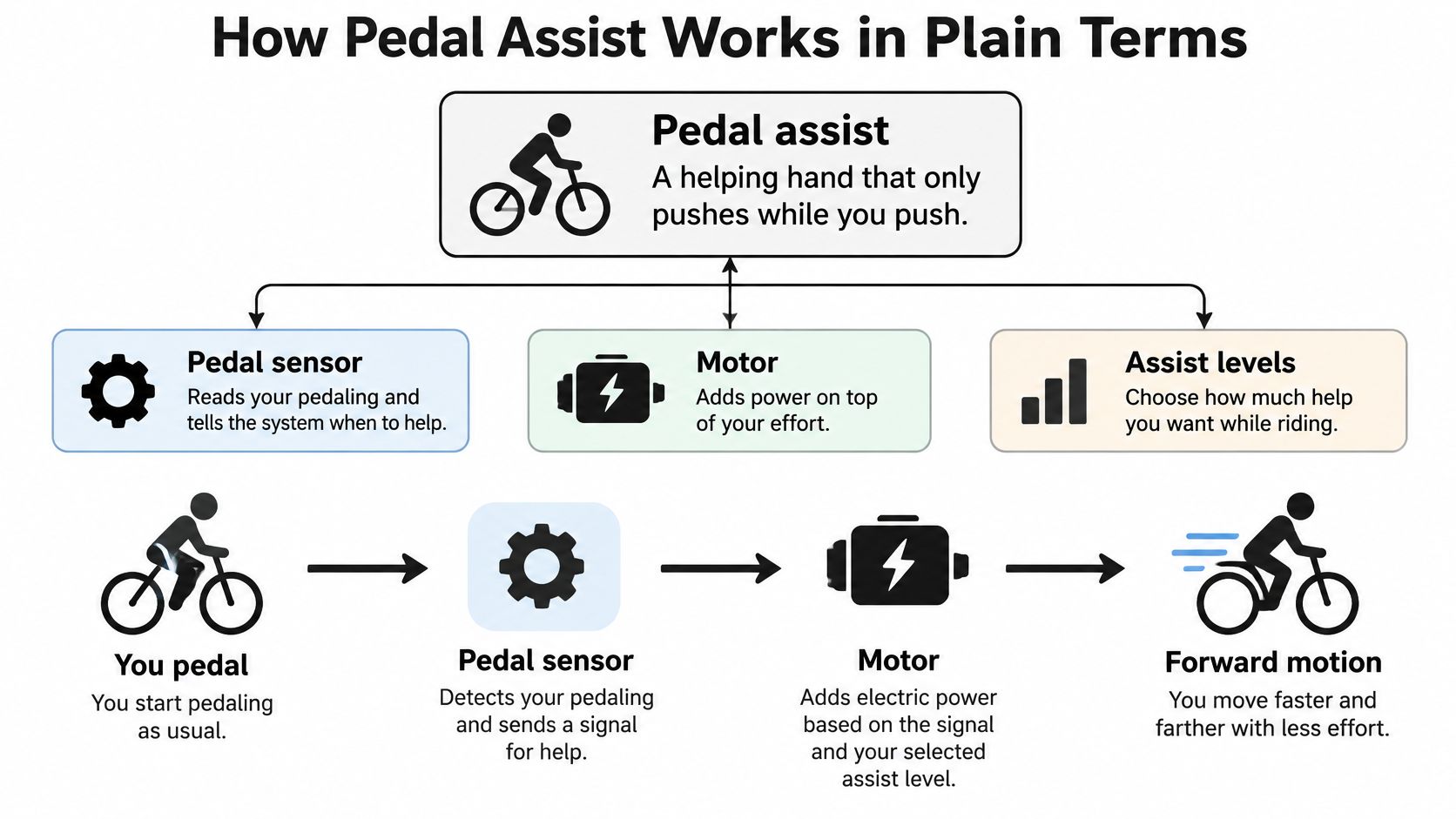
Pedal assist is a helping hand that only pushes while you push. You pedal. A sensor notices. The motor adds power on top of your legs. You stop pedalling, and the help stops.
Sensor, motor, levels
A pedal sensor reads cadence, or how hard you push, and tells the system you're working. The motor, usually in the hub or at the cranks, adds power. Assist levels set the size of that add-on. Low is a nudge on a hill. High is a shove. You can still pedal past the cut-off. The motor just clocks off.
On a road-legal European-style bike the usual ceiling is a motor rated at 250 watts continuous, with assistance that stops at 25 km/h. You can go faster on your own legs. The motor isn't allowed to keep helping.
A throttle is a different machine. It can drive the bike without your pedals. That often kicks the bike out of bicycle rules and into motor-vehicle rules, which the legal section covers for Britain and the EU. Don't treat "off-road mode" as a free upgrade.
This isn't a niche gadget anymore. Germany sold 2.05 million e-bikes in 2024, and e-bikes were 53% of all bicycles and e-bikes sold that year, figures from Germany's Zweirad-Industrie-Verband reported by the Federal Mobility Forum.
Before you pay, ride one hill three ways: assist off, lowest level, highest level. If the lowest setting already does the work and the bike stays calm, that model fits a commute. If only max assist feels usable, you'll burn the battery and skip the exercise.
How Much Exercise a Pedal-Assist Bike Gives You
A pedal-assist bike gives you a real workout, just a different one from a normal bike.
A 2018 systematic review of 17 studies involving 300 participants, published via PubMed Central, found moderate evidence that electric cycling produced at least moderate-intensity physical activity. Intensity sat below conventional cycling and above walking. The same review found moderate evidence of better cardiorespiratory fitness, mainly in people who were inactive before. Effects on metabolic and psychological health were inconclusive, and the longer studies were thin.
Regular e-cycling improves aerobic fitness, with no consistent change in body mass index or blood pressure. Treat it as a way to ride more, not a weight-loss tool. The point is not the bike sitting in the garage. The point is the trips it takes off your car, the bus, a taxi or a parking space each week.
What a real commute is worth
Say your trip is 5 km each way, five days a week. That's 50 km of moderate work a car commute never gives you. Hills, heat and a headwind are why the motor earns its keep. Drop to a high assist the whole way and you turn a training ride into a bus with pedals.
Already fit and chasing hard sessions? You'll get less fitness per ride than on a normal bike. Keep the acoustic bike for intervals. Use assist for the days you'd otherwise drive.
If you want a lab number instead of a guess from how sweaty you feel, VO2 max fitness testing in Manchester gives you a baseline, then you can see whether the commute is actually working.
Pick the lowest assist that leaves you slightly out of breath on the hills you ride. Save the top level for a rotten headwind, not for every flat kilometre.
Range, Hills and Everyday Performance
Advertised range is a best case: light assist, flat road, light rider, mild air. Your week is not that test.
Real range drops when you ride a higher assist level, carry shopping, meet a headwind, ride in the cold, run soft tyres, or climb. Cold batteries give up sooner. Stop-start traffic uses more than a steady roll.
What to compare instead of peak watts
Peak motor wattage is a poster number. Daily riding depends on four things.
- Assist-level control: You want steps you can feel, not two modes called "eco" and "rocket."
- Torque at a hill start: A high watt claim that bogs on a junction is useless.
- Battery capacity: Watt-hours, not a marketing mile figure.
- Manners at top assist: The bike should stay predictable, not surge.
In a randomized study of 12 healthy adults on a 3.54 km mixed-terrain course, reported in the International Journal of Exercise Science, pedal assist cut average time from 13.8 ± 0.3 minutes to 12.5 ± 0.3 minutes, about 9.4% faster. Perceived exertion fell from 14.8 ± 0.5 to 12.0 ± 0.4 on the Borg scale. Average heart rate stayed similar, 147 ± 5 versus 149 ± 5 beats per minute, and oxygen use didn't fall off a cliff. Both modes were vigorous for that group. Assist made the trip quicker and less grim. It didn't switch the heart off.
A hilly 15 km route with two long climbs will empty a battery far faster than 15 km of flat river path. Same distance, different bill.
Size the battery for double your one-way distance once hills, load, cold and headwind are in the picture. If the spec only just covers the nice-day number, you'll be pushing home in January.
UK and EU Rules That Affect Your Purchase
In Great Britain a legal pedal-assist bike is an electrically assisted pedal cycle. GOV.UK electric bike rules set three gates: working pedals that can propel the bike, a motor of no more than 250 watts continuous rated power, and assistance that cuts out at 15.5 mph (25 km/h). Riders must be at least 14.
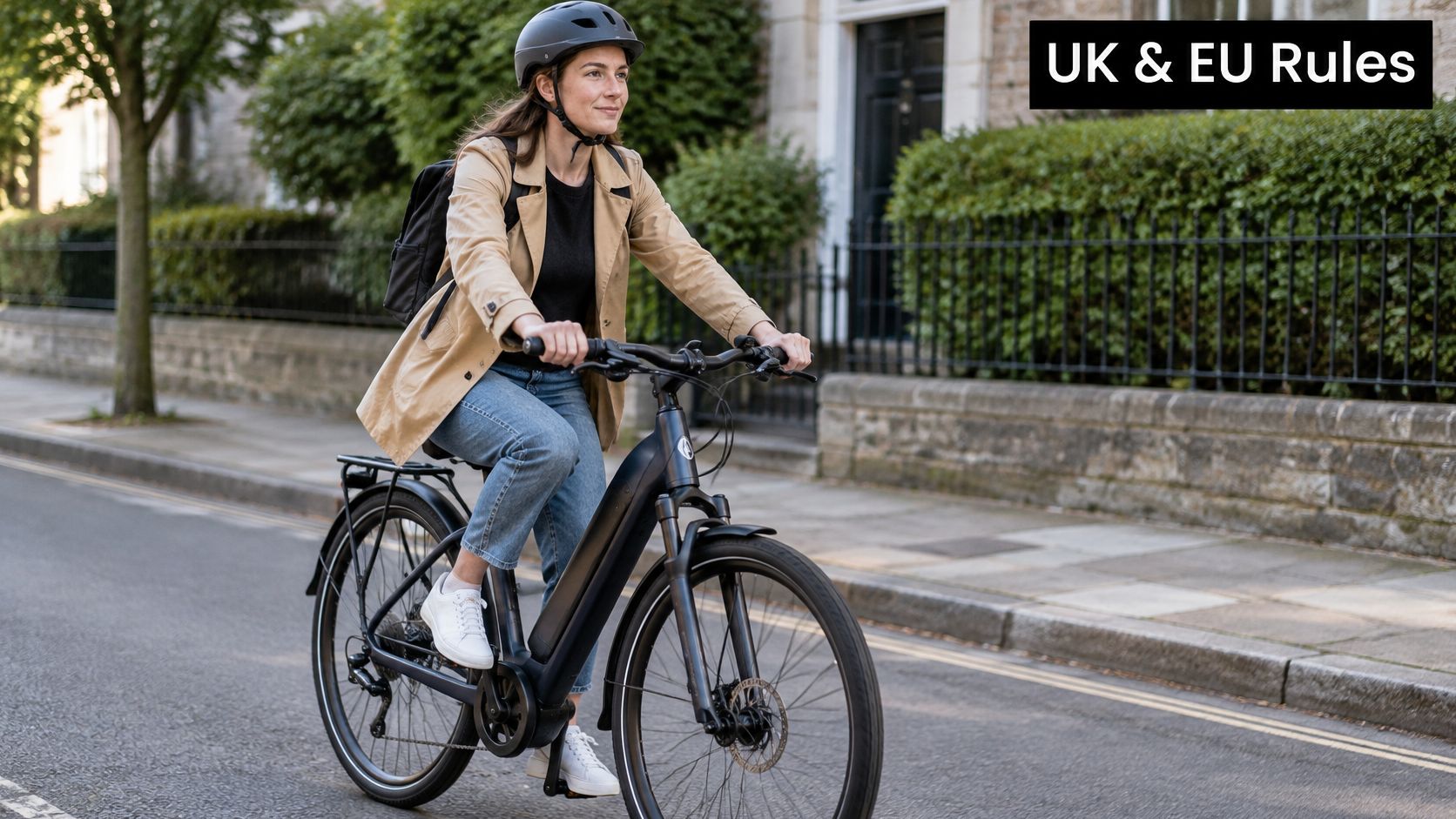
A compliant EAPC needs no registration, insurance or vehicle tax. That's a real saving next to a moped. If the motor can drive the bike above 15.5 mph, including through an off-road mode, it's a motor vehicle. That can mean registration, insurance, tax, licensing, type approval and an approved motorcycle helmet. A cheap "boost" button can turn a bicycle into a costly mistake. Street-legal detail for common setups sits in our guide to whether electric bikes are street legal.
UK and EU side by side
The EU EPAC pattern, referenced to EN 15194, uses the same power and speed cut-off. Minimum age and helmet rules are set country by country, so read the national page before you import one.
| Rule | UK (EAPC) | EU (EPAC, EN 15194) |
|---|---|---|
| Maximum continuous motor power | 250 W | 250 W |
| Assistance cuts out at | 15.5 mph (25 km/h) | 25 km/h |
| Minimum rider age | 14 | Set by each member state |
| Motor propulsion above the cut-off | Treated as a motor vehicle | Not an EPAC; treated as a motorised vehicle |
| Registration, insurance and tax | Not needed when compliant | Check that member state before you pay |
US buyers meet Class 1, 2 and 3 labels instead, often with a 20 mph or 28 mph assist cap, and local path bans on top. Australian buyers can't assume one national bike. Transport for NSW allows up to 500 watts continuous, with throttle help only to 6 km/h and pedal assistance to 25 km/h. Queensland stays at 250 watts and wants an EN 15194 label. A bike that's legal in Sydney can be the wrong machine in Brisbane.
Read the spec sheet for continuous power and the cut-off speed. Ask the seller for proof of compliance before you pay. If they can't show it, walk away.
Maintenance Costs Most Buyers Forget
A pedal-assist bike is heavier, and the motor adds torque the chain, cassette and tyres have to swallow. City miles with lots of stops eat brake pads faster than a Sunday pootle on a dry lane. Budget for that before the first winter, or the "cheap commute" turns into a repair queue.
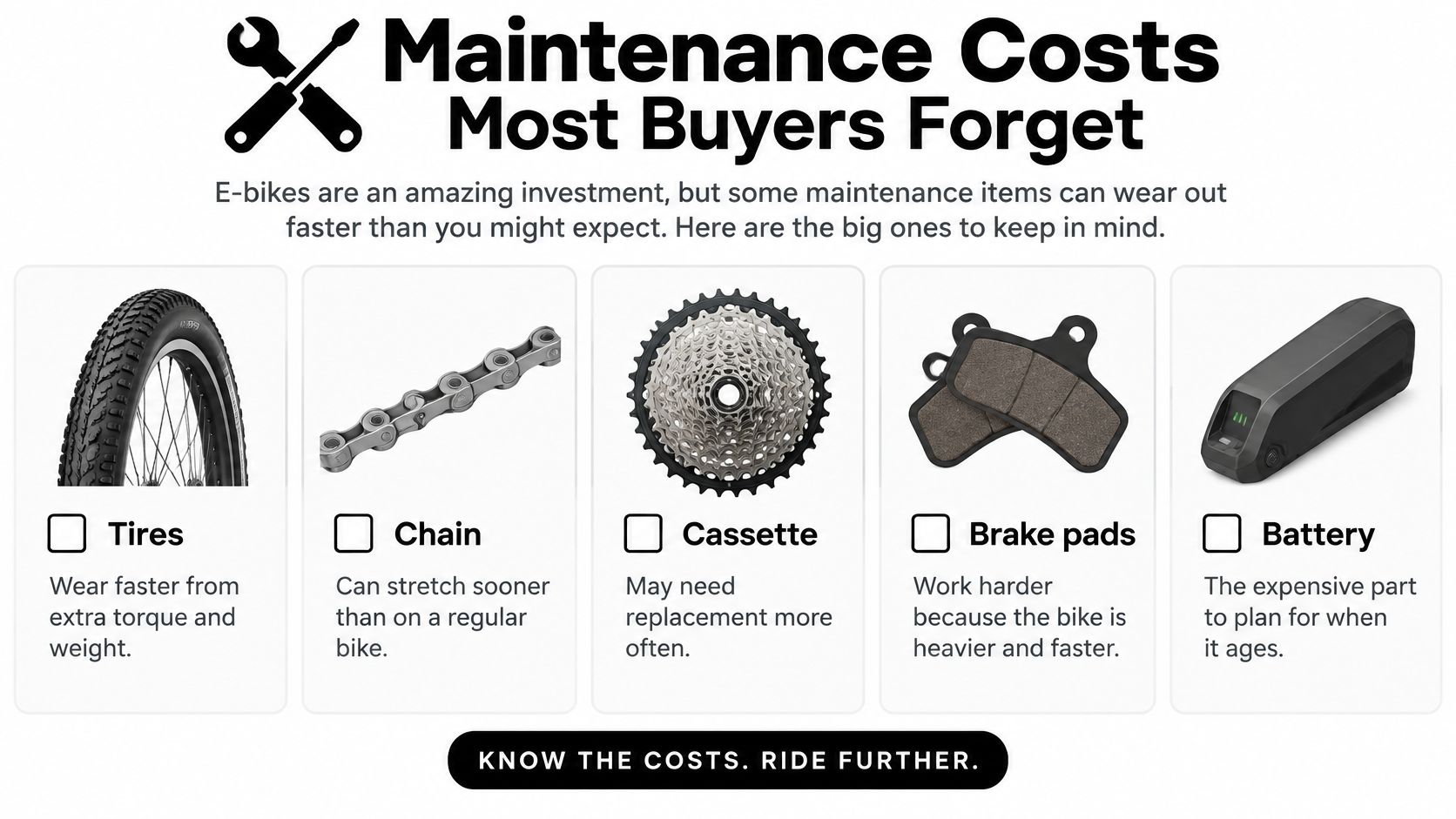
The battery is the expensive part that ages in the background. Capacity fades with years and charge cycles. Leaving it flat, stuffed full for weeks, or parked in a hot shed speeds that up. Store it cool, part-charged, off the bike if you're away for a month. Connectors and software updates are small, and they're still failure points. A wet plug or a botched firmware flash can brick a Tuesday.
A routine you can copy
- Weekly: Set tyre pressure and wipe the chain, then lube it. Our notes on e-bike chain lube cover what to use so you aren't grinding a dry chain under motor torque.
- Monthly: Look at brake pads, rotor rub and bolt torque on racks, axles and the battery mount.
- Yearly: Book a workshop visit for the drivetrain, brakes and a battery-health check. Don't wait for a slipped chain on a hill.
A daily wet commute can finish a set of pads long before a fair-weather weekend rider notices them. Higher assist and a loaded rack make tyres square off sooner too.
Set a yearly maintenance pot aside on the day you buy. The first service shouldn't feel like a fine.
Break-Even Math for Pedal-Assist Ownership
The bike earns money when it steals trips from a car, not when it replaces a walk you enjoyed.
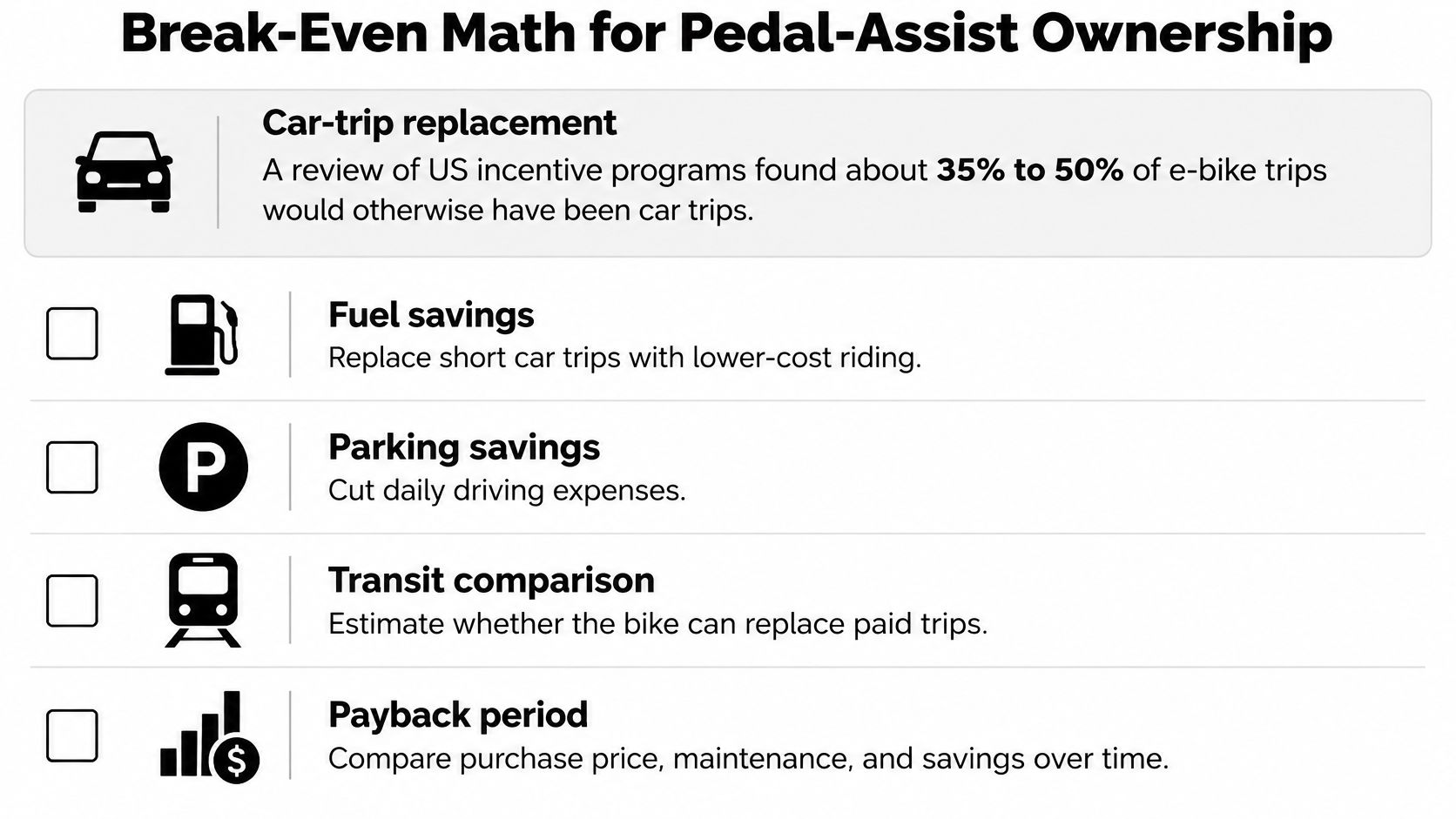
A review of U.S. e-bike incentive programs, published via PubMed Central, reported that about 35% to 50% of e-bike trips would otherwise have been car trips. Individual studies put car-trip substitution between 11% and 46%. Replacing total vehicle miles was smaller, about 1.6% to 5.2%. Targeted schemes did more: about 20% in Brighton and 33% in Utrecht. In one Delft trial, car commuting fell from 88% to 63%, while e-bike commuting rose from 2% to 18%. That's a slice of driving, not the end of the car.
Fill this from your own trips
| Cost or saving | How to estimate it | Effect on the yearly total |
|---|---|---|
| Purchase price | Divide the price by the years you expect to ride | Cost; usually the largest item |
| Fares or fuel avoided | Trips replaced × fare or fuel per trip × weeks you ride | Saving; the biggest lever |
| Parking or congestion charges avoided | Weekly parking or charge × weeks you ride | Saving, mainly in cities |
| Electricity to charge | Battery kWh × price per kWh × charges per week | Small cost |
| Tyres, brakes and drivetrain wear | Yearly service plus pads, chain and tyres | Recurring cost |
| Insurance and vehicle tax | £0 for a compliant UK EAPC; add insurance, tax and licensing only if the motor can propel the bike above 15.5 mph | Usually no cost when compliant |
Worked example, not a promise. A £2.50 bus fare, eight trips a week, 48 weeks, is £960 before you subtract charging and pads. Spread a £1,000 bike over four years and the hardware is £250 a year. If the fares, fuel and parking you drop still beat £250 plus upkeep, the bike is paying rent. If you only ride eight weeks, it doesn't. A side-by-side of an electric bike versus a car helps when the alternative is a second car, not a bus pass.
If you're weighing the purchase against bigger money goals, you can calculate your early retirement target and see whether a few hundred pounds a year of avoided fares is noise or a real line in the budget. Be honest about winter. A fantasy diary makes every bike look cheap.
Decide If a Pedal-Assist Bike Fits Your Routine
Use the scores you already have. Don't restart the argument in the shop.
- If the bike would replace fewer than three car, bus, taxi or paid-parking trips a week, don't buy yet. Rent for two weeks, including a wet one.
- Range has to cover double the one-way distance after hills, load, cold and headwind. If it doesn't, the fare saving is fiction.
- Spec sheet: working pedals, continuous power of 250 watts or less, cut-off at 15.5 mph (25 km/h) where those are the local bicycle rules. Refuse any off-road mode that drives the bike past the cut-off. That machine brings registration, insurance and tax.
- Put the yearly maintenance pot and the charge cost into the worksheet. Spread the price over the years you'll ride. Buy only if replaced fares, fuel and parking still win.
- On the test ride, climb your real hill with assist off, then the lowest level, then the highest. Keep the bike that stays controllable at the lowest level that leaves you slightly out of breath.
- Shortlist two compliant bikes for that route. Let them differ only if you need cargo space or a fold for the train.
Riding only happens if the habit survives a boring Thursday. A workout consistency guide for lifters is blunt about showing up when motivation is gone, and a commute dies the same way if the bike is a faff.
Our e-bike range includes adult bikes, city and commuter bikes, folding bikes, fat tyre bikes, off-road bikes and cargo bikes. If two compliant models are close, contact the Punk Ride team and say which trips you're replacing. We'll help you pick between them.
Punk Ride LLC sells electric bikes, electric scooters, kids' ride-on toys and accessories for people who want a trip to replace a car, a bus or a taxi, not a bike that gathers dust. If the weekly count and the spec sheet both say yes, browse the city, folding and cargo pedal-assist bikes and match one to the route you already ride. Visit Punk Ride LLC and start with the trips, not the watt sticker.