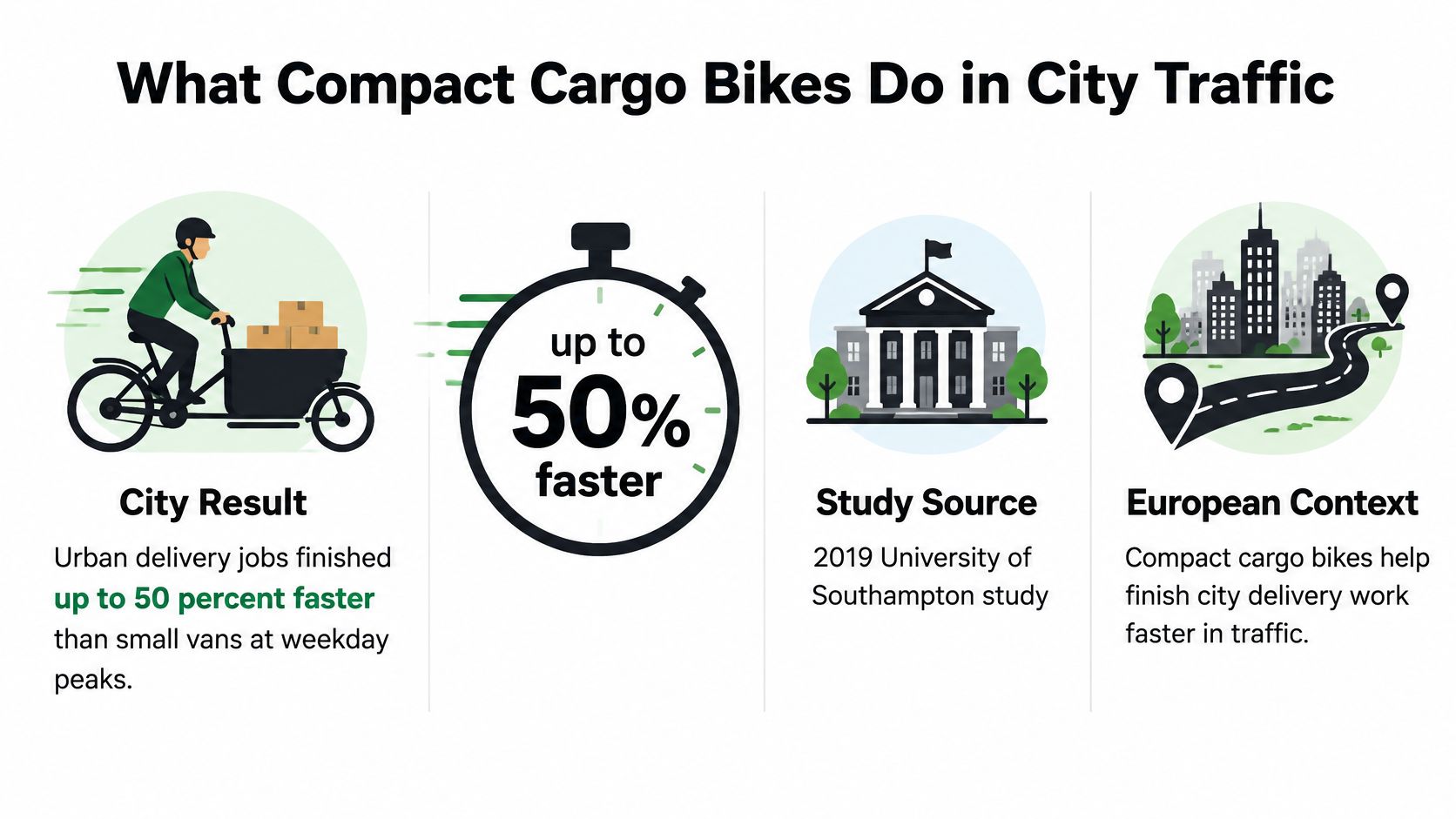
A cargo bike can finish an urban delivery job up to 50% faster than a small van during the weekday peak. That comes from a 2019 University of Southampton study reported by the European Commission's Urban Mobility Observatory, and it has nothing to do with travelling fast on the road. The bike wins at the kerb, in the loading bay, at the one-way sign and in the time a driver spends circling for a space.
The machine behind that result is usually a long freight bike. The one in your hallway is a compact cargo bike, a pedal cycle or pedal-assist e-bike with the short wheelbase, smaller wheels and tight rack of a city bike, built to move a child, a week of shopping or a morning of parcels. Think of the errand list of a small hatchback, on something that can use a cycleway and skip the parking loop entirely.
Choosing one is mostly a filtering job, and the order matters. Footprint first, because a bike that won't fit the shed gets sold within a year. Legal class second, because a 250 W pedal-assist machine and a throttle-driven moped are different objects on a UK street. How it steers and stops with weight low and heavy third. Motor watts come last, once those three have knocked out the wrong bikes.
What Compact Cargo Bikes Do in City Traffic
A city round is stop-start work. Every drop costs the time to pull in, unload and push back out into traffic, and that parked time is where the day disappears. In its 2019 briefing on urban freight, the European Commission's Urban Mobility Observatory recorded cargo-bike loading and unloading at as little as 3 minutes per stop, against roughly 12 minutes for vans and lorries. Multiply that gap across a dozen drops and the parked time alone runs to the best part of two hours.
Payload tells the story from the other end. The same Observatory briefing recorded electric cargo bikes carrying up to 350 kilograms, and an average van load of roughly 130 kilograms per trip in the Netherlands. Plenty of urban rounds run with a light load inside a big vehicle. A compact bike can absorb that load and still use a cycleway and a bike bay, which is why the comparison matters more than the raw ceiling.
What counts as compact
Proportions give it away before the badge does. Both wheels are usually 20 inches, the wheelbase is short enough to slot into a standard bike bay, and the load sits on a reinforced rear rack, a small front platform or a short box. Get the weight low and inside the wheelbase, as a good design does, and a short bike feels planted instead of twitchy. That geometry, more than motor size, is what you feel on a wet painted cycle lane.
Three layouts cover most of what you will see on the street: folding compact cargo bikes, midtails and compact box bikes. Each answers the same question in a different shape, and the right one follows from your hallway, your route and your load rather than from the loudest number on the spec sheet.
One number to keep in perspective
Treat 350 kilograms as the outer edge reported for freight cargo bikes. A folding commuter, or a midtail with a child seat, is a different machine, and loading it like a depot van is how you end up with a wobbly, brake-cooked descent on a wet hill. What settles whether a compact cargo bike works for you is narrower: the space it takes up in your hall or shed, the pedal-assist class UK and EU law lets you ride, and whether you can steer and stop it with your real load on board. Only then is it worth comparing motors.
Folding Midtail and Box Layouts Compared
Before any brand talk, get the shapes straight. The table below is the filter, and every row after it is just the picture behind a cell.
| Layout | Footprint | Where the load sits | Best everyday job | Main trade-off |
|---|---|---|---|---|
| Folding | Shortest stored length, often hallway or boot sized once hinged | Rear rack, crate or small front platform | Flat commute plus a light shop, stored indoors | Least stable when the rack is piled high |
| Midtail | A little longer than a city bike, usually still lift friendly | Low rear deck behind the saddle | One child or two deep panniers | Not a two-child school bus |
| Compact box | Wider, and longer than a folder, still shorter than a full long john | Low front or centre box | Groceries, tools or a seated small child | Harder in narrow halls, sheds and pinch points |
Folding designs hinge to fit a hallway
A folding compact cargo bike has a hinge in the frame or the head tube, so the stored length drops toward something you can stand behind a door. Picture a third-floor flat with a narrow hall and no lift. The bike lives in the porch, folded, next to the coats, and that single fact is why it gets used in February.
The carrying is a rear rack, a crate or a small front platform. That's a laptop, a change of clothes and a modest shop. What it doesn't like is a rack piled high with bottles and potatoes, because the weight ends up above the rear axle on the shortest possible frame.
Midtails keep a normal bike feel
A midtail keeps the front end of an ordinary city bike and adds a short low deck behind the saddle. A child seat or two deep panniers sit near the rear axle, so the steering stays familiar and the bike still swings a leg over at the school gate without you lifting a long frame.
Most midtails still fit a standard lift, which matters more than any spec sheet admits. The limit is capacity, not handling. One child with a bag, yes. Two children plus school bags on a daily basis, no, and that's the point where you stop looking at compact bikes.
Compact boxes put the weight down low
A compact box, including a short bakfiets rather than a full-length front loader, puts groceries, tools or a small child low in a front or centre bay. Mass down low and between the wheels is calmer in a straight line and calmer under braking, which is why parents gravitate to them.
The cost is width. Picture a shed door with a step, a hallway with a shoe rack, or a cycle-lane pinch point at a width restriction. A box that clears your door on paper can still be a two-person shuffle every evening.
Test it with a tape measure: measure the lift interior, the shed door width, the narrowest gate on your route and the length of wall you can spare. Write the numbers down before you open a single product page.
A longtail that only ever lives on the street, chained to a railing, is a cargo bike rather than a compact one, however strong the motor. Storage is the whole point of the category.
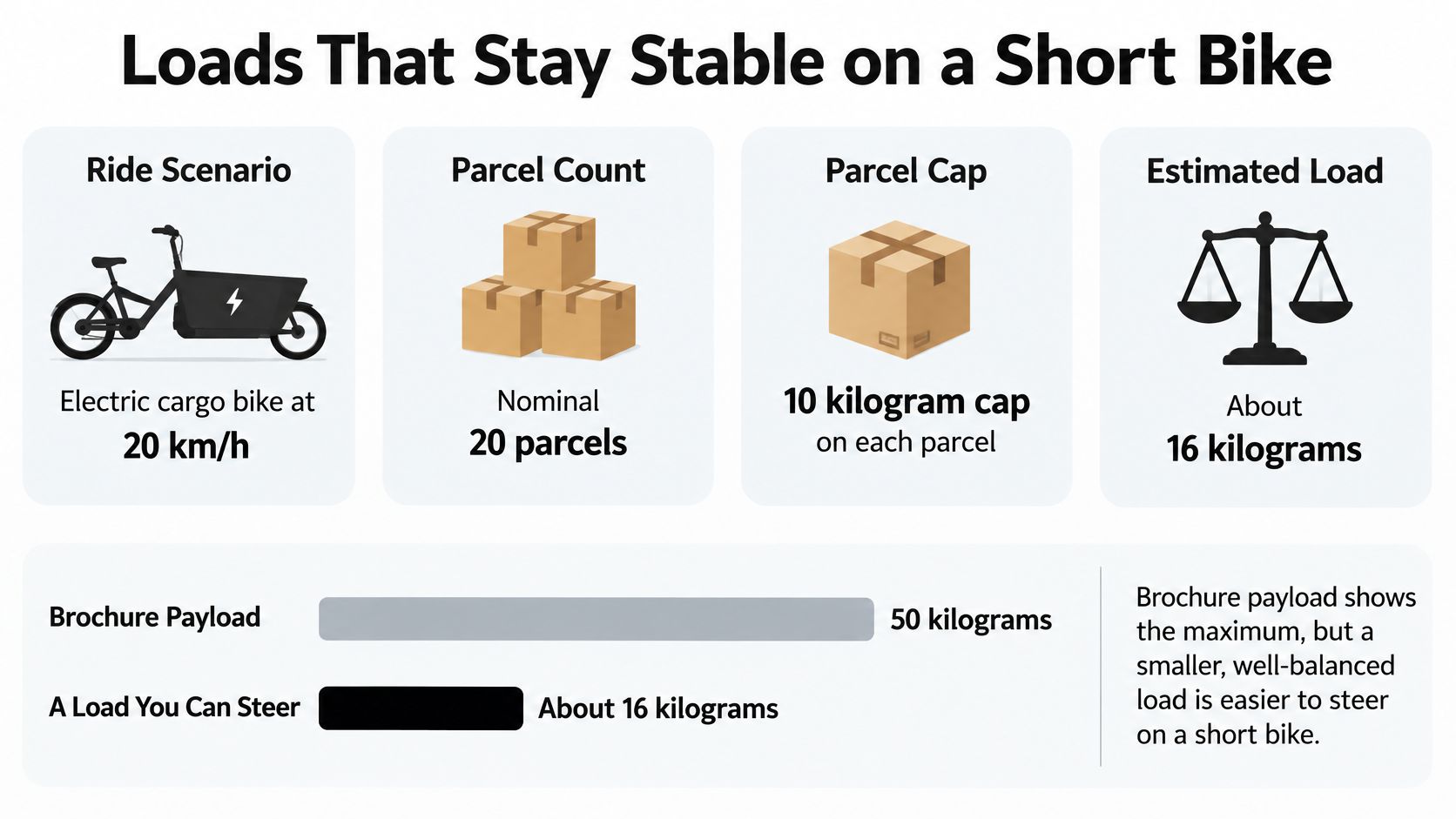
Loads That Stay Stable on a Short Bike
Brochure payload and steerable load are two different numbers, and only one of them gets you home. A cargo-bike logistics model published in European Transport Research Review ran an electric cargo bike at 20 km/h with a nominal capacity of 20 parcels, each capped at 10 kilograms. It estimated roughly 16 g of CO₂ per kilometre for the cargo bike, against 155 g/km for an electric van and 317 g/km for a diesel van.
Why a small vehicle wins on short trips
The gap is that wide because the bike is light. Small mass, low rolling resistance and an efficient electric drivetrain need far less energy per trip, and the bike skips most of the deadheading and parking circulation a van does on every round. You don't need a huge payload to win a two-kilometre errand.
The same study modelled a dense Seoul delivery scenario and found that roughly three cargo bikes per truck could cut operating costs by 14.1% and carbon-pollutant emissions by 10%, largely because bikes shorten the walk from a parked vehicle to a customer's door.
Translate that to a household. A solo commute is a laptop and 5 to 10 kilograms. A weekly shop behaves best at around 15 to 25 kilograms, kept low and between the wheels. One child plus a small bag suits a low midtail deck. A small business round looks like those twenty lighter parcels, not a depot load.
What fails first when you add weight
A high rear pile lightens the front wheel in a turn, and you feel it as vagueness before you feel it as a slide. A front box loaded over the tyre makes the steering heavy and the low-speed balance fussy. Hills expose weak brakes long before the motor runs out of boast.
| Trip | Sensible load | Calmer layout | Watch for |
|---|---|---|---|
| Solo commute | Laptop and about 5 to 10 kg | Folding | A high rack that wobbles |
| Weekly shop | About 15 to 25 kg, low and centred | Midtail or small box | Brakes on the way home uphill |
| One child plus bags | Child seat plus about 10 kg | Midtail with a low deck | Weight stacked above the rack |
| Short business round | About 20 parcels, each under 10 kg | Stable box or reinforced midtail | Treating it like a full freight load |
Weigh your heaviest regular load on the kitchen scales before you shop. A crate of milk, a laptop bag and a bag of potatoes weigh more than most people guess, and that number decides your layout.
Once the load is settled, sort the mounting hardware. A rear rack setup that keeps weight low and close to the axle does more for stability than a bigger motor ever will.
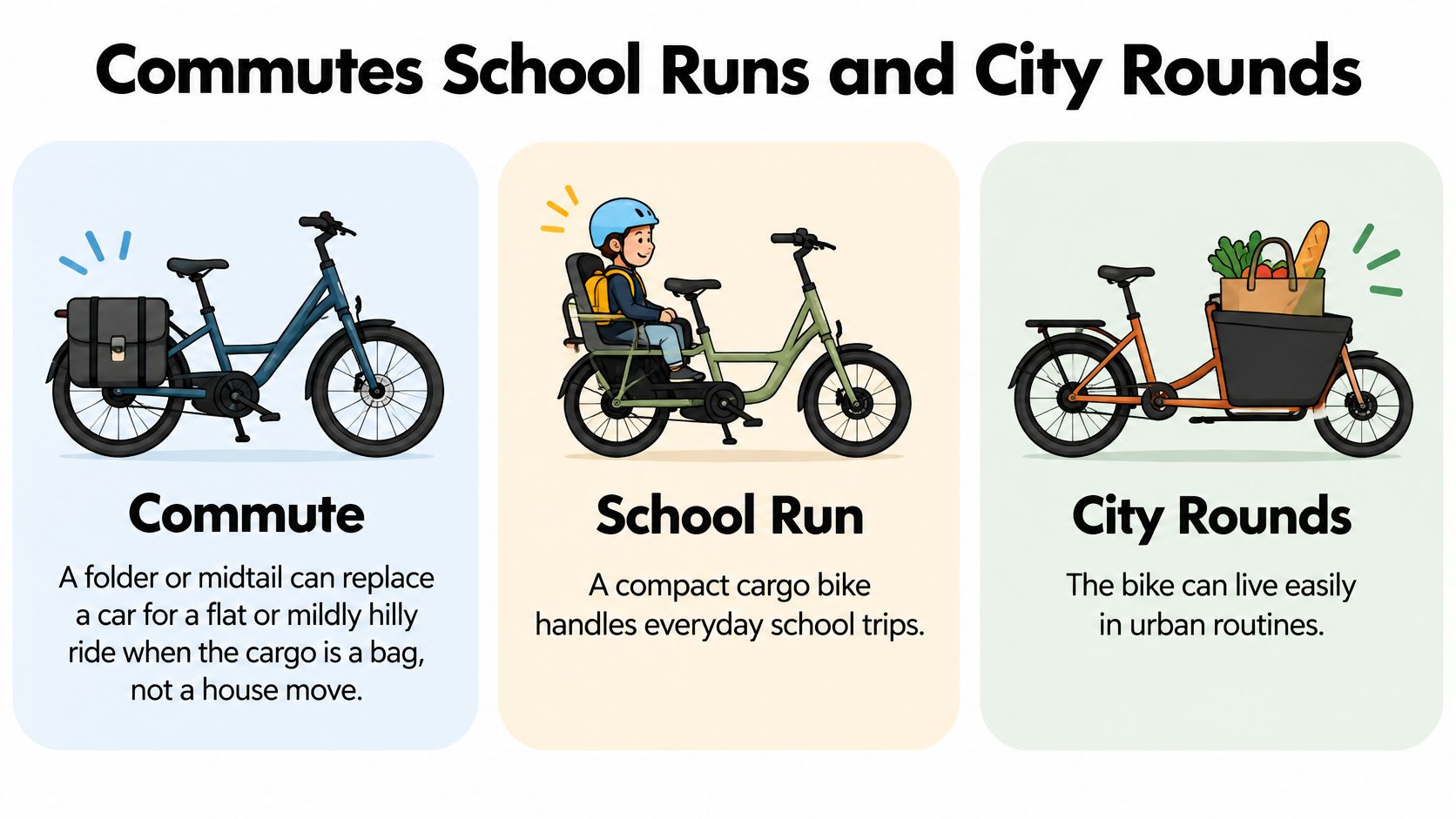
Commutes School Runs and City Rounds
The bike by the front door is the one that leaves. The one in a cold garage often stays there.
The commute that actually happens
Filter the commute before you compare motors. Stored footprint comes first. A folding compact cargo bike that leans in the hallway gets ridden on a wet Tuesday, with a laptop and a soft bag on a low rack. A faster, longer bike that lives off the alley does not. Next is the UK or EU pedal-assist class you are allowed to use between home and work. A class that only helps while you pedal, and that fits the cycle paths and streets you already ride, replaces more car trips than a bigger watt figure on a bike you cannot store or cannot legally use there.
On a flat or mildly hilly run, the folder or a short midtail is enough. With the bag kept low, steering stays predictable and the brakes, not the motor, decide whether you stop cleanly at the lights.
The school run and its ceiling
One child on a low rear deck, or a small child in a box, covers the nursery or school hop that is awkward on the bus and too short to justify parking a car. It feels closer to pushing a loaded buggy than to riding a light hybrid. The mass sits down between the wheels, the turn starts more slowly, and you plan the stop a little earlier.
Two children is usually the moment to step up from compact to a longer cargo bike. The short bike still moves. The load, and the floor space it needs indoors, stops being compact.
The delivery round that fits
A peer-reviewed study of Porto, Portugal, a city of approximately 237,000 inhabitants, concluded that cargo bikes could replace up to 10% of conventional vans in areas with maximum linear distances of about 2 kilometres while overall network efficiency held, and the authors tested scenarios at 3%, 5% and 10% of freight movements shifting to electric cargo bikes and found potential improvements in traffic performance rather than gridlock, according to the published modelling study.
On short, dense rounds, electric cargo bikes can take a meaningful share of local van work and cut emissions when the trips stay inside the neighbourhood. The same pattern does not stretch to every logistics job.
Distance and density set the limit. A motorway leg, a heavy trade load, or a route with no safe place to ride is still a van job. For families weighing up the school-run version of this decision, our guide to cargo e-bikes for families covers the seat, rail and accessory choices that follow once the layout is settled.
How a Loaded Short Bike Behaves in Traffic
A shorter bike is not automatically a safer bike, and it isn't automatically an easier one. Compact designs turn tightly and block less of the pavement, but they also stack weight over less frame and put you closer to the vehicles overtaking you.
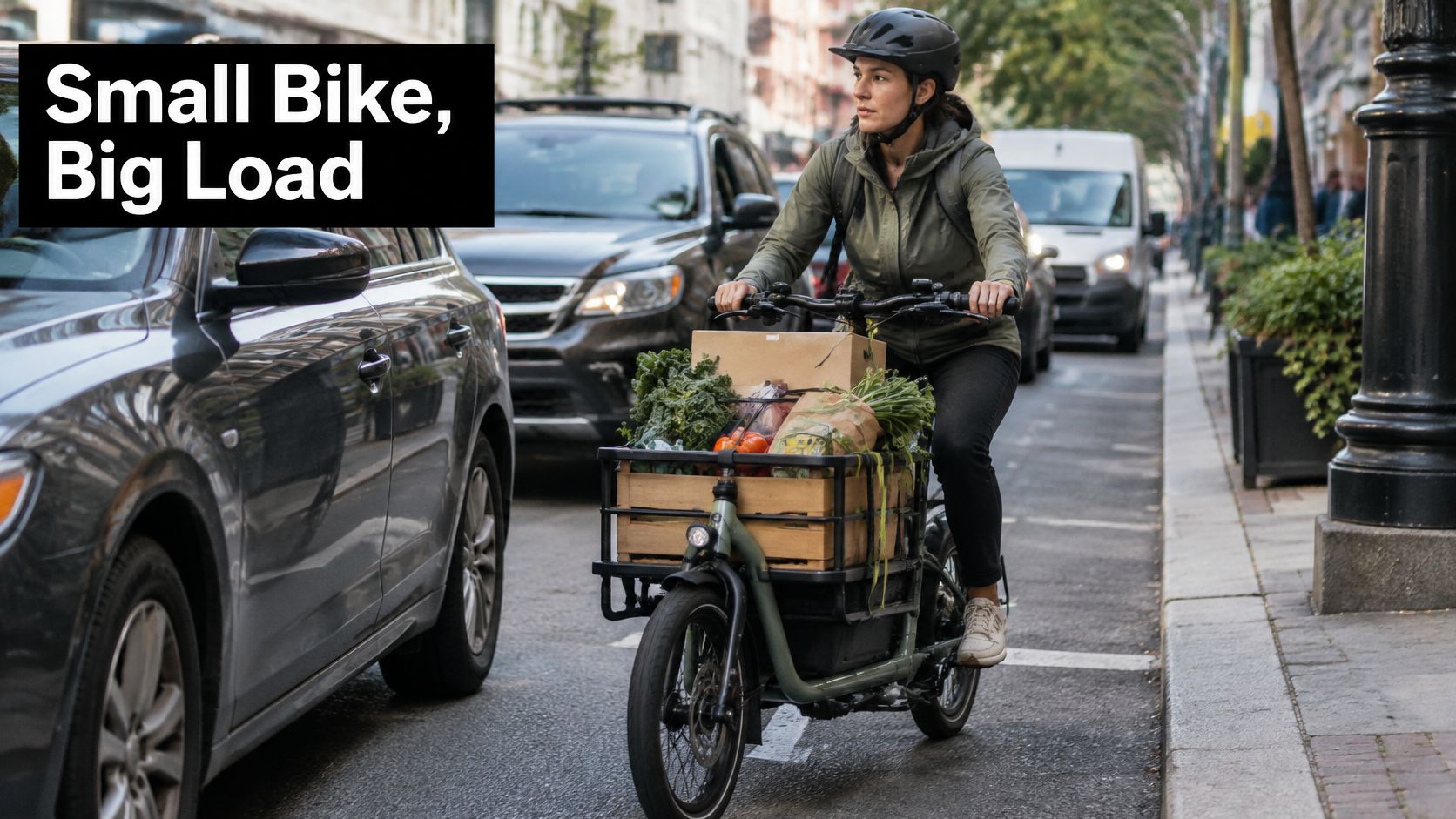
The infrastructure question is still open. Interviews gathered for the Cargo E-bikes research report identify the lack of protected bicycle lanes as a major barrier to scaling cargo-bike use, even in places where cargo e-bikes can legally operate without them. Salzburg Research's Bikealyze NEXUS project goes further and uses a compact cargo bike to measure overtaking distances and cyclist-vehicle interactions, which tells you that real-world clearance is still being worked out rather than settled by a product spec.
Four street moments to check on the test ride
- The tight turn with a high load. A pile over the rear rack lightens the front wheel, and the bike runs wide before it feels like it's slipping.
- The slow U-turn with a full box. Front weight makes low-speed balance heavier, especially with a child who shifts in the seat.
- The loaded stop. Groceries, tools or a passenger need both brakes and a longer gap than the empty bike you rode round the shop car park.
- The road. Painted lanes, door zones, narrow streets, hills and delivery bays are the test. A car park tells you almost nothing.
A smaller footprint can slip through a gap a van can't, and it can also leave less room when a driver decides to pass close on a narrow street. The two things are the same measurement seen from different seats.
Buy the bike you can stop and turn with Tuesday's real load, on the road you actually ride, not the bike that looks shortest in the photo.
Buy Only a Compact Cargo Bike That Passes the Law
In the UK, an electrically assisted pedal cycle can be ridden from age 14 with no registration, vehicle tax, licence or insurance, but only inside set limits. As the government's electric bike rules set out, the motor must have a maximum continuous rated power of 250 watts, assistance must stop when the bike reaches 15.5 mph (25 km/h), and the machine must have working pedals capable of propelling it. If walk assistance is fitted, that function must cut out at 3.7 mph (6 km/h).
The UK limits that set the class
Cross those thresholds and the bike stops being an ordinary bicycle. It can be treated as a moped or motorcycle, with approval and road-use requirements attached, which changes insurance, licensing and where you can ride it. Most EU countries apply the same 250 W and 25 km/h shape of rule, so a bike built to the UK limits usually travels well across the continent. A throttle that drives the bike without pedalling is a different legal object wherever you are. If you're unsure how a particular model lines up, our guide to whether electric bikes are street legal walks the same limits.
Six checks before you pay
- Measure the storage and keep only what fits. Shed, lift, hallway, the space behind the door. A layout that fails here fails permanently, whatever the motor does.
- Match the load, not the dream. A bag starts with folding, one child or a deep shop points at a midtail, and a low box only works if the doorway and the route are wide enough.
- Read the spec plate for class. 250 W continuous, assistance ending at 25 km/h, real pedals that move the bike. Anything else is a different category of vehicle.
- Test both brakes and a slow turn with weight on board. Load it the way you'll load it on a Tuesday, then try a hill and a tight corner.
- Check the battery and the riding position. A pack you can lift and charge indoors, and a reach and saddle height you can hold for the full trip, beat a bigger battery that lives in a bike you can't steer.
- Walk away from a bike that only feels good empty. Stop immediately if the legal row fails, because nothing later in the list fixes a classification problem.
| Check | Pass | Fail |
|---|---|---|
| Motor and speed | 250 W continuous, assist ends at 15.5 mph or 25 km/h, pedals work | Assist above that speed, or a throttle that propels the bike |
| Walk mode | Cuts out at 3.7 mph or 6 km/h if fitted | A throttle you can ride on without pedalling |
| Brakes with a load | Two strong brakes you can feather on a hill | A single weak brake on the loaded test |
| Battery | A pack you can remove and charge indoors | A buried battery you cannot lift upstairs |
| Storage | Parked or folded length clears the measured space | A longtail that only fits on the street |
| Load position | Mass low and between the wheels | A high rear pile that lightens the front wheel |
A worked fail
Punk Ride sorts e-bikes into adult, city and commuter, folding, fat tyre, off-road and cargo categories, which matters because cargo and tricycle frames carry different load layouts and dimensions from a conventional two-wheel bike. The NAKTO F4 is a 750W electric cargo bike listed at £628.08, and on the 250 watt row it fails the UK test. That's exactly the point of filtering by class first. A motor rating above the limit puts the machine outside the pedal cycle definition, so it isn't something to plan a UK commute around without knowing what it would be registered as. Every NAKTO listing lets you compare frame style, tyre size, motor and battery specification, brakes and overall bike weight, which is the comparison worth making once a bike has passed the legal rows and the tape measure.
Punk Ride LLC stocks e-bikes across adult, city and commuter, folding, fat tyre, off-road and cargo categories, with warehouses in the UK and Germany, so the compact cargo bike you've filtered down to here can be checked against real frame, tyre, motor, brake and weight specifications instead of a headline. If you've measured your hallway and weighed your Tuesday load, browse the range at Punk Ride LLC and compare the cargo and folding models side by side. Start with the class and the footprint, and the watts will look after themselves.