The usual advice is to buy the biggest battery and trust the "up to 100 miles" line on the listing. I would ignore that. A 100 mile range ebike claim is an energy budget, not a distance you can bank for a Tuesday ride, a headwind, or a loaded cargo trip. Spec-sheet miles are the friendly case: light assist, modest speed, and a rider who keeps pedalling.
What you can ride is watt-hours divided by the energy your route burns per kilometre. Two bikes with the same sticker can finish 40 miles apart once hills, stops, and cold air show up. If you shop in the UK, the EU, Australia, or the US, the sticker still has to sit inside the local power and speed cut-off. Range never buys you a different legal class.
What 100 Miles Really Demands From a Battery
A century ride is an energy bill before it is a badge on a listing. 100 miles is 160.9 km, so the pack has to cover 160.9 multiplied by the watt-hours your motor burns each kilometre, with enough left over that you are not limping home on reserve.
A 2015 study of urban e-bike operation measured 7–12 Wh/km at 15–25 km/h with motors from 100 to 300 W. In that same work, one observed route used 390.49 Wh over 34.77 km, which works out to 11.2 Wh/km.
Put those numbers against 160.9 km and the demand stops looking friendly. At the measured 11.2 Wh/km, 100 miles needs about 1,802 Wh of usable energy. At the study's efficient end, 7 Wh/km, the same trip needs about 1,126 Wh. A 2016 urban-commuting performance study described mainstream pedal-assist bikes reaching up to 110 km on a 432 Wh pack and estimated that a 100 km ride with no pedalling would need at least a 40 Ah battery weighing about 7 kg. Dividing 432 Wh by 110 km gives about 3.9 Wh/km, an easy-riding case that still wants roughly 628 Wh for 100 miles.
Energy needed for a 100 mile ride
| Riding profile | Consumption (Wh/km) | Energy for 100 miles (Wh) |
|---|---|---|
| Best-case pedal-assist, 2016 urban commuting study (432 Wh over 110 km) | 3.9 | 628 |
| Efficient flat riding, best case from 2015 urban study | 7 | 1,126 |
| Measured urban route, 2015 study | 11.2 | 1,802 |
| Hilly or heavy cargo riding, illustrative calculation | 15 | 2,414 |
| Steep climbs or strong headwind, illustrative calculation | 20 | 3,218 |
The 15 and 20 Wh/km rows are calculated, not measured. Every row is flat-ground energy before hills, wind, rider weight, temperature, tyre pressure, battery ageing, or the reserve you should leave in the pack.
That spread reflects demand. A genuine 100-mile setup usually needs a large pack, a second battery, efficient assist, a patient rider, or a route that stays flat and calm. Often it needs several of those at once.
Read the label in watt-hours, because voltage alone hides capacity. Two packs can share a 48V badge and store very different energy once amp-hours differ. Voltage marketing creates the same trap in other battery categories, which is why a plain labelling example like compare 18V and 20V MAX packs is a useful reminder to multiply volts by amp-hours before trusting a number.
The 100 km trap
100 miles is 60.9% farther than 100 km. A listing that only says “100 km range” is describing a shorter target, and it should never be treated as a 100-mile bike. If the seller will not state watt-hours, do the conversion yourself from volts and amp-hours before you trust the distance claim.
Turning Battery Size Into Real Distance
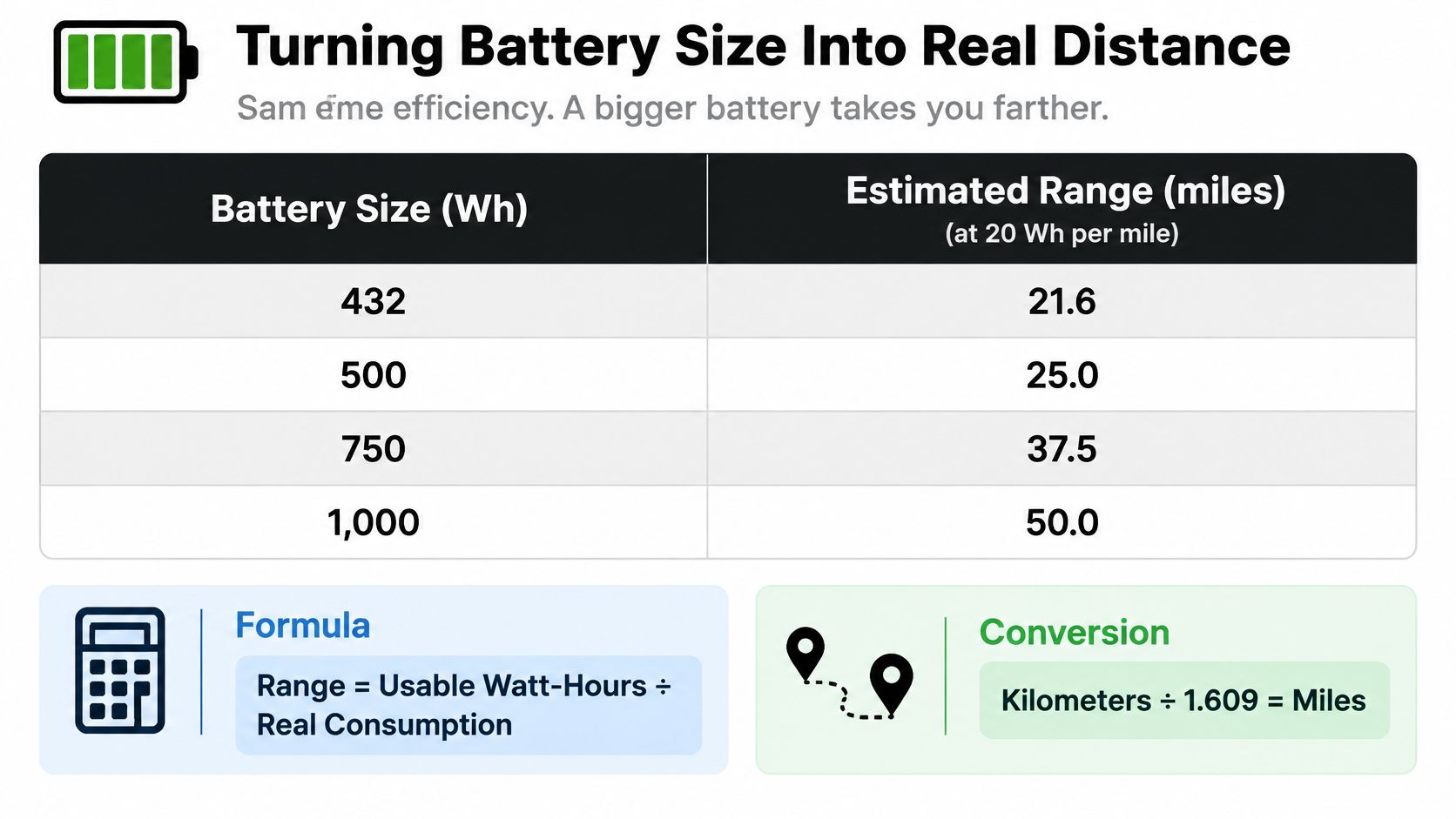
Treat the pack as a fuel budget in watt-hours, not a distance promise. Range is usable watt-hours divided by real consumption in Wh/km. Divide the kilometres by 1.609 and you have miles. The rated figure on the label sits at the top of that budget, and the spendable amount is lower, because the controller cuts power before the cells are empty.
Distance from common battery sizes
| Battery energy (Wh) | At 3.9 Wh/km | At 7 Wh/km | At 11.2 Wh/km |
|---|---|---|---|
| 432 Wh | 69 miles (111 km) | 38 miles (62 km) | 24 miles (39 km) |
| 500 Wh | 80 miles (128 km) | 44 miles (71 km) | 28 miles (45 km) |
| 750 Wh | 120 miles (192 km) | 67 miles (107 km) | 42 miles (67 km) |
| 1,000 Wh | 159 miles (256 km) | 89 miles (143 km) | 55 miles (89 km) |
Pick the row closest to your pack, then the column closest to the riding you do. A 432 Wh commuter pack, the size that covered 110 km in the easy urban test, becomes a 24-mile bike once consumption sits at 11.2 Wh/km. The 500 Wh row tells a different story. It can stretch to a long flat day, around 80 miles at 3.9 Wh/km, yet at realistic consumption of 7 to 11.2 Wh/km it returns 28 to 44 miles. Useful for distance riding, yet still short of a century.
Which packs can hit 100 miles
The check takes one line of arithmetic. A hundred miles is 160.9 km, so divide the pack's watt-hours by 160.9 to get the consumption you must hold for the whole day. A 750 Wh pack needs about 4.7 Wh/km or less. A 1,000 Wh pack needs about 6.2 Wh/km or less.
That is why only the two larger packs reach three figures at all, and only in the friendly column. At a realistic 7 Wh/km, the 1,000 Wh pack lands near 89 miles and the 750 Wh pack near 67. At 11.2 Wh/km neither is close. Smaller packs still combine usefully: two 500 Wh batteries budget exactly like one 1,000 Wh unit, which is the entire logic of a dual-battery frame.
Rated watt-hours are not spendable watt-hours
The table assumes the sticker figure reaches the wheel. It does not. The battery management system holds back a reserve to protect the cells, so the last slice of rated capacity never powers a pedal stroke. Capacity also fades as a pack ages: the unit you budget around on day one is a smaller budget a few seasons in.
Practical rule: Treat the table result as a ceiling and plan the ride on the lower figure. Whatever the sticker says, your spendable watt-hours are the smaller number.
If your typical ride belongs in the right-hand column, buy watt-hours for that column. Counting on the left-hand column to show up on a windy Friday is how riders end up walking the last three miles.
Riding Conditions That Shrink the Range
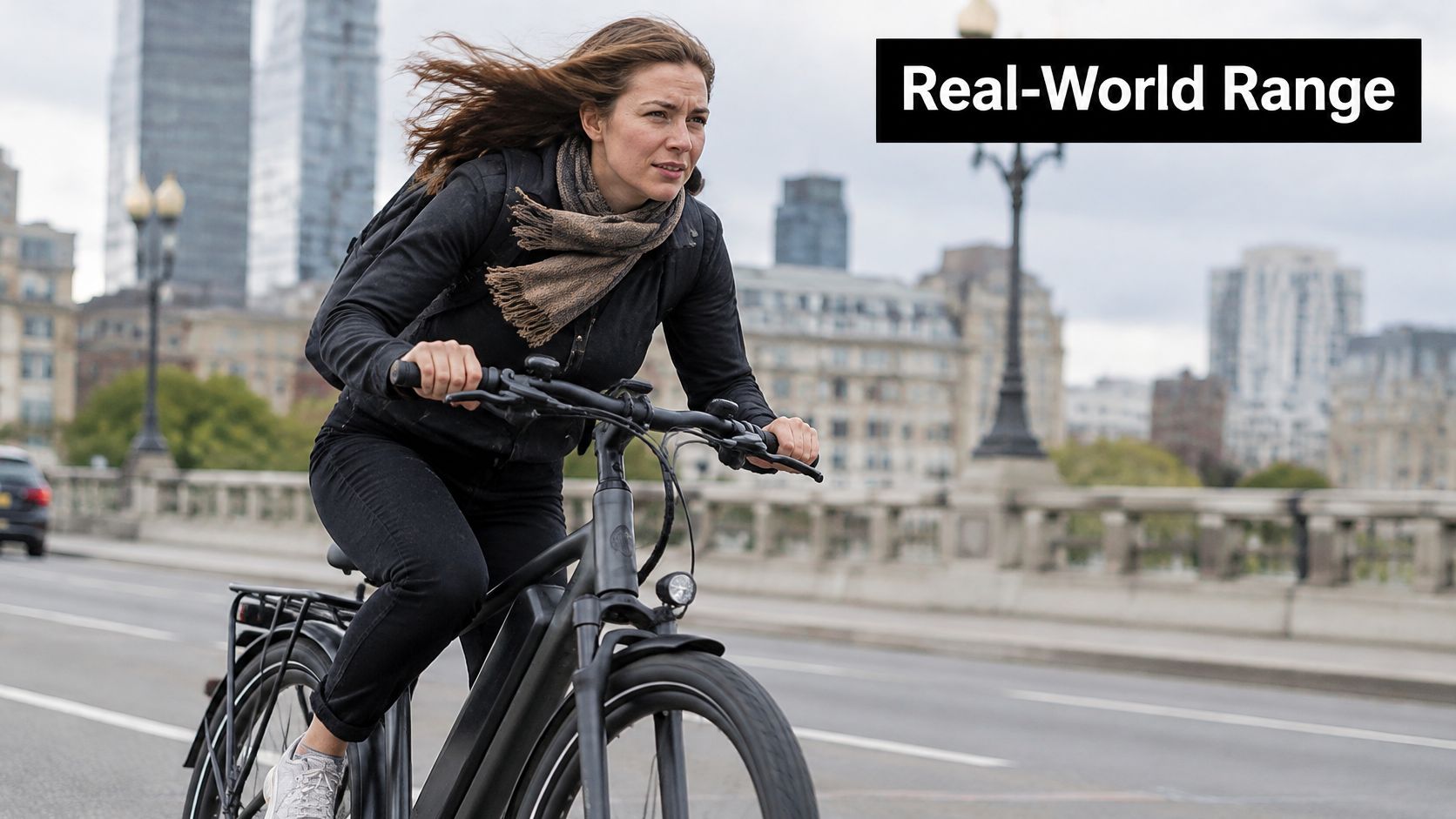
A lab-style figure assumes steady pedalling, mild assist, and no one waiting at a junction. A Tuesday commute is the opposite. The photo is the easy version of that commute: flat, open, and nowhere near a loaded climb.
What moves the number, and which way
- Higher speed: Air drag rises sharply, so the last few mph cost more than the first.
- Turbo or high assist: Those modes burn watt-hours much faster than an eco setting.
- Heavier riders and cargo: Every start and every hill has to lift the extra mass.
- Stop-and-go traffic: You pay to accelerate, then throw that speed away at the next light.
- Headwind: It behaves like a hill that never crests.
- Cold weather: Usable capacity drops just when lights, gloves, and a slower warm-up are already in play.
- Soft tyres: Under-inflation adds rolling resistance on every metre.
- Ageing cells: The pack you bought at 1,000 Wh is not a 1,000 Wh pack in year four.
Climbing is the drain people underestimate. In 2025, BikeRadar reported a test ride of 62.25 miles with 3,795.8 feet of ascent that still left 45% of the battery. Long hilly days are possible. They are not free, and that leftover 45% would vanish if the same climbing sat on a smaller pack or a higher assist mode.
A mid-drive can put the motor through the gears, which helps on those climbs if you shift early. Hub motors skip the gears and stay simpler on flat city routes. Neither layout creates watt-hours. Our notes on an e-bike mid motor cover when that layout earns its weight.
Match your own route before you trust a number. Flat and steady can live near the left of the distance table. Hilly, stop-start, or windy belongs on the right. Plan around the lower end of the range you expect, and keep a slice of charge you do not intend to spend.
UK and EU Rules for High-Range Ebikes
A long claimed range does not change the legal class. In Great Britain the bike is an ordinary bicycle only if it is an Electrically Assisted Pedal Cycle (EAPC). The GOV.UK electric bike rules require pedals that can propel the bike, a motor of no more than 250 watts continuous rated power, and assistance that cuts out at 15.5 mph. Riders must be at least 14. A compliant EAPC needs no registration, vehicle tax, insurance, or driving licence.
Legal classes for high-range e-bikes in the UK
| Bike category | Motor and speed limits | Paperwork |
|---|---|---|
| Pedal-assist EAPC | Motor up to 250 W continuous; assist cuts out at 15.5 mph | None: no registration, tax, insurance or licence |
| Walk-assist function on an EAPC | Assist cuts out at 3.7 mph (6 km/h) | No extra paperwork if the bike otherwise meets EAPC criteria |
| Twist-and-go sold before 1 January 2016 | Propels without pedalling | Check status before riding |
| Twist-and-go without pre-2016 sale or type approval | Propels without pedalling | Not generally legal on UK roads |
| Above EAPC power or speed limits | Exceeds 250 W or 15.5 mph assistance | Registration, insurance, tax, driving licence and approved helmet |
Transport for London states that legal road e-bikes must stop assistance at 15.5 mph, and any walk-assist must cut out at 3.7 mph (6 km/h). A twist-and-go that moves without pedalling is not generally legal on UK roads unless it was sold before 1 January 2016 or has the required type approval while still meeting EAPC criteria. Step over the power or speed line and the bike can be treated as a motor vehicle, with registration, insurance, tax, a driving licence, and an approved motorcycle helmet.
Across the EU, the pattern on most pedal-assist spec sheets is the same 250 W cap with assistance cut at 25 km/h, which is the GB 15.5 mph line in metric. National rules still differ, so check the country you will ride in before you import a US-spec machine. Street-legal status is a controller question first. Our guide on whether electric bikes are street legal is the checklist to run before range even comes up.
Australia is not one rule
In New South Wales, Transport for NSW allows a maximum continuous rated power of 500 watts, throttle assistance only to 6 km/h, and pedal assistance only to 25 km/h. Victoria's EPAC rules cap the motor at 250 watts, allow assistance only while you pedal, and cut it at 25 km/h, with throttle only to 6 km/h in walk mode. Under either state's rules, a 100-mile claim is secondary to the controller's cut-off and the motor rating. Confirm those two lines on the spec sheet before you look at watt-hours.
Battery Safety and Lifecycle Checks
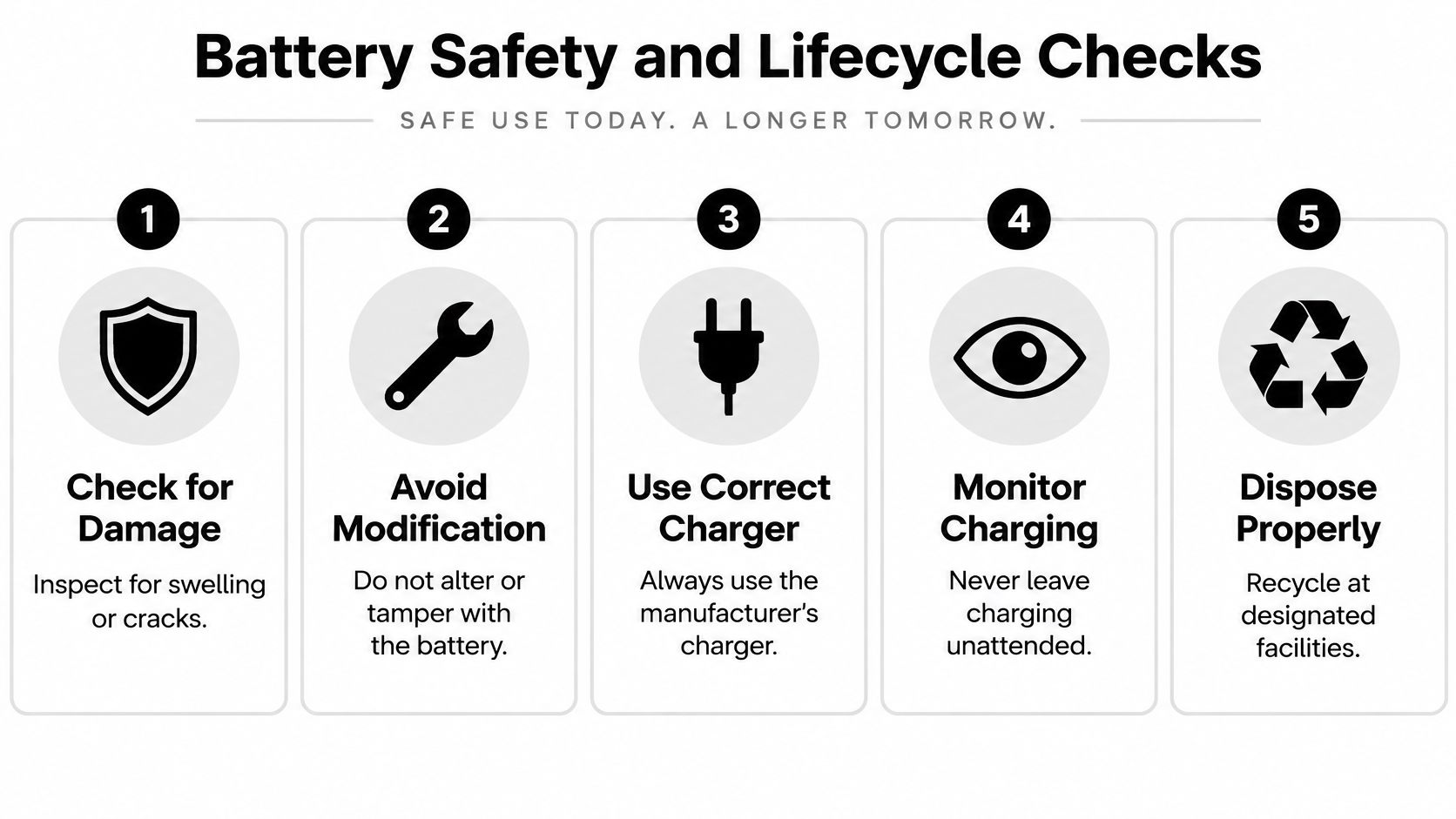
A pack sized for 100 miles stores more energy, weighs more, and costs more to replace. Damage or a home-made conversion has more to go wrong, though capacity by itself does not make a battery unsafe. UK government battery-safety research found that many battery-management systems did not stop cells from exceeding the manufacturer's current and temperature limits, and that standards differ between e-bikes and e-scooters. US consumer-safety guidance points the same way: use the supplied or approved charger and replacement battery, charge while you are present rather than asleep, and do not fit modified or reworked packs.
The buying and owning checklist
- Certification for the whole system. Confirm it covers the battery and the bike's electrical system, not a loose cell listing.
- The right charger only. A higher-amp charger from another brand can push current the BMS was not built to allow.
- Charge while you are awake and nearby. Unattended overnight charging is the habit the safety guidance tells you to drop.
- Look for swelling, heat, odd smell, or impact marks. Stop using the pack if any of those show up.
- Skip aftermarket and reworked packs. A "range upgrade" that bypasses the original BMS is how fires start.
- Store and charge on the maker's schedule. Sitting full in a hot shed ages cells faster than commuting does.
- Price a replacement before you buy the bike. If the pack is a one-off, the 100-mile claim dies with the first worn set of cells.
A 100-mile claim is not a durability guarantee. Ask how capacity holds after several years, and whether the pack can be serviced or swapped.
Thermal management and a pack you can still buy in year five matter as much as the day-one watt-hours. How electric bike battery life fades is the question to settle before you pay for a huge pack you cannot replace.
Matching Range to Your Commute and Routes
A flat city rider doing short loops, and charging at home or at work, rarely needs a century pack. Think 4 to 8 miles one way at about 7 Wh/km. A 432 to 500 Wh battery covers that with room, and you are not hauling a brick up the stairs.
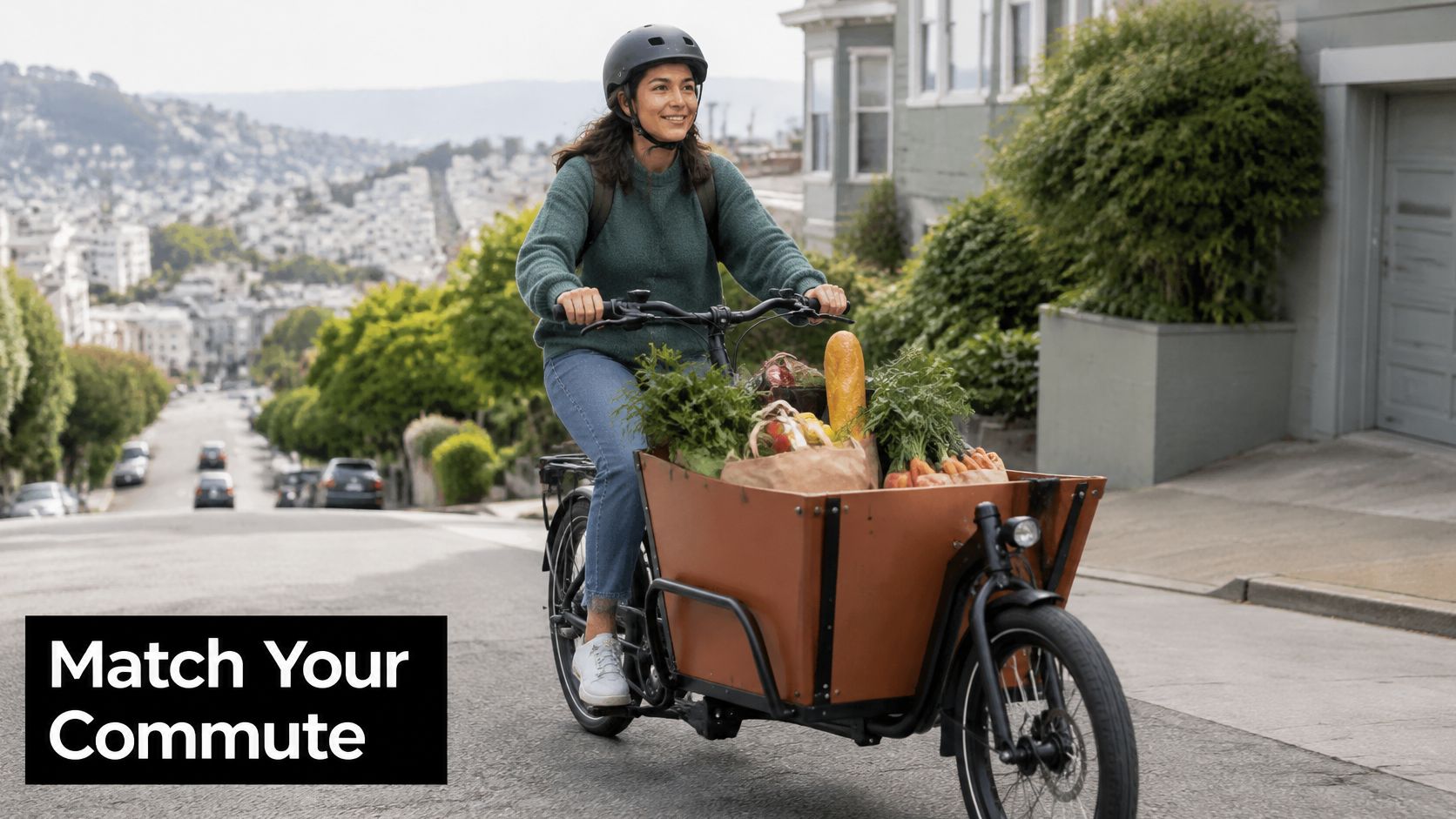
A hilly cargo rider with shopping or children is a different budget. 10 to 15 miles one way at 11.2 to 15 Wh/km points at 500 to 750 Wh. The photo is that job: mass on the rack, a stop every few blocks, and a hill that does not care about the eco mode.
A low-assist tourer on long countryside days, 40 to 60 miles, at 7 to 11.2 Wh/km, is the person who uses 750 to 1,000 Wh. A multi-stop worker covering 15 to 25 miles between sites sits in that same consumption band, but a 400 to 500 Wh pack plus a charged spare is often lighter than one huge battery you cannot lift onto a train.
Battery class by rider profile
| Rider profile | One-way or daily distance | Consumption (Wh/km) | Battery class |
|---|---|---|---|
| Flat city commuter, short round trips, charges at home or work | 4 to 8 miles one way | 7 | 432 to 500 Wh |
| Hilly cargo rider carrying shopping or children | 10 to 15 miles one way | 11.2 to 15 | 500 to 750 Wh |
| Low-assist tourer on long countryside days | 40 to 60 miles per day | 7 to 11.2 | 750 to 1,000 Wh |
| Multi-stop worker riding between sites all day | 15 to 25 miles per day | 7 to 11.2 | 400 to 500 Wh with a second pack |
These distances and classes are planning estimates, not test results.
Count only about half to two-thirds of the claimed range as usable one-way, and keep a reserve of around 20 to 30 percent for hills, wind, and a pack that is no longer new. For a lot of urban riders, a smaller pack you can charge at work beats a huge pack that is miserable to carry. A removable battery and a socket at the office often buy more freedom than another 20 miles of headline range.
Write down your longest normal day and your worst hill before you pick a class. If that day is 18 miles with one steep climb and a charger at the desk, you do not need a 100-mile bike.
Confirm the Range Claim Before You Buy
Work through five checks, in this order, and skip any listing that fails one of them.
- Turn watt-hours into distance. Find the battery's watt-hour rating and divide by the consumption you expect. That usable figure, not the sticker, is what you compare.
- Match motor rating and cut-off to where you ride. That is 250 W and 15.5 mph in Great Britain, 250 W and 25 km/h on the usual EU pedal-assist listing, or the NSW and Victoria limits if you are in Australia.
- Read the test conditions. Rider weight, assist level, and whether the test assumes continuous pedalling all change the result. AutoWeek listed the Gazelle Eclipse C380 Plus at an as-tested $5,999 with up to 100 miles in Eco mode. U.S. News listed the Lectric XP Lite 2.0 long-range battery at $200 above the standard model, with 80 miles under most conditions. Ask which mode and which load produced the figure you are being sold.
- Run the charger and certification checks. Approved charger, no reworked pack, no damage.
- Compare the usable result with your longest route plus a 20 to 30 percent reserve. If the listing is vague, message the seller for watt-hours and motor power before you compare models.
We list 871 products, including over 100 e-bikes and over 100 e-scooters, from adult and city bikes through folding, fat tyre, off-road, and cargo bikes. Run those five checks against the listing before you commit.
Punk Ride LLC stocks pedal-assist e-bikes and e-scooters for city commutes and longer days, with warehouses in the UK and Germany and headquarters in Florida, so you can match watt-hours and motor cut-off to the rules where you ride. If a 100-mile claim only works in Eco on a flat path, we would rather you see that before you pay. Visit Punk Ride LLC and check the battery size against your longest real route.