Buying the lightest folding electric scooter you can find isn't always good advice. A scooter can win on the scales and still be awkward on stairs, uncomfortable on broken pavement, or unsuitable for the roads you intend to use.
Buy for your hardest part of the journey, not the smallest number on the product page. For UK and EU buyers, that means checking legal use and transport-operator policies before getting attached to a compact folder. Then weigh up carrying balance, braking, battery safety and realistic range alongside the headline weight.
Lightest Folding Scooters by Measured Weight
Lightest folding models by measured weight
| Model | Weight (lb and kg) | Folding mechanism |
|---|---|---|
| Razor E Prime III | 24.0 lb (10.9 kg) | Single anti-rattle knob |
| Unagi Model One | 26.5 lb (12 kg) | One-click fold |
The lightest folding scooter is not automatically the right one for a daily commute. A 24 lb machine with a weak brake or a latch that fights you on a crowded platform is a worse buy than a 27 lb scooter you can carry comfortably and stop safely. Weight is the starting number, not the finish line.
In its 2026 comparison, Rider Guide recorded the Razor E Prime III at 24.0 lb, the lightest scooter in that test group, with a single anti-rattle knob; the same comparison listed portable models at 24.7 lb, 26.0 lb and 27.5 lb. That spread is narrow on paper. It feels wider on a staircase when you are also carrying a charger and a lock.
The NIU figure has separate support: Freshly Charged's 2024 KQi Air review recorded 26.2 pounds and described it as the second-lightest 20-mph scooter in its comparison tool. That is a category result, not a claim that it is the second-lightest scooter available anywhere.
Read the weight before the ranking
Small differences matter most when you carry repeatedly. They matter less when an awkward stem, protruding handlebar or badly positioned lifting point makes the lighter scooter harder to control. A published weight also needs a definition. A bare frame figure is not comparable with a complete scooter ready to ride, and neither tells you what your total luggage will weigh once you add a charger, lock and commuting bag.
- Check the exact version. Do not assume a newer battery option or similarly named model shares the reviewed weight.
- Identify the measurement. Look for a tested complete-scooter weight rather than shipping weight or an unexplained net figure.
- Inspect the fold separately. A light scooter with a fiddly latch can be a poor choice for rushed platform changes.
Buying rule: Compare pounds and kilograms, then establish whether the quoted weight includes the battery and fitted accessories.
The Razor is the lightest in the cited comparison. That makes it worth investigating for frequent carrying, not an automatic recommendation for every rider. The table gives you documented weights and a fold type. It does not tell you whether the brakes, certification or legal use fit your route, and those checks decide whether a lightweight folder is a good buy or an expensive mistake.
Where the Weight Savings Come From and What They Cost
Weight savings in a folding scooter are rarely free. The Unagi Model One shows the pattern clearly. TechGearLab's electric-scooter guide identifies it as the lightest scooter in its reviewed set at 12 kg, approximately 26.5 lb, and points to a magnesium-alloy handlebar, carbon-fibre tubing and one-click fold. Those are real weight-saving choices. They are also choices you pay for elsewhere in the spec sheet.
Any folding scooter still has to carry a motor, battery, controller, wiring and the folding hardware itself. No single component makes the whole machine light. The savings come from many small decisions, and each one has a consequence.
Frame, battery and motor
Frame construction is one route. Magnesium alloy and carbon fibre can replace heavier parts, but the material name does not prove strength, repairability or ride quality. What matters is how the joints are built, how stiff the deck feels underfoot, and whether the fold mechanism stays tight after repeated use. A light frame with a loose hinge is worse than a slightly heavier one that locks solid.
Battery size is the next major lever. Fewer cells mean less weight, and also less reserve for headwinds, hills and detours. If your commute is longer than the realistic range, a lighter battery has not solved your problem. It has moved the risk to your return trip. A heavier scooter that completes the round trip without a charge may be the more practical buy.
Motor and associated hardware add mass too. Do not judge the design by the motor label. Wheel construction, brake hardware, wiring and mounting parts all belong in the finished package. A modest motor in a light scooter can still feel lively, but the brake and tyre package around it determines whether the ride is secure.
What the lighter build can cost
The compromises tend to show up in a practical order. Range comes first, because battery capacity is the easiest thing to cut. Ride comfort comes next, since weight-conscious designs leave less room for suspension and wide tyres. Rider capacity follows: a scooter with a low maximum load can rule out a rider before its carrying advantage matters.
Say you are close to a scooter's maximum load and your route crosses patched tarmac. If the deck or stem flexes during a permitted test ride, do not ignore it because the materials sound premium. Check the folding joint for play, and ask the retailer to separate normal compliance from a fault.
For that decision, our guide to choosing a foldable electric scooter for heavy adults is a more useful starting point than a weight ranking.
Lightness is a priority, not a quality rating. Before accepting a range comparison, establish the complete carry weight, the folded dimensions and an independently tested range under a rider load and weather conditions that resemble yours. A 12 kg scooter that folds awkwardly and needs charging at work is not automatically the better commuter than a heavier one that fits the trip.
Carry Weight, Folded Size and the Stair Test
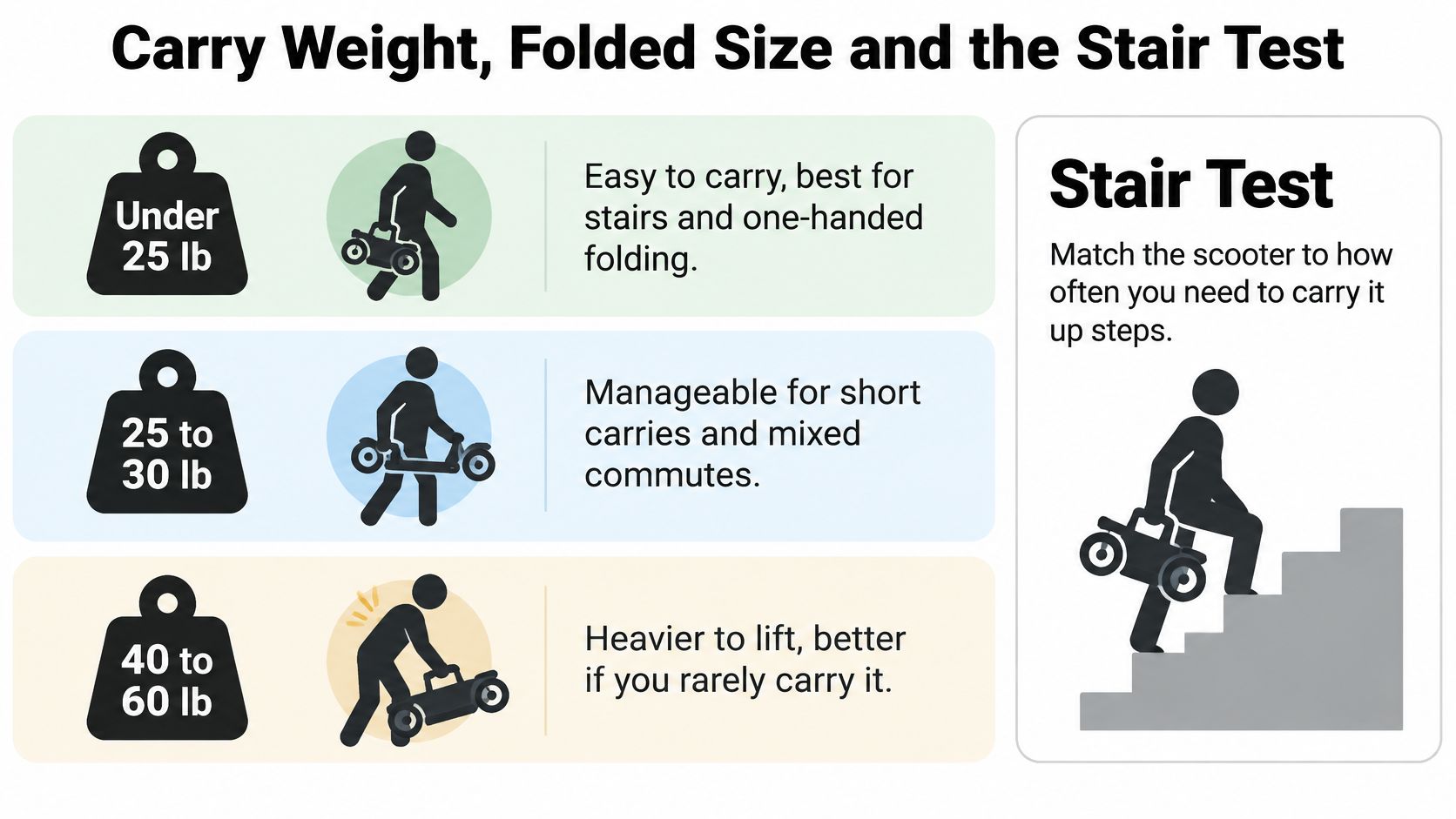
Weight bands and what they mean for carrying
| Weight band | Typical examples | Carry experience | Best for |
|---|---|---|---|
| Under 25 lb (approximately under 11 kg) | Razor E Prime III class | Potentially manageable up stairs and onto permitted transport | Multimodal commuters |
| 25 to 30 lb (approximately 11 to 14 kg) | NIU KQi Air, Unagi Model One, Mosquito | Short carries may be comfortable; long staircases need testing | Commuters with occasional stairs |
| 40 to 60 lb (approximately 18 to 27 kg) | Heavier commuter and off-road models | Difficult for many riders to carry repeatedly | Riders who park and rarely lift the scooter |
These are shopping bands, not promises about what your body can comfortably lift. A scooter that's manageable in a showroom may feel very different when you're carrying a work bag and wearing a coat.
Use the stair test to assess the whole folded package.
Test the lift, fold and roll
Start with the lifting point. Fold the scooter and lift it beside your leg. Notice whether the deck hangs level, the handlebar catches your clothing, or the rear wheel swings towards your ankle.
For a practical shop test, try a 20-step one-handed carry, provided you can do so comfortably and the retailer permits it. Stop if your grip slips or you have to lean sideways to compensate.
Then test the staircase. With permission and a clear route, carry it two-handed up a flight while keeping your view of the steps unobstructed. Don't conduct a balance experiment on a busy public staircase.
Finally, operate the latch and try rolling it. You should be able to release and secure the folding mechanism without pinching your fingers or forcing parts out of alignment. If the folded scooter rolls on its own wheels, check whether you can steer it without dragging the deck.
Ergonomics work published by Springer identifies handlebar height, footrest width and control accessibility as contributors to comfort and safety. Those fit issues deserve particular attention if you're shorter, have limited grip strength or struggle to reach controls comfortably.
A balanced scooter you can hold close to your body can be a better carrying tool than a lighter one that keeps twisting outwards.
Check your transport operator's scooter policy before planning a mixed commute. A compact fold doesn't guarantee admission, and an overhead luggage rack isn't automatically a suitable place for a heavy battery-powered device.
For the wider habit of making practical transport choices rather than buying equipment you won't use, the everyday sustainability tips from HYDAWAY provide useful context. The sensible purchase is the one that fits your routine.
Braking, Stability and Safety Checks Before You Ride
Lighter doesn't automatically mean safer or easier to stop. Your stopping confidence depends on the brake system, grip, riding position and the surface beneath you, not just how little the scooter weighs.
Field research indexed by Chalmers found that the tested e-scooters generally had poorer braking performance than bicycles, and that the larger scooter stopped in shorter distances than the light scooter, without a significant difference in steering performance; the accompanying safety findings also describe 250–350 W scooters producing roughly 2.5 m/s² acceleration, compared with nearly 2 m/s² for 500 W models in the cited tests.
That isn't a reason to buy the biggest scooter available. It's a reason to stop treating either low mass or motor wattage as a shortcut for real-world performance.
Screen the brake arrangement
A front-only mechanical brake can increase forward-pitch risk during a sudden stop. Independent front and rear braking gives you a stronger basis for controlled stopping, although you still need to learn how the particular scooter responds.
Run through these checks before accepting a lightweight model:
- Independent controls. Establish which control operates each brake and what remains available if an electronic function fails.
- Rear mechanical braking. Identify the actual mechanism rather than accepting a vague combined-braking description.
- Tyre diameter and condition. Inspect tread, damage and pressure where applicable, and consider how the wheels will handle your route.
- Reach and response. You should be able to operate the levers without loosening your grip on the handlebar.
A sticky lever, excessive travel or damaged cable needs attention before riding. The guide to replacing brake levers can help you understand the components involved, but compatibility and correct adjustment matter more than fitting a part that merely looks similar.
Practise without adding risk
Use a clear, level, dry private area where riding is permitted. Begin slowly, apply the brakes progressively and establish how the scooter behaves before attempting a firmer stop.
Wear a helmet and keep pedestrians out of the test area. Don't move straight from a dry test to deliberate emergency braking on wet pavement; first build familiarity and reduce speed substantially when conditions deteriorate.
Heavier riders, downhill journeys and wet surfaces warrant more caution. If a scooter feels nervous or difficult to stop during a controlled test, don't expect busy mixed traffic to make it more manageable.
Where You Can Legally Ride a Folding Scooter in the UK
A lightweight folding scooter isn't automatically road-legal. According to the UK government's electric-scooter rules, privately owned e-scooters can't be ridden in public places in Great Britain, including roads, pavements, parks and cycle tracks; approved rental-trial scooters may use public roads and cycle lanes within the relevant scheme, but not pavements or motorways.
That distinction changes the buying decision. Owning a scooter that resembles an approved rental model doesn't give you the rental scheme's permission to ride.
Private ownership and trial rentals
Private-land use requires the landowner's permission. Don't assume a publicly accessible car park or a quiet route is available because there's little traffic.
The House of Commons Library briefing explains that England's rental trials began in 2020 and have been extended until May 2028, while e-scooters remain treated as motor vehicles; it also discusses a proposed Low-speed Zero Emission Vehicle category and the need for further consultation and primary legislation before privately owned scooters can be legalised.
For privately owned scooters under the current framework, footpaths, bridleways, restricted byways and cycle-only routes aren't a workaround. The approved rental-trial exception shouldn't be read as general permission for personal machines.
- Buying for private land. Confirm permission and that the space suits the scooter's intended use.
- Planning a rental journey. Check the approved operator's area, eligibility requirements and parking rules.
- Buying for a future law change. Don't assume today's product will satisfy requirements that haven't been finalised.
Legal reality: Portability helps only after you've established somewhere lawful to ride.
EU readers should check their own national road-traffic rules and any relevant local restrictions. Don't apply the British ownership framework to another country, or assume a scooter sold across Europe is lawful everywhere.
Before buying for a UK commute, resolve the route question first. A beautifully compact fold won't make an otherwise prohibited public-road journey permissible.
Speed Limits Outside the UK
A scooter's advertised top speed can affect its legal classification, not just how quickly you intend to ride it. Australian and US buyers need to separate equipment requirements from operating limits.
Australia and technical compliance
The Victorian Government's e-scooter rules set a compliant scooter's maximum capability at 25 km/h on level ground and permit use on roads with speed limits up to 60 km/h, subject to the applicable restrictions.
The capability threshold isn't a recommended cruising speed. A model configured to exceed it may fall outside the permitted category even if you promise to ride slowly.
US state differences
The National Conference of State Legislatures review reports 17 states with a 20 mph manufacturing-speed limit, including seven with a lower 15 mph operating limit; 12 states, including Florida, New York, Oregon, Tennessee, Utah and Washington, specify a 15 mph operator limit, while Illinois sets 10 mph and Oklahoma 25 mph for e-scooters.
The same review identifies road-access restrictions in Arizona, California, Oklahoma and Oregon involving roads posted at 25 mph or higher. Check current state and municipal guidance before choosing a route, because a broad comparison isn't a substitute for the rule that applies locally.
Buy the compliant configuration, not an assurance that you can restrict yourself. Also check where riding is permitted, rather than assuming any road below the scooter's advertised top speed is suitable.
Which Lightweight Folder Fits Your Commute
The right folder depends on where you lift it, where you store it and what the riding surface demands. Start with the routine that most closely resembles yours, then reject models that fail its deciding requirement.
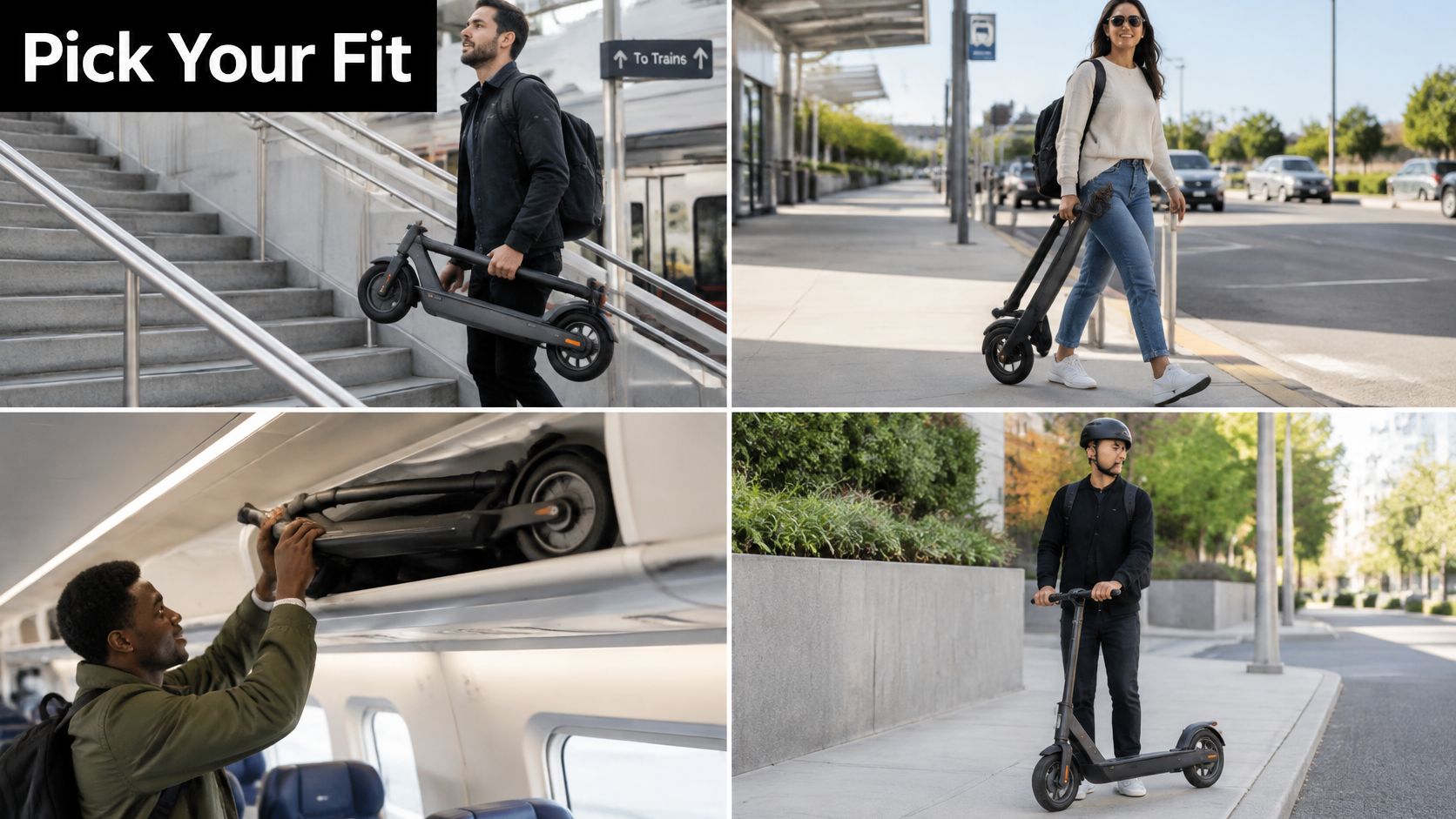
These everyday carrying and storage situations are more useful than a showroom pose.
Train connections and repeated stairs
Start in the lightest carrying band, with the Razor class as a candidate rather than a default winner. The deciding specification is folded usability: can you lift it without twisting, operate the latch while managing your bag, and store it where the operator permits?
Measure the intended storage space instead of assuming it will fit an overhead rack. Some operators prohibit e-scooters entirely, so check admission before shopping for dimensions.
If the scooter passes the scale test but fails your stair test, it's the wrong buy.
Door-to-door riding on a flat route
A moderately lightweight folder, including the NIU, Unagi and Mosquito comparison band, is a sensible starting point when carrying is occasional. Here, usable journey range should decide the purchase.
Don't assume a slightly heavier scooter automatically has a bigger battery or more comfortable tyres. Compare those features explicitly, and favour the machine that completes your routine without making storage awkward.
Our guide to an electric scooter for daily commuting helps frame that decision around the whole journey rather than the carrying stage alone.
Use the video alongside a hands-on inspection, not as a substitute for testing fit.
Heavier riders and demanding surfaces
Start with rider-rated commuter models, accepting a heavier frame if necessary. Your deciding requirement is adequate load capacity with controllable braking, not a place near the top of a lightweight ranking.
Include your bag and anything else the scooter carries when checking the permitted load. For damp or descending routes, assess tyre suitability and braking behaviour before worrying about saving a little carrying weight.
The lightest option is the wrong purchase when it leaves you uncertain about fit, support or stopping.
Mixed routes and longer days
Look for a range-focused commuter folder if errands and detours regularly extend the journey. The deciding specification is independently tested range under conditions resembling your own.
A larger battery can be worth carrying if it removes dependence on destination charging. Conversely, carrying extra battery mass every day for a journey you rarely make isn't automatically sensible.
Choose the lightest model you can carry comfortably up your own stairs that also meets your route's range, fit and braking needs. Don't select on weight first and hope the rest works out.
Check Weight, Certification and Brakes Before You Buy
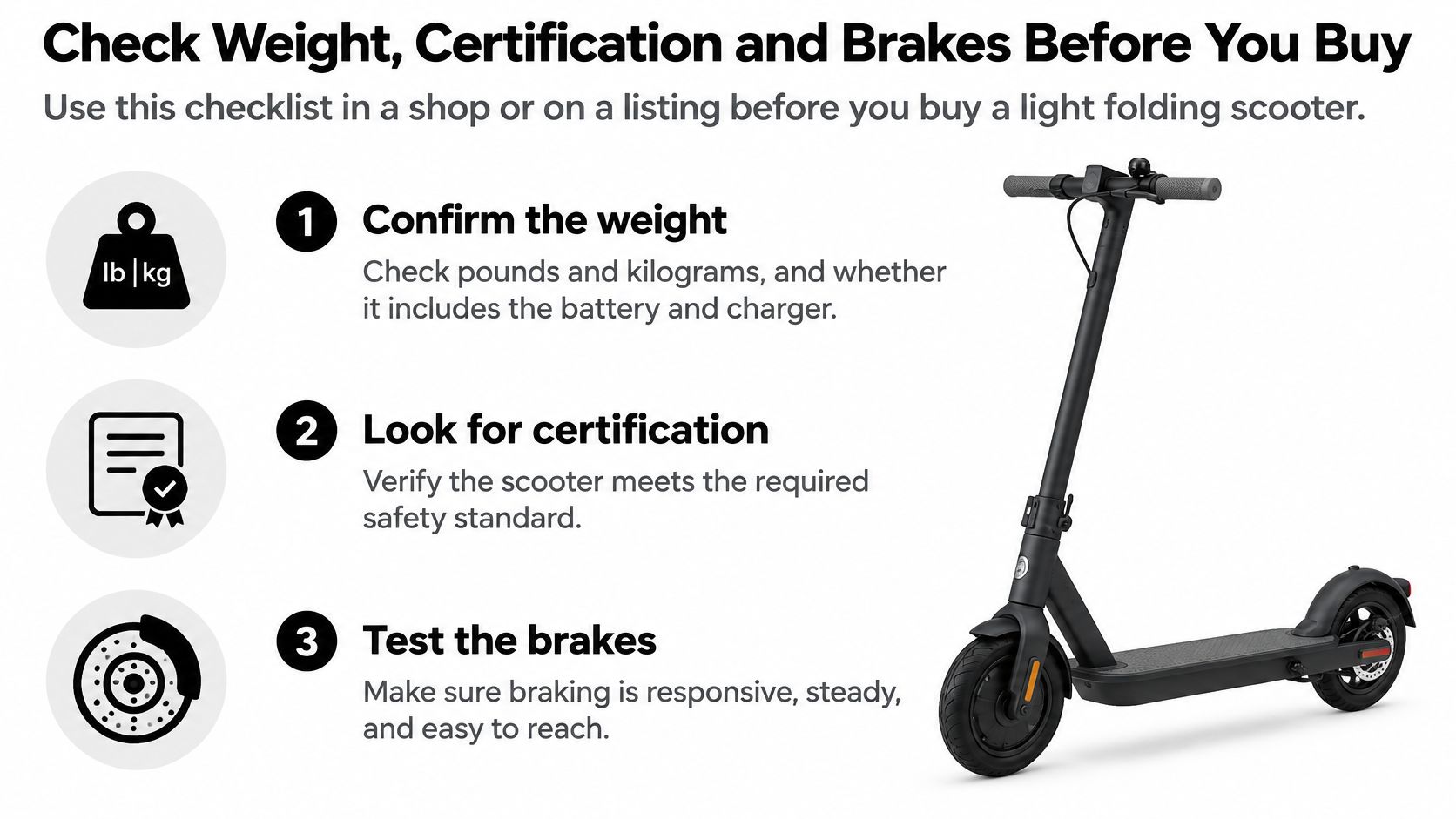
Use the same inspection process in a shop and on an online listing. Missing information should prompt a specific question, not an optimistic assumption.
Keep these checks beside the product specifications.
Work through the purchase checks
- Confirm complete weight. Record pounds and kilograms, establish whether the battery is included, and account separately for anything you'll carry.
- Verify certification. Match safety documentation to the exact model and electrical system rather than trusting a logo in a product image.
- Inspect the brakes. Identify the independent systems, check mechanical operation and make sure the controls suit your hands.
- Perform a complete fold. Check the latch, carrying balance and actual storage fit, including protruding grips and wheels.
- Check rider compatibility. Compare the maximum load and height guidance with your body and usual luggage.
- Confirm lawful use. Match the product and ownership type to your intended route, then check transport admission separately.
Certification deserves more effort than a glance at a badge. A 2025 UC Davis electric-micromobility inventory found that only 64% of catalogued devices displayed verifiable UL/EN safety certification. That finding covers the catalogued devices, not every scooter on sale, but it gives buyers a concrete reason to verify rather than assume.
Keep different scooter categories separate
Our quick-fold scooter listing describes a lightweight aluminium frame, an approximate weight of 2.5 kg, a 50 kg maximum load and a 135 cm maximum rider height. Those limits make it unsuitable as a shortcut to an adult electric-commuter recommendation; check the listing's propulsion type and intended rider rather than comparing its weight directly with the adult electric models above.
We have warehouses in the UK and Germany, which is relevant to UK and EU shoppers, but warehouse location doesn't establish product suitability or road legality. Before ordering, save the exact model specifications and supporting safety documents so you know what you're buying.
Punk Ride LLC offers folding and commuter electric scooters alongside electric bikes, with options for different storage and riding needs. Visit Punk Ride LLC to compare the stated weight, rider limits and folding specifications, then shortlist only the models that fit your carrying test and lawful route.