You're staring at seven tabs, every listing shouting a bigger wattage and a longer range, and none of them answering the only question that matters on Monday morning. Will this thing get you to work, up that hill by the station, and home again without you pushing it? That's exactly where most pedal assist bike reviews let you down. They rank by headline power. I judge them in a different order. First, is it legal where you ride. Second, what's its measured range under stated conditions. Third, can you safely charge, replace and recycle the battery for years. Get those three right and the rest is preference.
Pedal Assist Bike Picks at a Glance
Start here, then work backwards from your route. Don't start from price.
| Pick | Model | Sale price (GBP) | Best for |
|---|---|---|---|
| Budget city commute | DUOTTS C29 with Single Battery | 699.00 | Flat, short urban trips |
| Road-legal commuter | DUOTTS C29 Max 250W | 909.00 | Daily commuting within the 250W limit (verify rating) |
| Step-through comfort | ENGWE L20 Boost Step-Thru | 1,099.00 | Upright riding and easy mounting |
| Dual-battery distance | DUOTTS C29-K 750W Dual-Battery | 1,040.38 | Long rides on private land |
| Fat-tyre rough ground | NAKTO F2 Plus 750W Fat-Tire | 827.47 | Off-road and private land |
| Folding for transit | ENGWE Engine X Foldable | 1,049.00 | Train journeys and small storage spaces |
| Balance-first trike | HIDOES ET1 Electric Bike Tricycle | 1,889.00 | Riders who want stability at low speed |
How to Read This Table
Pick your job first, then your distance, then your storage. A flat four-mile hop across town doesn't need a second battery. A hilly return trip with a laptop, a lock and no charging at work does, or it needs honest range with room to spare.
We sell DUOTTS electric bikes, including the F26, N26 and C29 families, so you'll see that name crop up a lot in the C29 variants above. Treat the family resemblance as a clue, not a verdict. The single battery, the 250W Max and the dual-battery K do very different jobs despite looking related.
Start from your longest regular day, not your average day. If a bike only just covers the average, it'll strand you on the bad one.
Watch the power split. The 750W models sit above the 250W continuous limit used for UK and EU electrically assisted pedal cycles, so they're tools for private land and off-road riding unless you confirm a different local rule applies to you. That's not a mark against them. It's a routing decision. The NAKTO F2 Plus 750W Fat-Tire Electric Bike has a sale price of £827.47, which looks sharp next to road models, but the value only counts if you've got somewhere legal to use that power.
Use this table as a shortlist, nothing more. The checks that follow, legal status, battery in watt-hours, measured range and cost over a few years, are what turn a pick into a purchase you'd repeat.
UK and EU Legal Limits Before You Ride
Legal status comes first because it decides where the bike can go. Get this wrong and the best motor in the world is stuck in a field.
| Category | Motor limit | Assist cut-off | Throttle | Notes |
|---|---|---|---|---|
| UK EAPC | 250W max continuous | 15.5 mph (25 km/h) | Walk assist only, to 3.7 mph (6 km/h) | Riders 14+, no registration, insurance or tax |
| UK Twist and Go | Not an EAPC rating | Above 15.5 mph | Yes | Generally not road-legal unless sold before 1 Jan 2016 or type-approved |
| EU pedelec | 250W nominal continuous | 25 km/h | Not standard | Age and helmet rules vary by country |
| EU speed pedelec | Higher-power type-approved class | 45 km/h | Pedal assist class | Usually type approval, registration and insurance |
The UK Rule in Plain Terms
In Great Britain, the GOV.UK electric bike rules treat a bike as an electrically assisted pedal cycle (EAPC) only when it has usable pedals, a motor of no more than 250 watts of maximum continuous rated power, and assistance that cuts out at 15.5 mph (25 km/h), with riders at least 14 years old. A compliant EAPC needs no registration, vehicle insurance or vehicle tax under those rules. Fall outside them and the bike can be treated as a motor vehicle instead.
Walk assist is the exception people misread. It can nudge the bike along at walking pace while you push it, which helps on ramps and platforms. It isn't a way to ride without pedalling. If you're weighing the wider picture, our guide on whether electric bikes are street legal walks through the same check before you commit.
The Throttle Trap
This is the mistake I see buyers walk into most often. The Transport for London e-bike safety advice explains that a throttle-controlled Twist and Go bike capable of moving faster without pedalling is generally not road-legal unless it was sold before 1 January 2016 or has the required type approval while meeting EAPC criteria. So don't just read the wattage. Ask whether it propels itself without pedal input.
Across the EU, the standard pedelec pattern mirrors the UK cut-off, while speed pedelecs sit in a separate, faster class with more paperwork. Helmet and age rules still change by country, so check where you'll ride, not where the seller ships from.
Before you buy, do two things. Read the rated continuous power on the spec sheet, not the headline. Then ask the seller in writing for a statement of EAPC compliance. If you can't get that sentence in writing, treat the bike as private-land only.
Motor and Battery Specs Compared Side by Side
Spec sheets are written to win a glance. You need them to win a winter commute instead.
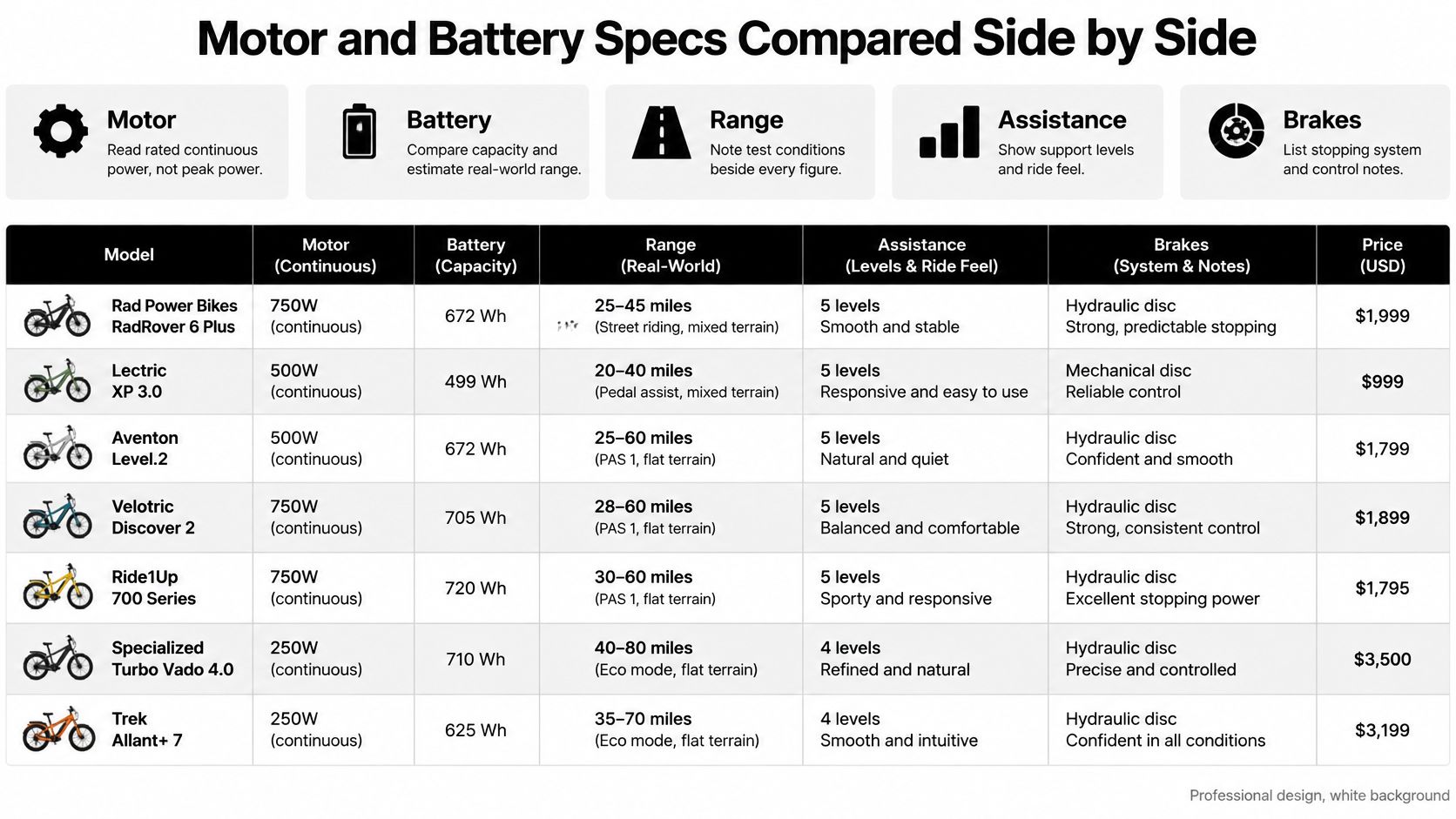
| Model | Motor rating | Battery |
|---|---|---|
| DUOTTS C29 with Single Battery | Rated continuous power on product page | Single |
| DUOTTS C29 Max 250W | 250W | Battery details on product page |
| DUOTTS C29-K 750W Dual-Battery | 750W | Dual battery |
| NAKTO F2 Plus 750W Fat-Tire | 750W | Battery details on product page |
| ENGWE Engine X Foldable | Rated continuous power on product page | Battery details on product page |
| ENGWE L20 Boost Step-Thru | Rated continuous power on product page | Battery details on product page |
| HIDOES ET1 Electric Bike Tricycle | Rated continuous power on product page | Configuration on product page |
Motor Means Continuous, Not Peak
Read the rated continuous power, because that's the figure the legal limit applies to. Peak power is a short burst number. It tells you almost nothing about how the bike behaves at minute twenty on a climb, or whether it belongs on a public road.
Motor position changes feel, too. A hub motor pushes or pulls from a wheel, while a mid motor drives through the cranks and can use your gears. If you want that trade-off unpacked, our guide to e-bike mid motors explains where each layout earns its keep. Don't pay for a layout just because it sounds premium. Pay for predictable pull on your terrain.
Battery Means Watt-Hours
Convert before you compare. Voltage times amp-hours gives watt-hours, so for example a 36V 10Ah pack works out to about 360Wh. Amp-hours on their own mislead, because the same Ah figure stores different energy at different voltages.
Note the count as well as the size. A single battery keeps weight and charging simple. A dual-battery build like the C29-K spreads range across two packs, which helps on distance but adds weight, cost and another pack to store, inspect and eventually replace. More energy isn't free. You carry it every mile.
Brakes, Tyres and Weight
Hydraulic disc brakes generally give stronger stopping power and better lever feel than mechanical discs, and they adjust for pad wear automatically. The catch is servicing. Bleeding them takes more work than swapping a cable, so budget for that or learn the job. A brake label on its own still isn't a result. You want a measured stopping distance, covered in the testing below, because a heavy bike at assisted speed asks a lot of its brakes.
Fat tyres are the same story. They add grip and comfort on rough ground, and they add weight and rolling resistance everywhere else. Check the listed bike weight and maximum payload before you fall for the chunky look, especially if stairs are part of your day.
Use the listing pages properly. Each NAKTO product page lets buyers compare frame style, tyre size, motor and battery specification, brakes and overall bike weight. Each Hidoes bike listing shows frame shape, battery configuration, tyre size and included equipment for comparison. If a cell in the table above still points you to the product page, confirm it there before publishing a shortlist for yourself. Don't estimate a missing rating.
Comparison rule: Never compare a 250W bike with a 750W bike on motor power alone. They live under different rules and do different jobs.
How to Judge Pedal Assist Range and Ride Quality
A range figure without its test conditions is marketing, not measurement. Here's how to read pedal assist bike reviews like a tester would.
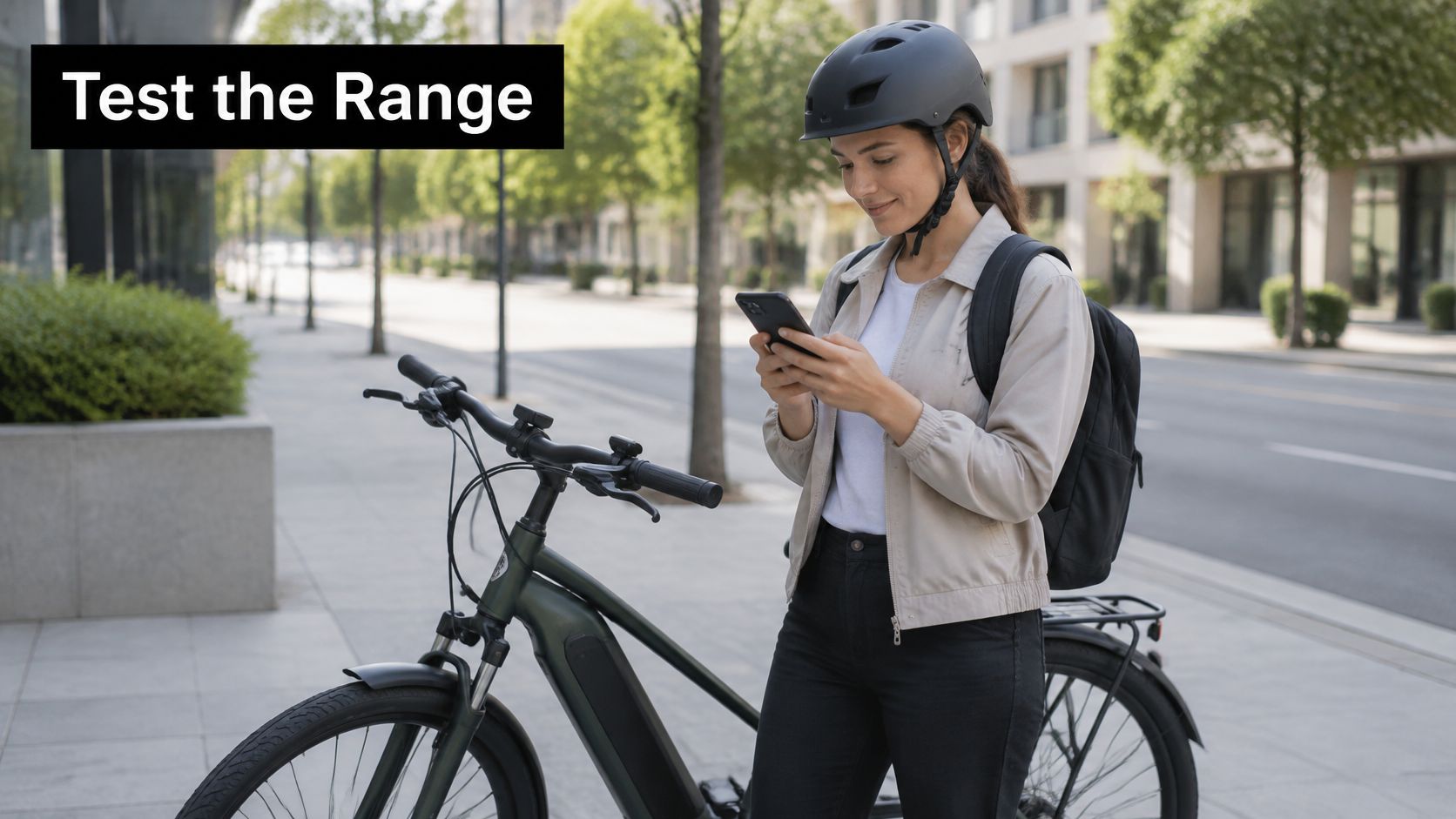
This rider pausing to check her phone is the moment range stops being theoretical.
Three Checks for Any Range Claim
- Two assist levels: Demand range at maximum assist and at a lower level. The first tells you your worst case, the second tells you what careful riding buys back.
- Battery in watt-hours: For example, a 36V 10Ah pack is about 360Wh. Without that, you can't compare efficiency between models.
- Rider and route: Who rode it, at what weight, on what ground, at what tyre pressure and temperature. Skip any review that won't say.
Say two commuters ride the same advertised bike. One crosses a flat riverside path, the other climbs out of a valley with a full bag every evening. Their range won't match, and neither will their verdict on climbing. That's why rider mass and gradient matter more than a single headline number, and why our notes on electric bike battery life stress conditions over claims.
What a Real Test Loop Looks Like
A flat laboratory loop flatters everything. Real commuting is stops, starts, junctions and one hill you'd rather forget. The Consumer Reports electric bike testing methodology uses a controlled hilly loop with stops and starts, full-speed sections, U-turns, a sustained climb and a sharp descent, and in that test using maximum motor assistance, five electric bikes traveled between 15 and 30 miles before battery depletion. That spread is the point. Same course, same method, very different answers.
So publish, or demand, the full set beside every figure. Rider mass, tyre pressure, temperature, terrain, average speed, battery capacity in watt-hours. Otherwise you can't tell whether a gap between two bikes is efficiency or just a lighter tester on a warmer day.
Ride Quality Is More Than Range
Range gets you home. Ride quality decides whether you enjoy getting there and stay in control doing it. Test how fast assistance arrives from a standstill at a junction. Test re-engagement after braking, and low-speed hill starts where a clumsy surge can unsettle the bike.
The Consumer Reports e-bike buying guide reported noticeable pedal-assist lag on one three-level model, while a torque-sensing mountain e-bike rewarded light uphill pedal pressure and delivered assistance proportionally enough that a relaxed cadence took minimal effort. That difference is everything in traffic. A torque sensor generally meters help against how hard you're pushing, so it feels like stronger legs. A basic multi-level system can feel like an on-off push that arrives late.
Check transitions between levels, too. Smooth steps let you fine-tune effort. Abrupt steps force you to choose between too little help and a lurch. Neither feels safe filtering past parked cars.
This short video is worth watching before your own test ride, so you know what sensations to look for.
The Dead Battery and Braking Tests
Ride it with assistance off, ideally pointing uphill. Every battery empties eventually, through age, cold or a forgotten charge, and a heavy bike with draggy gearing can turn that into a long push. If you can't pedal it home in a low gear, it isn't a dependable commuter, whatever the display promised.
Then brake from the top assisted speed on a clear, dry surface and note the distance. Repeat it loaded. Braking performance belongs next to range in any review worth trusting, because mass and speed are what you're stopping.
Set your threshold now. Rule out any bike that falls short of your daily distance at maximum assist, or that feels unpredictable at low speed. A bike that fails either test won't get better once you own it.
Which Rider Type Fits Which Pedal Assist Bike
There's no best bike here. There's a best match for a route, a body and a hallway. E-Bikes are offered in the categories Adult Bikes, City & Commuter Bikes, Folding Bikes, Fat Tyre Bikes, Off-Road Bikes and Cargo Bikes, and that spread exists because riders' days look nothing alike.
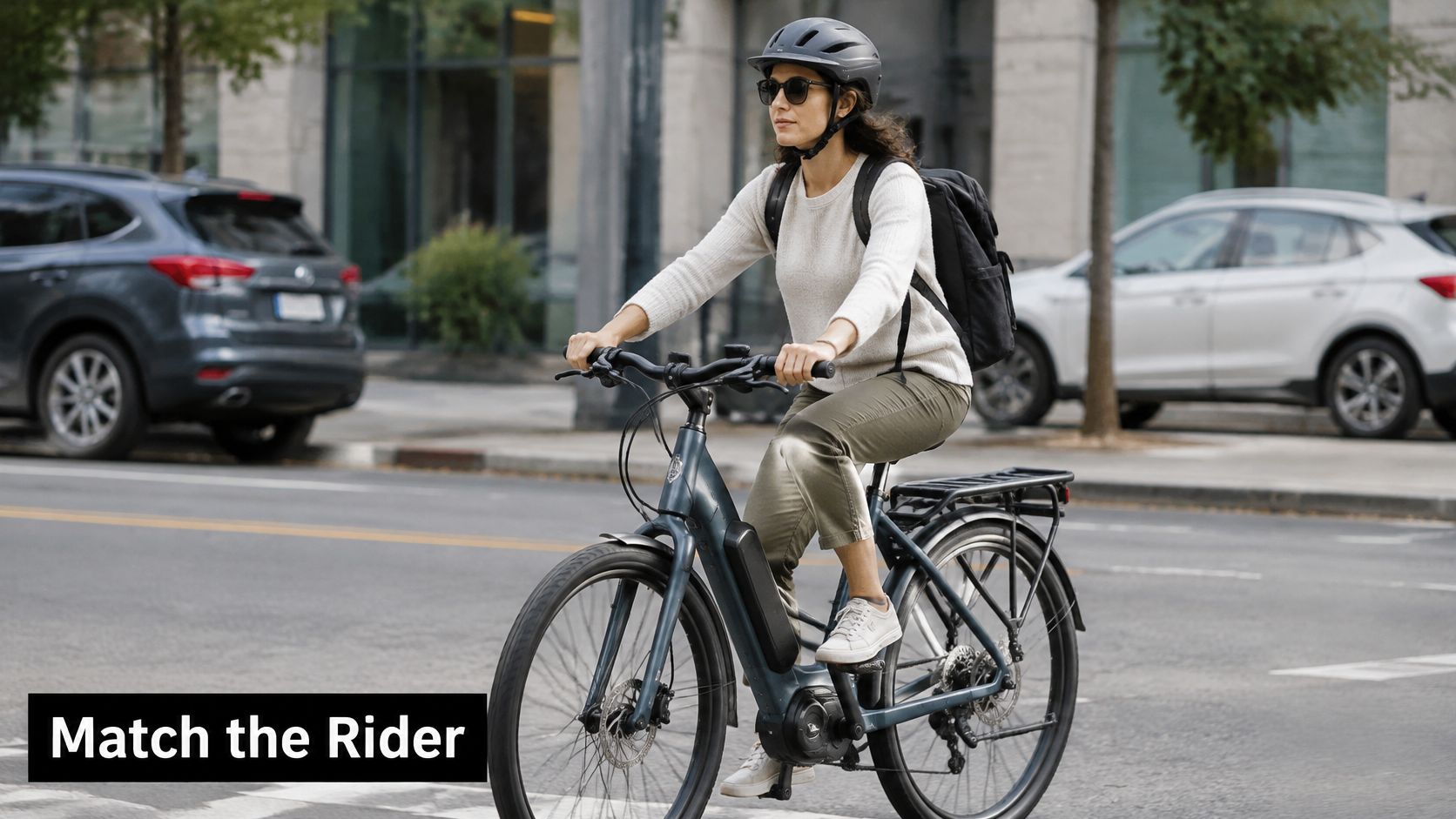
This city rider is the classic case, upright, visible and riding to get somewhere.
The Daily Commuter
Say your route is five miles of rolling streets, two sets of lights and a secure shed at work. Prioritise smooth assistance, confident braking and a motor rated within the 250W limit, plus a rear rack for a bag. Range needs to cover the return trip with a buffer, not just the morning leg.
- Pros of the road-legal commuter pick: It fits public roads and cycle paths without extra paperwork, and the upright position suits traffic.
- Cons: You give up the brute pull of higher-power models, and you'll still pedal properly on climbs.
- Deciding question: Does your longest return trip fit inside its maximum-assist range with energy left over?
Hill Riders and Heavier Riders
If your home sits at the top of a climb, predictability beats punch. Look for assistance that engages cleanly from a hill start and a clearly stated payload limit that covers you, your bag and your shopping. Remember, rider mass cuts range, so discount any claim gathered by a much lighter tester.
A torque-sensing setup usually suits this rider, because help scales with effort instead of surging. The trade-off is cost and, sometimes, a firmer ride feel. Ask whether the bike still climbs politely at a low cadence, or only when you spin fast.
Outdoor and Rough-Ground Riders
Gravel, towpaths, kerbs and farm tracks change the brief. Fat tyres add grip and soak up broken surfaces, which is lovely on a trail and tiring on tarmac. NAKTO electric bikes and tricycles sold by Punk Ride include step-through, folding, fat-tyre, cargo and three-wheel designs, so you can choose the shape around the surface rather than forcing one frame to do everything.
Keep the legal line in view. In UK and EU terms, 750W models are off-road tools, not road bikes with extra fun. If your riding mixes public roads with weekend trails, a road-legal bike with sensible tyres may serve you better than power you can't use to get there. Riders planning longer touring days might enjoy browsing scenic cycling routes through Basque Country from Northern Spain Travel for route ideas before matching a bike to that kind of distance.
Cargo, Family and Balance-First Riders
Carrying kids, shopping or tools shifts the priority to maximum payload, frame strength and stability at walking pace. Check whether the bike fits your car rack if that's how trips start, and how it behaves fully loaded at a junction. A trike like the HIDOES ET1 suits riders who value not putting a foot down, but it needs more storage width and turns differently, so test your gate and your corners.
Flat-Share and Transit Riders
Folding frames solve the hallway problem and the train problem. They also add weight at the hinge and smaller wheels can feel busy on rough streets. Time the fold, then carry the folded bike up your actual stairs. If you dread that lift in the shop, you'll dread it twice a day at home.
Choose Your Pedal Assist Bike Before You Buy
My verdict is simple. Buy the bike whose legal status, measured range and battery pathway all pass. If one fails, walk away, however good the discount looks.
Your Pre-Purchase Checklist
- Confirm EAPC compliance: Find the rated continuous power on the spec sheet and get a written compliance statement from the seller. No statement, no road use.
- Check the charger and replacement route: The charger should be certified for that battery, and a replacement-battery path should be documented now, not promised later.
- Check recalls, charging and disposal: Look for recall information, practical charging guidance for flats and garages, and an end-of-life disposal option you'll use.
- Check traceability and damage advice: You want battery traceability and clear instructions for inspecting a pack after a drop or crash.
Step two to four aren't paperwork for its own sake. The UK government publication on fires in e-bikes and e-scooters in 2025 recorded 267 e-bike and e-scooter fires in 2025, with batteries or generators identified as the ignition source in 235 cases, or 88%, and two fires causing fatalities. A bike with great range is still a poor choice if its battery can't be safely replaced or responsibly recycled.
Comfort counts across years of ownership, too. Sore feet on long rides are worth sorting early, whether that's saddle height, pedal choice or specialty insoles for time on the bike from Insoles.com. Small contact points decide whether you keep riding.
Red Flags and Real Costs
Walk away from unclear weight and capacity, no rider-height guidance, uncertified batteries or chargers, range claims without test conditions, brakes underspecified for the bike's speed and mass, and no replacement-parts path. Each one predicts a bike that becomes unusable when a proprietary part fails.
Then price three to five years, not one afternoon. Add tyres, brake pads, tune-ups, a likely battery replacement, shipping and local service. Our website offers free delivery on all orders, which helps the first line of that sum, but it doesn't change the rest. If you're torn between two models, customers who need help choosing can contact the Punk Ride team for guidance before ordering.
The Seven Picks in One Line Each
- DUOTTS C29 Single Battery: Cheapest entry for flat, short trips, but confirm its rating and don't expect distance.
- DUOTTS C29 Max 250W: The road-legal commuter route at £909.00, provided you verify the 250W rating in writing.
- ENGWE L20 Boost Step-Thru: Easiest mounting and upright comfort at £1,099.00, with step-through convenience over sporty handling.
- DUOTTS C29-K Dual-Battery: Distance on private land at £1,040.38, paid for in weight and a second pack to manage.
- NAKTO F2 Plus Fat-Tire: Rough-ground grip at £827.47, but it's an off-road tool, not a road EAPC.
- ENGWE Engine X Foldable: Transit and small-space storage at £1,049.00, if you can happily carry it folded.
- HIDOES ET1 Tricycle: Stability at low speed at £1,889.00, in exchange for width, weight and different cornering.
Ready to match a bike to your actual route, hills and hallway? Browse the commuter, folding, fat tyre and cargo electric bikes at Punk Ride LLC, check each model's rated power and battery details on its product page, and pick the one that passes the legal, range and battery tests above. If you're still torn between two picks, ask the team which one fits your longest regular day before you order.