Ask most riders what changes when you move from a 500 W motor to a 750 W one and you'll get the same answer. It's faster. Then they buy the bigger motor, ride the same flat commute, and find the bike still cuts out at the same speed it always did. So what did the extra watts buy?
Quite a lot, as it happens, just not where many riders look. The extra capacity changes how the bike pulls away, how it behaves when the road tilts up, and how it copes with a week of shopping on the rack. It also changes the battery you need, how often you charge, and, in Britain and the EU, which set of road rules the bike falls under. That last part catches more buyers out than any hill.
This is the 500W vs 750W e-bike question answered the way you'd want it before spending money. What changes, what doesn't, and which rating suits the riding you do.
500W vs 750W at a Glance
Here's the short answer. A 750 W motor carries 250 W more rated power than a 500 W motor, and that extra capacity goes into torque and reserve rather than top speed. The controller sets your ceiling, the battery decides how long you get to enjoy it, and the motor rating decides how gracefully the bike handles gradient, load and headwind.
The comparison below uses typical nominal figures for both classes:
| Factor | 500 W motor | 750 W motor |
|---|---|---|
| Rated motor power | 500 W | 750 W, a 250 W (50%) difference |
| Hill climbing under load | Solid on rolling hills, slows on steep grades when loaded | Holds speed on steep grades and with cargo or heavier riders |
| Acceleration from a stop | Comfortable for commuting | Stronger starts at lights and junctions |
| Current draw at 48 V | About 10.4 A (idealised) | About 15.6 A (idealised) |
| Range per charge, same battery | Usually longer | Usually shorter |
| Best fit | Flat commuting, lighter riders, range first | Hills, cargo, heavier riders, stop-start routes |
What the table can't show
Treat those rows as a starting point, not a spec sheet. Controller current limits, battery voltage and pack size all shift the result, and a restricted 750 W bike can feel softer than an unrestricted 500 W one. The current figures are idealised at 48 V with no losses, so a real system pulls more.
Rider weight, terrain, tyre pressure and gearing move the numbers around as much as the motor rating does. Then there's the figure the listing hides: whether the badge is continuous or peak. A 500 W motor with a high peak output can feel closer to a 750 W motor on a short sharp climb than the labels suggest, and a 750 W motor with a modest peak can feel flat.
Legality isn't in the table either, because a motor rating can change the category of vehicle you're riding, not just its acceleration. UK and EU limits are set out further down, and they decide more than the watts do if you ride in Britain or the EU.
Each row gets unpacked below. If hills are your deciding factor, go there first. If range anxiety is the main concern, the battery maths matters more than the badge. If you're buying in the UK, start with the rules.
What the Extra 250 Watts Really Buys
The jump from 500 W to 750 W is a 50% increase in rated power, but it does not mean 50% more speed. The extra capacity is most useful when the motor is working hard: pulling away, climbing or carrying a heavier load.
Top speed depends on the controller limit, wheel size, total weight, drag, rolling resistance and battery voltage. Torque, gearing and whether the wattage refers to continuous or peak output also affect how a bike feels on the road.
Controlled comparisons of otherwise identical e-bike platforms show a common trade-off: a higher-rated motor can bring modest average-speed gains, while using more energy. The practical benefit of the 750 W rating is extra power in demanding conditions, not a guaranteed speed increase.
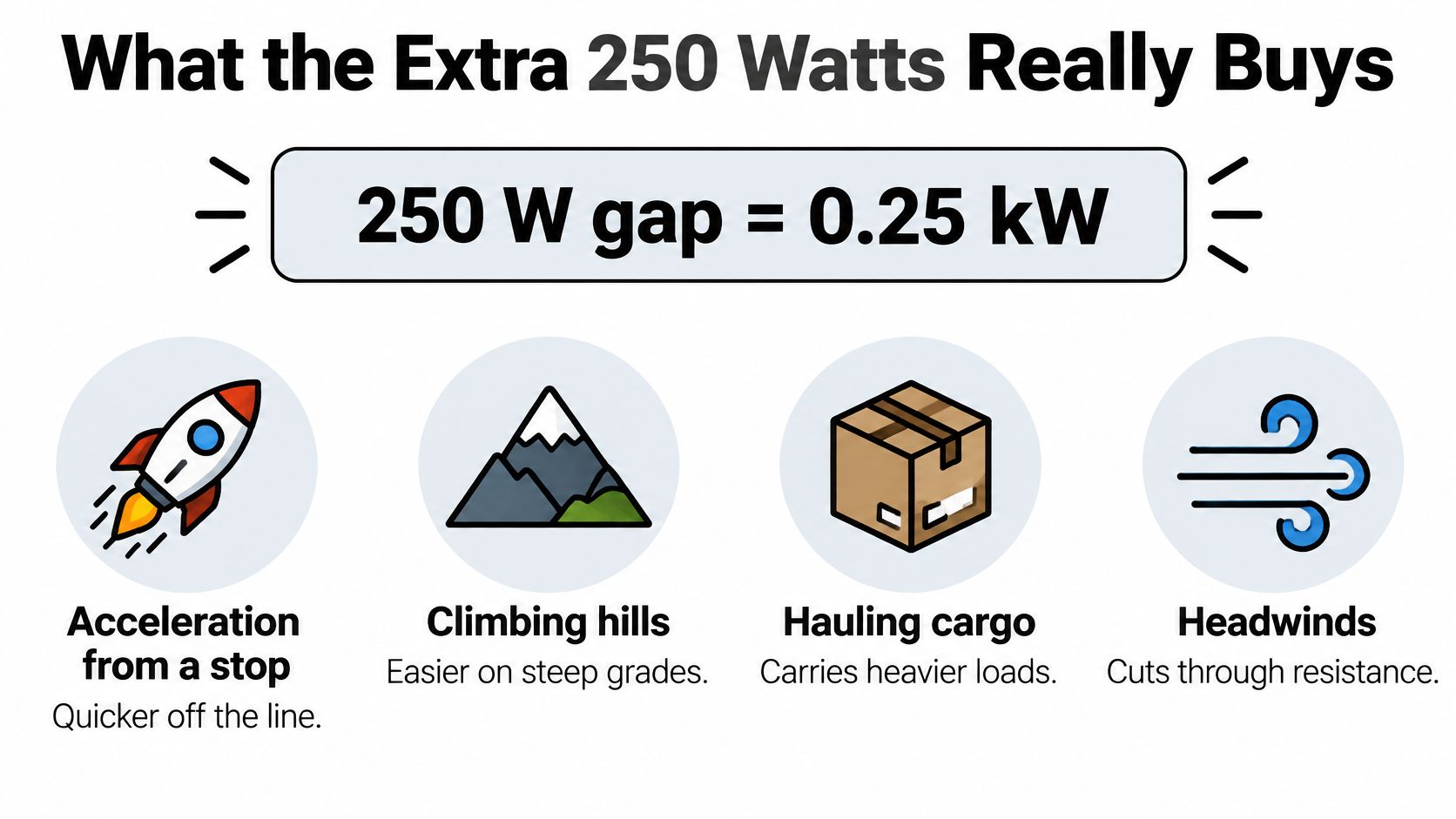
The principle to shop by: higher rated power gives more reserve under load. A lower-powered setup can use less energy when speed and load remain moderate.
Battery capacity matters just as much. A 750 W motor with a small battery may offer less range than a 500 W motor with a larger pack. Check the battery's watt-hours alongside the motor rating; the badge alone cannot tell you how far the bike will go.
Read the spec sheet beyond the headline wattage. Check the continuous and peak ratings, controller current, nominal voltage and torque. A bike rated at 90 Nm and 500 W may climb better than one rated at 34 Nm and 750 W, because torque describes turning force, while power also depends on how fast the motor is turning.
Which Motor Fits Your Route, Load and Rider
Motor choice is a route question before it's a spec question. A rider doing six flat miles each way with a laptop bag needs something very different from a rider hauling two kids up a 12% ramp twice a day.
That's the moment the decision usually gets made, at the junction where the road starts to rise:
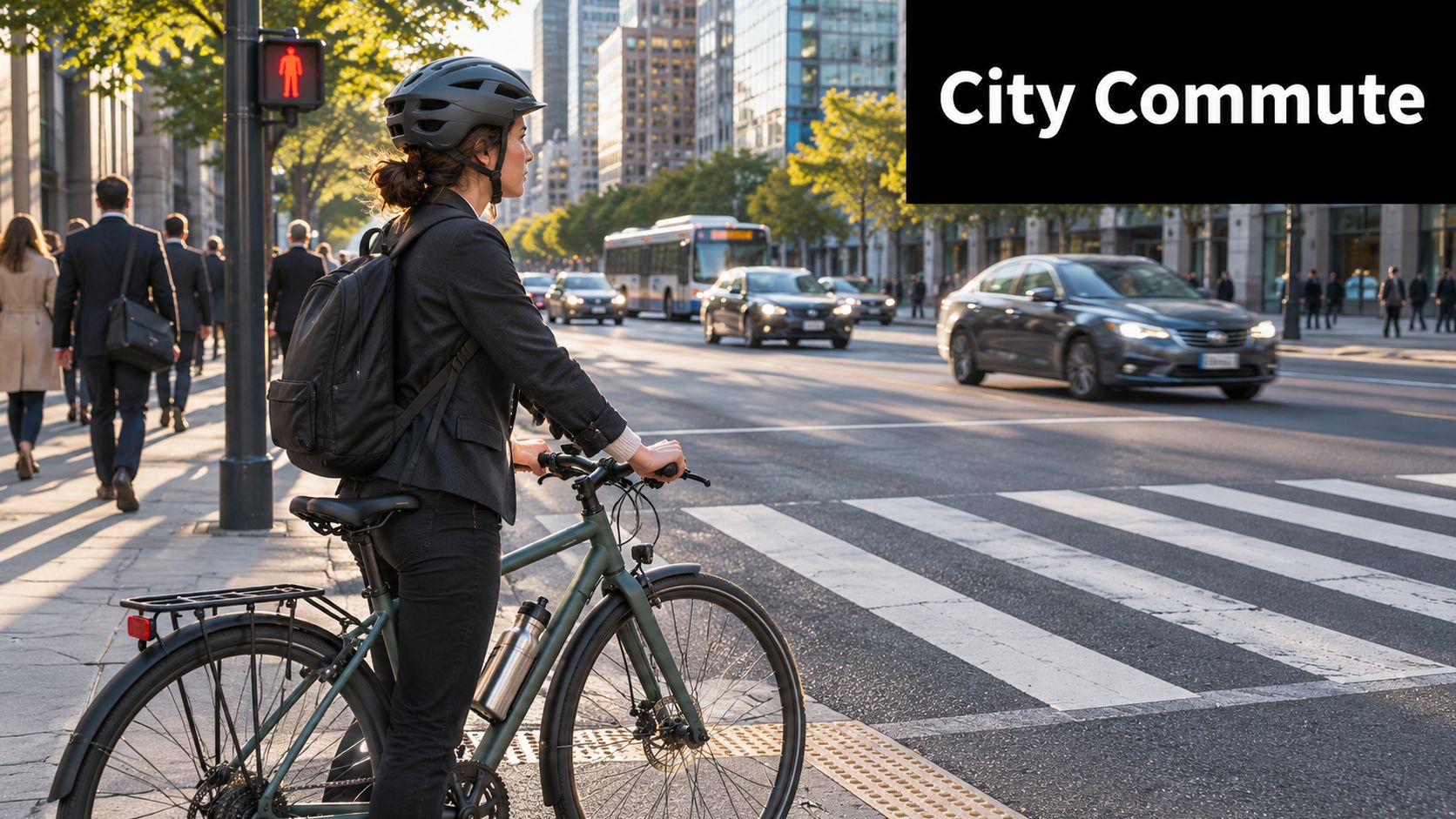
Four routes and the motor that wins each
Flat city commute, under about 10 miles, stops every few hundred metres, light load. Take the 500 W with a mid-size battery. It stays efficient, it asks less of the pack, and it's the cheaper bike to run over a year of commuting. On level ground, both ratings reach the same limited speed anyway, so you'd be paying for reserve you never draw on.
Hilly route with sustained climbs. The 750 W wins. It holds speed on steep grades where a 500 W motor slows and then sits at high current for longer, which is exactly the condition that heats a motor and drains a pack. If your commute includes one long drag rather than lots of short ramps, this is the case for the bigger rating.
Heavier rider, or regular loads like a child seat, panniers or a big shop. Go 750 W. The extra torque helps most at the two moments that matter, pulling away and climbing, and it means the motor isn't pinned at maximum just to keep you moving.
Stop-start traffic with constant launches from zero. Again 750 W, because the start at a junction feels more confident and less strained. If your route is a series of traffic lights, the motor spends most of its life in the exact band where the extra capacity lives.
If you want a shortlist rather than a rule, our guide to the best electric bikes for hills narrows the field by gradient and load.
Cargo, fat tyres and the case for more motor
For a cargo bike carrying bags, boxes or children every day, choose a 750 W cargo model. The weight is constant, the starts are frequent, and a smaller motor spends its life at the top of its range.
For fat-tyre trail riding on rough ground and climbs, pick 750 W and budget for a larger battery at the same time. Wide tyres add rolling resistance, the terrain adds drag, and the combination eats range. One example from our own range is the NAKTO F2 Plus, a 750W fat-tyre electric bike, listed at £827.47.
Test it on your own ride before you commit
- Time a loaded climb at the same assist level on both bikes, ideally the same hill on the same day.
- Watch the speed drop. If it falls below what the route needs, the motor is undersized for your weight and gradient.
- Listen for strain at the top of the climb. A motor working at its limit sounds rough and hot; a motor with reserve sounds unchanged.
- Check the battery gauge over the same loop. Range loss shows up fast on hills, and it tells you whether you need a bigger pack more than a bigger motor.
If you're mapping a route with real gradients, planning bridge climbs on Florida rides with an elevation-aware planner shows where the sustained ramps sit before you commit to a motor rating. It's worth ten minutes with a route map before spending several hundred pounds on the wrong one.
Terrain, load and battery size decide how a ride feels. Wattage is the label on the box, not the experience.
Battery Size Decides How Far Either Motor Goes
Battery capacity sets the energy available for a ride. A 750 W motor can draw from it faster than a 500 W motor when both are working at full output, so a higher rating is useful only if the battery can supply the current and has enough capacity for your route.
| Battery | Energy | Runtime at 750 W |
|---|---|---|
| 36 V 10 Ah | 360 Wh | About 29 min |
| 48 V 14 Ah | 672 Wh | About 54 min |
| 48 V 15 Ah | 720 Wh | About 58 min |
| 48 V 20 Ah | 960 Wh | About 77 min |
How those runtimes are calculated
Watt-hours are calculated by multiplying battery voltage by amp-hours. Divide that energy by the motor's power draw to estimate runtime. These figures assume the motor draws its full rated power continuously, which gives a useful comparison rather than a real-world range forecast.
At 48 V, a 500 W input corresponds to about 10.4 A; 750 W corresponds to about 15.6 A. Electrical losses in the motor, controller and wiring mean the battery must supply more energy than reaches the motor. A 48 V 15 Ah battery stores roughly 720 Wh, giving theoretical runtimes of about 1.44 hours at 500 W or 0.96 hours at 750 W before allowing for reserve, riding conditions or battery age.
In practical terms, that pack gives about 86 minutes at 500 W and 58 minutes at 750 W under the same full-output assumption. Treat both as upper limits. Assist level, stops, cold weather and climbs all reduce the time available.
Theoretical runtime is a ceiling, not a range forecast. Real range is lower, especially when the battery is working hard on hills or in cold weather.
What this means for your shortlist
Compare battery capacity in watt-hours before choosing between motor ratings. If you ride at the same assist level on the same route, a larger battery can make a more noticeable difference to distance than unused extra motor power.
A 750 W motor also needs a battery, controller and connectors rated for its current draw. A high amp-hour figure alone does not guarantee that a pack can supply the required power. A dual-battery setup is one option for combining higher output with more stored energy. The DUOTTS C29-K 750W Dual-Battery Electric Bike uses two batteries and is listed at £1,040.38.
For a longer-distance shortlist, compare the electric bikes with the longest range by battery capacity as well as motor rating.
UK and EU Legal Limits for 500W and 750W Bikes
In Great Britain, both ratings sit outside the ordinary electric bicycle category. An electrically assisted pedal cycle (EAPC) must have pedals capable of propelling it, a maximum continuous rated power of 250 W, and assistance that stops at 15.5 mph (25 km/h) (GOV.UK electric bike rules).
A 500 W or 750 W bike is generally treated as a motor vehicle rather than an ordinary bicycle. Depending on its specification and approval status, it may require registration, insurance, vehicle tax, an appropriate driving licence and an approved motorcycle helmet. The motor rating can therefore affect where and how you may ride.
For an EU pedelec meeting the EN 15194 definition, the motor is rated at no more than 250 W, assistance cuts off at 25 km/h, and assistance operates only while the rider is pedalling. A 500 W or 750 W model falls outside those standard pedelec limits.
| Rule | UK (EAPC) | EU (EN 15194) |
|---|---|---|
| Maximum continuous rated power | 250 W | 250 W |
| Assistance cut-off | 15.5 mph (25 km/h) | 25 km/h |
| Pedalling requirement | Pedals must be able to propel the bike | Assistance stops when the rider stops pedalling |
| 500 W model | Generally outside EAPC, treated as a motor vehicle | Outside the standard pedelec limits |
| 750 W model | Generally outside EAPC, treated as a motor vehicle | Outside the standard pedelec limits |
National rules can add conditions for roads, paths, rider age and helmets. Check the rules where you intend to ride.
Short note for US and Australian riders
In the US, federal law defines a low-speed electric bicycle as having fully operable pedals, a motor rated at less than 750 W, and a motor-only top speed below 20 mph on a paved level surface with a 170-pound rider (Consumer Product Safety Commission bicycle guidance). Since the federal wording says less than 750 W, check the documentation for a bike labelled exactly 750 W.
California defines an electric bicycle as having fully operable pedals and a motor rated at no more than 750 W, which can include a typical 500 W bike (California Vehicle Code 312.5). Connecticut classifies pedal-less vehicles with motors between 750 W and 3,500 W as motor-driven cycles (Westport Police e-bike and scooter safety guidance).
Australian federal importer guidance says an e-bike meeting EN 15194 may be treated as a bicycle. In most Australian states and territories, e-bikes used on roads and paths are limited to 250 W maximum continuous rated power, with assistance stopping at 25 km/h (Product Safety Australia e-mobility guidance). The continuous rating, rather than the advertised peak figure, is the relevant power measure.
Wattage affects legal category as well as assistance. Before choosing a motor, check the bike's classification against the rules where you plan to ride. Our guide to whether electric bikes are street legal explains the categories in more detail.
Confirm the Motor and Rules Before You Buy
Five checks settle most of this before money changes hands.
- Confirm the legal category in your country. Start with the power limit and the assistance cut-off, whether that's 15.5 mph in Britain or 25 km/h in the EU and Australia.
- Read the rated continuous power, not just the peak. Then check controller current. A 500 W motor with a generous controller can feel stronger than a restricted 750 W one.
- Match the battery in watt-hours and discharge rating. Capacity for distance, continuous discharge for the current the motor will really pull.
- Check the pedals and the cut-off. Pedals must be able to propel the bike, and assistance must stop at the local limit.
- Compare your own route, weight and load against the scenarios above. If your ride looks like the hilly one, don't buy for the flat one.
Then apply the shortlist rule. If your route is hilly or your load is heavy, shortlist 750 W models and budget for the bigger pack that makes them worthwhile. If the route is flat and range is the priority, shortlist 500 W with a larger battery and put the savings into capacity.
A cargo case makes the point. The NAKTO F4 is a 750W electric cargo bike, and the NAKTO F4 750W Electric Cargo Bike is listed at £628.08. That's the heavy, loaded, hilly job where the extra rating earns its keep rather than sitting unused.
Your next step is a page of notes, not a checkout. Write down your commute distance, the steepest ramp on your route, your weight plus regular cargo, and the range you'd like between charges. Then open each shortlisted model's spec sheet and check continuous power, watt-hours and the legal label against that page. Two minutes of reading beats a returns label.
Punk Ride LLC stocks e-bikes across both motor classes, from 250 W commuters to 750 W fat-tyre and cargo models, with warehouses in the UK and Germany so delivery doesn't drag on. If you're weighing up the 500W vs 750W e-bike decision for a specific commute, Punk Ride LLC lets you compare the specs side by side before you commit. Start with your route and load, then pick the rating that matches it.