To estimate your journey with an electric scooter travel time calculator, use the core formula: minutes equals distance divided by speed multiplied by 60. At a steady 20 km/h, a 5 km ride works out to 15 minutes of pure moving time.
Real street journeys rarely match that tidy number. Shared e-scooter trips across North America in 2023 averaged just 1.2 miles and took 11.6 minutes, according to U.S. Department of Energy figures compiled from the North American Bikeshare and Scootershare Association. That's a far cry from the breezy pace a scooter's brochure promises, because traffic lights, slow starts, and crowded corners eat into every kilometre.
Most riders get caught out by treating their machine's top speed as their cruising pace. If you want to stop turning up late to work or missing trains, you need to separate three numbers: what the motor can theoretically do, what local law lets you ride at, and your door-to-door time. Planning around that door-to-door figure is the difference between a calm commute and sprinting the last block with a folded scooter under your arm.
Moving Time at a Glance for Common Distances
Every travel-time estimate starts with one simple calculation: divide your route distance by your average speed, then multiply by 60 to convert hours into minutes. Keep both numbers in the same unit, so kilometres pair with km/h and miles pair with mph.
Before you add traffic stops or hills, it helps to see what pure moving time looks like across typical urban distances. The table below maps four common trip lengths across the three speed bands UK and EU riders see most often.
| Distance | At 15 km/h | At 20 km/h | At 25 km/h |
|---|---|---|---|
| 1 km | 4 min | 3 min | Just over two min |
| 3 km | 12 min | 9 min | Just over seven min |
| 5 km | 20 min | 15 min | 12 min |
| 10 km | 40 min | 30 min | 24 min |
Each column reflects a distinct riding environment rather than a random guess:
- 15 km/h pace: Dense town centres, narrow backstreets, and corridors packed with pedestrian crossings where you rarely hold full throttle for long.
- 20 km/h pace: Mixed commuter routes, lower national speed caps, and steady cruising through moderate traffic.
- 25 km/h pace: Clear, flat cycle lanes and open stretches running right up against standard regional speed ceilings.
Why That Spread Matters on Short Trips
Look at the 5 km row to see why speed assumptions break schedules. At 25 km/h, you're moving for 12 minutes, yet dropping to 15 km/h stretches that same trip to 20 minutes. That's an eight-minute swing before you hit a single red light.
Every figure in that grid is moving time only. It assumes rolling wheels from start to finish with zero waiting at junctions, zero dismounting for pedestrian zones, and zero detours around roadworks.
Sanity check: Pull up your route in Google Maps or Citymapper and check the cycling estimate. If your scooter moving time sits way below the cycling number, your assumed speed is almost certainly too optimistic for real traffic.
Find the row closest to your route distance and treat it strictly as a baseline floor. Once you know the best-case moving time, you can match it against local speed laws and add realistic delays.
Choosing a Speed Your Route Can Actually Hold
Plugging an advertised motor speed into an electric scooter travel time calculator almost always gives you a fantasy arrival time. A dual-motor machine might look quick on a spec sheet, yet firmware caps, local ordinances, and bike-lane rules decide how fast you can legally roll.
Legal Speed Caps Across Major Markets
Speed rules shift sharply depending on where you ride. According to the Greenmoov e-scooter speed limit guide, the United States has no federal e-scooter speed limit, leaving states and cities to set their own caps, with many jurisdictions sitting near 15 mph. Across Europe, public-road limits commonly centre on 25 km/h, while Germany and several Nordic markets commonly enforce 20 km/h caps.
In the UK, the UK government guidance for e-scooter trial users sets the maximum permitted speed for rental trial scooters at 15.5 mph (approximately 24.9 km/h), while noting that individual trial areas can impose lower local limits. Trial scooters are allowed on roads and permitted cycle lanes or tracks, never on pavements, and riders must be at least 16, hold a full or provisional driving licence, and carry motor-vehicle insurance.
That pavement ban changes your distance math immediately. A footbridge shortcut or pedestrianised high street that Google Maps suggests for walking isn't rideable scooter distance, so you either detour onto the road or walk the machine through at pedestrian pace.
Three Speeds Worth Comparing Side by Side
Rather than trusting one overly precise number, break every route into three separate estimates. First is your best-case machine speed, which is the scooter's mechanical ceiling on flat ground, something you can explore further in our breakdown of how fast electric scooters go. Second is your legal-speed estimate, capped by the road or cycle-lane limit where you live. Third is your realistic door-to-door estimate, which trims the legal cap to match actual junctions, traffic flow, and slow zones.
Treat the legal speed cap as your ceiling, never your average, and drop your planning speed a notch whenever the route hits busy urban junctions.
Watch out for trips that cross municipal or national borders. The same scooter can face different speed limits, cycle-lane rules, or public-road status a few kilometres apart. A higher-powered scooter won't shave minutes off a flat, road-legal commute when a 20 km/h or 25 km/h cap is the real bottleneck holding your throttle back.
How to Turn Distance and Speed Into a Trip Estimate
Once you know the legal ceiling for your city, turning map distance into a trustworthy departure time takes six quick steps. I'd run through this once for any new commute rather than guessing on the morning of an early meeting.
Follow the flow in the graphic below to see how raw kilometres turn into an honest arrival window.
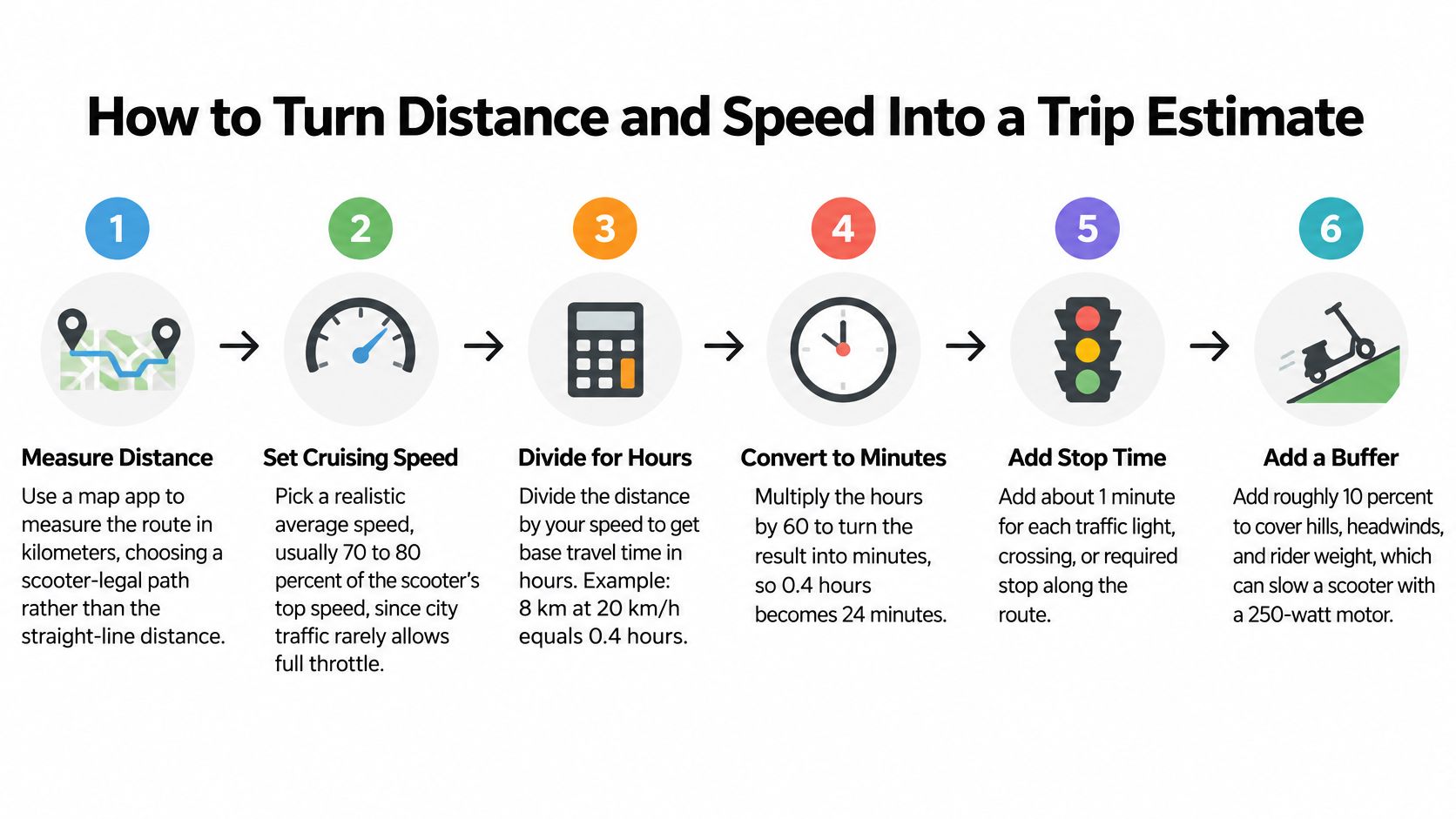
- Measure the true rideable distance in kilometres. Open Komoot, Apple Maps, or Google Maps in cycling mode so you trace real streets instead of a straight line between two pins.
- Cut out banned sections and adjust the total. Strip away pedestrian precincts, park footpaths, and pavement-only shortcuts, then reroute along legal roads or cycle tracks so your kilometre count reflects where wheels can stay rolling.
- Pick a practical street speed. Step down from your local legal ceiling to a pace your route can realistically sustain, starting around 20 km/h on mixed city streets with decent flow.
- Compute your pure moving time. Divide the rideable distance by your practical speed and multiply by 60. That gives you the baseline minutes your tyres spend turning.
- Add a 20% delay allowance. Take 20% of your moving time and add it on to cover traffic signals, pedestrian crossings, and rolling stops.
- Round up to the nearest 5 minutes. Write that rounded figure down as your planning time, because nobody needs false precision down to the second when catching a train.
Why Moving Time and Planning Time Stay Separate
Real-world trip lengths swing wildly depending on scooter ownership and city conditions. In a German Transportation Research Procedia study by Oostendorp and Hardinghaus, shared e-scooter trips averaged 16 minutes, while privately owned e-scooters averaged 34 minutes, more than double the duration. Separate Austin city data in the same research showed 5,383,780 e-scooter trips in 2019 averaging 11.8 minutes, shifting to 1,588,741 trips in 2020 averaging 15.5 minutes, a jump of 3.7 minutes (about 31%) even as total trip volume dropped by around 70%.
Those swings prove why separating theoretical moving time from a buffered planning estimate works better than chasing a single magic number. In that research's example, a 3-mile journey at 10 mph works out to 18 minutes of moving time, while adding a 20% delay allowance lifts the planning estimate to roughly 22 minutes. Quiet canal towpaths might only need a modest buffer, whereas dense rush-hour grids quickly swallow that full allowance and more.
A Worked 5 km Commute Example
Say your daily commute measures 5 km on legal roads and painted cycle lanes, and you choose a steady 20 km/h practical pace. Divide 5 by 20 to get a quarter of an hour, then multiply by 60 for 15 minutes of moving time.
Next, add the 20% delay buffer (3 minutes) to reach 18 minutes. Rounding up to the nearest 5 minutes hands you a 20-minute planning time. You now have one concrete door-to-door target you can trust, along with the exact speed and buffer assumptions sitting behind it.
Hills, Stops and Rider Weight That Slow You Down
A flat distance-divided-by-speed equation falls apart the moment your route hits real street friction. Two commuters riding the exact same 6 km stretch on identical machines can finish ten minutes apart depending on gradient, cargo, and tarmac quality.
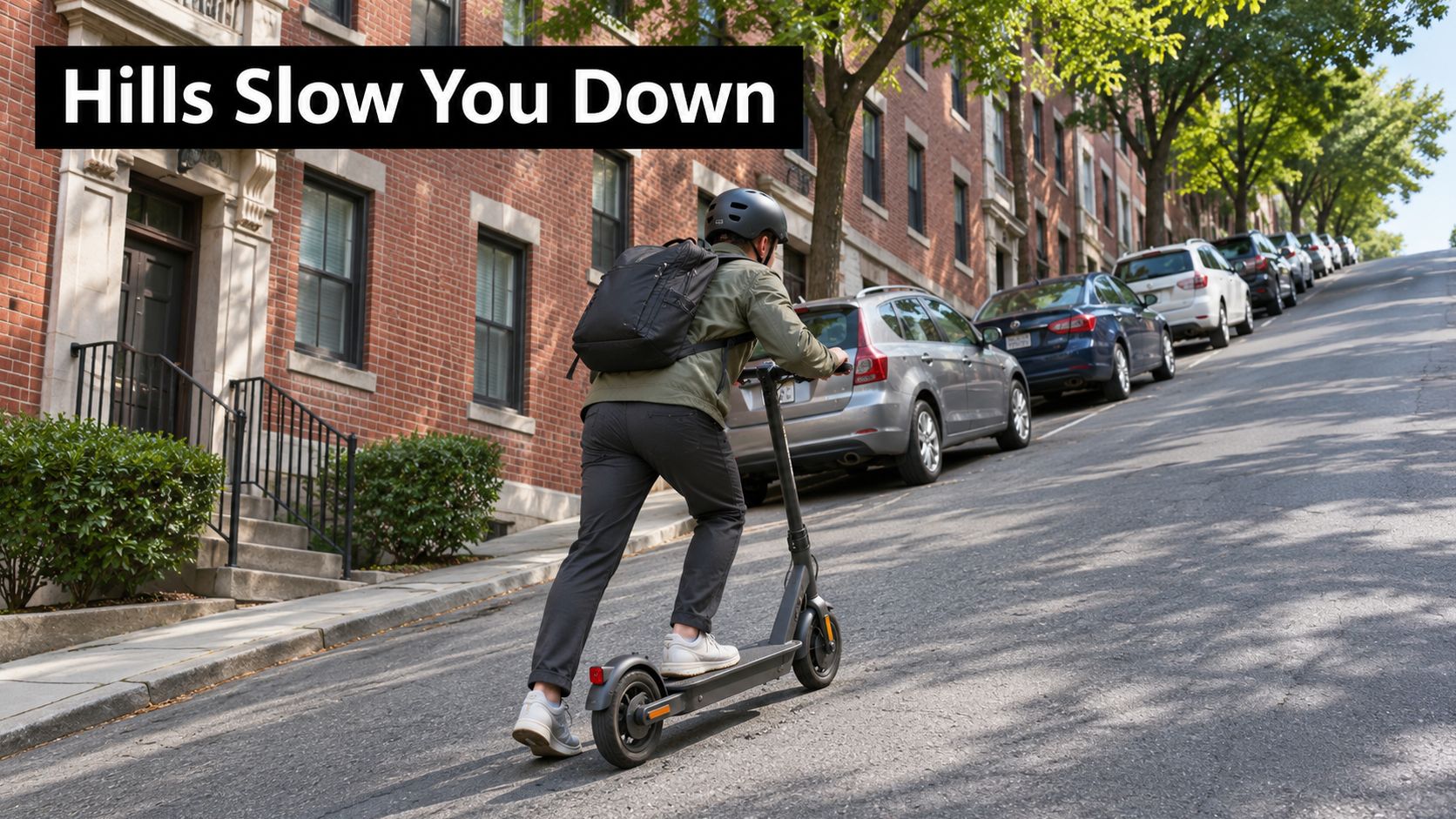
Gradients punish smaller motors hardest. Motor power limits are set country by country, so a machine that is perfectly legal where you live may still be modestly powered, and modest power fades quickly on sustained climbs. Speed drops off fast, battery draw spikes, and riders sometimes have to hop off and walk the steepest section. Treat any long climb on your route as a slow zone in your estimate, even if the descent afterwards claws some time back.
Weight works the same way. A heavy laptop rucksack, gym kit, or a bag of groceries adds mass that the motor has to accelerate from every single red light. Heavier combined weight blunts acceleration and magnifies speed loss on even mild inclines, so the rider carrying shopping home always runs slower than the same rider travelling light in the morning.
Weather and road surface also tax your pace:
- Wet tarmac forces wider braking margins and slower cornering.
- Headwinds act like an invisible hill on open riverfront paths.
- Cold air reduces battery voltage output, trimming both punch and range.
- Cracked asphalt or cobbles force you off the throttle whether you like it or not.
Then there is stop-start friction, which dominates short trips. Braking takes measurable distance and time: the UK Department for Transport guidance for e-scooter trial operators specifies that trial scooters using all braking systems together must achieve at least 3.5 m/s² deceleration or a maximum stopping distance of 7 metres from 15.5 mph, alongside stability testing at 20 km/h. Every roundabout, zebra crossing, parking spot, or charging detour adds overhead that can swallow a 1 km hop whole.
Infrastructure decides how much of your chosen speed you actually keep. Separated cycle tracks let you hold a steady rhythm without fighting turning vans or bus stops. Riding in mixed urban lanes means constant micro-braking behind slower vehicles and waiting for safe gaps.
Splitting Your Route Into Realistic Segments
Instead of guessing one blended speed for a varied journey, break the route into distinct legs. Estimate the flat protected cycle lane at 20 km/h, drop the steep uphill stretch to 10 to 12 km/h, and price the traffic-heavy town centre at 12 to 15 km/h, then add the segment times together. The slowest leg usually surprises people. A single kilometre of climbing or congested high street can cost as much time as three kilometres of clear path.
An honest travel-time estimate looks like a window, not a stopwatch guarantee. Showing the range keeps your assumptions visible when wind or rain shows up.
Take a typical 8 km urban route. Pure moving time at 15 to 20 km/h lands between 24 and 32 minutes. Once you factor in one sustained hill climb, several signalled junctions, and locking up at the destination, expressing that journey as a 30 to 40 minute door-to-door window gives you a realistic confidence interval. If your trip is shorter, scale the window rather than shrinking it to nothing, because the fixed costs of stopping, starting, and parking barely shrink at all.
Commute Times Versus Weekend Rides
A Tuesday commute and a Saturday cruise should not share one number in your planner. The machine may have the same top speed, but the legally usable speed, traffic pattern and door-to-door purpose change the pace you can hold.
Large-scale trip logs show that gap clearly. In a PMC analysis of roughly 1.7 million shared e-scooter trips in Austin, Texas, weekend rides ran roughly 26% longer in duration than weekday rides despite covering only about 14% more distance. That source link sits with the sentence those figures come from.
| Trip type | Average distance | Average duration | Implied speed |
|---|---|---|---|
| All trips | 0.77 miles | 7.55 minutes | 6.1 mph |
| Weekday | 0.71 miles | 6.83 minutes | 6.2 mph |
| Weekend | 0.81 miles | 8.62 minutes | 5.6 mph |
Read those rows as behaviour, not as a spec sheet. Across all trips, riders covered 0.77 miles in 7.55 minutes, which works out to about 6.1 mph, or roughly 9.8 minutes per mile before delays. Weekday trips were shorter at 0.71 miles and 6.83 minutes, with an implied pace near 6.2 mph. Weekend trips stretched to 0.81 miles and 8.62 minutes, dropping the implied pace to about 5.6 mph.
Metric Benchmarks for UK and EU Riders
Converting those Austin figures gives European riders a more familiar reference point. An average trip of 0.77 miles is roughly 1.2 km, and 6.1 mph is about 9.8 km/h. Weekday rides land near 10 km/h, while weekend leisure rides ease back to roughly 9 km/h.
Treat those as shared-fleet planning references, not personal limits. The data covers tourists, first-timers and casual hoppers on city streets. Local experience can help a regular rider avoid hesitation, but the safest approach is still to plan from the speed your route can reliably hold. Riders building a routine around adult scooter commuting should keep the commute figure tied to junctions, legal caps and arrival needs, then use the weekend figure when the ride itself is the point.
Turning Trip Type Into a Practical Rule
Match your assumed speed to the purpose of the ride before you touch the calculator:
- Weekday commutes: Use your tested practical street speed, because you already know the route, skip sightseeing, and ride with a clear destination.
- Weekend and social rides: Knock your assumed speed down and add extra buffer time for busier shared paths, slower companions, cafe stops, and checking directions.
The door-to-door figure is the one to plan around. A scooter's quoted speed describes what the machine can do under ideal conditions. Your deadline depends on what the street, the legal limit, the traffic lights and the final lock-up allow.
Check Your Planning Time Before You Ride
Your departure time should follow the door-to-door estimate. Before setting out on a new route, check your deadline, the riding rules and whether your scooter suits the journey.
First, compare your rounded planning time with your actual arrival deadline. If a train departs at 08:15 and your door-to-door estimate is 20 minutes, leaving at 07:55 leaves no cushion for locking the scooter or buying a ticket. Add a few minutes of arrival margin, and check that those station tasks are included rather than treating arrival outside as being ready to board.
Second, check local riding regulations along the whole route. Your machine's top speed is separate from the speed legally usable on that route, and neither is your door-to-door average. Confirm where riding is permitted, check applicable speed caps and pavement restrictions, and account for any trial rules, age limits or parking restrictions.
Third, check the battery against the journey. Advertised range figures for AOVO electric scooters are manufacturer estimates; actual range varies with rider weight, terrain, temperature and riding settings. Use an electric scooter range calculator alongside your travel-time estimate to assess whether a hilly or cold-weather leg fits your available range.
Matching the Scooter Category to Your Route
Punk Ride's range includes Commuter Scooters, Folding Scooters, Fat Tyre Scooters, Off-Road Scooters and Performance Scooters. Match the category to the route, then check the individual model rather than assuming its category guarantees a particular pace.
- Flat urban commutes: Compare Commuter Scooters for smooth tarmac and stop-start city riding.
- Train-plus-scooter journeys: Check Folding Scooters for carrying and storage needs around stairs, carriages and desks.
- Cobbles, canal paths and rougher lanes: Consider Fat Tyre Scooters and Off-Road Scooters, while checking surface suitability and whether riding is permitted.
- Hilly corridors and heavier loads: Compare Performance Scooters against the demands of climbs and rider load, within local rules.
Use your planning time to decide when to leave. A quicker moving time is spare margin when conditions cooperate, not a reason to shorten your scheduled door-to-door window.
Punk Ride LLC offers curated electric scooters and bikes, with warehouses in the UK and Germany alongside its US headquarters in Florida. Compare models against your terrain, carrying needs and realistic journey time before choosing your daily ride.