


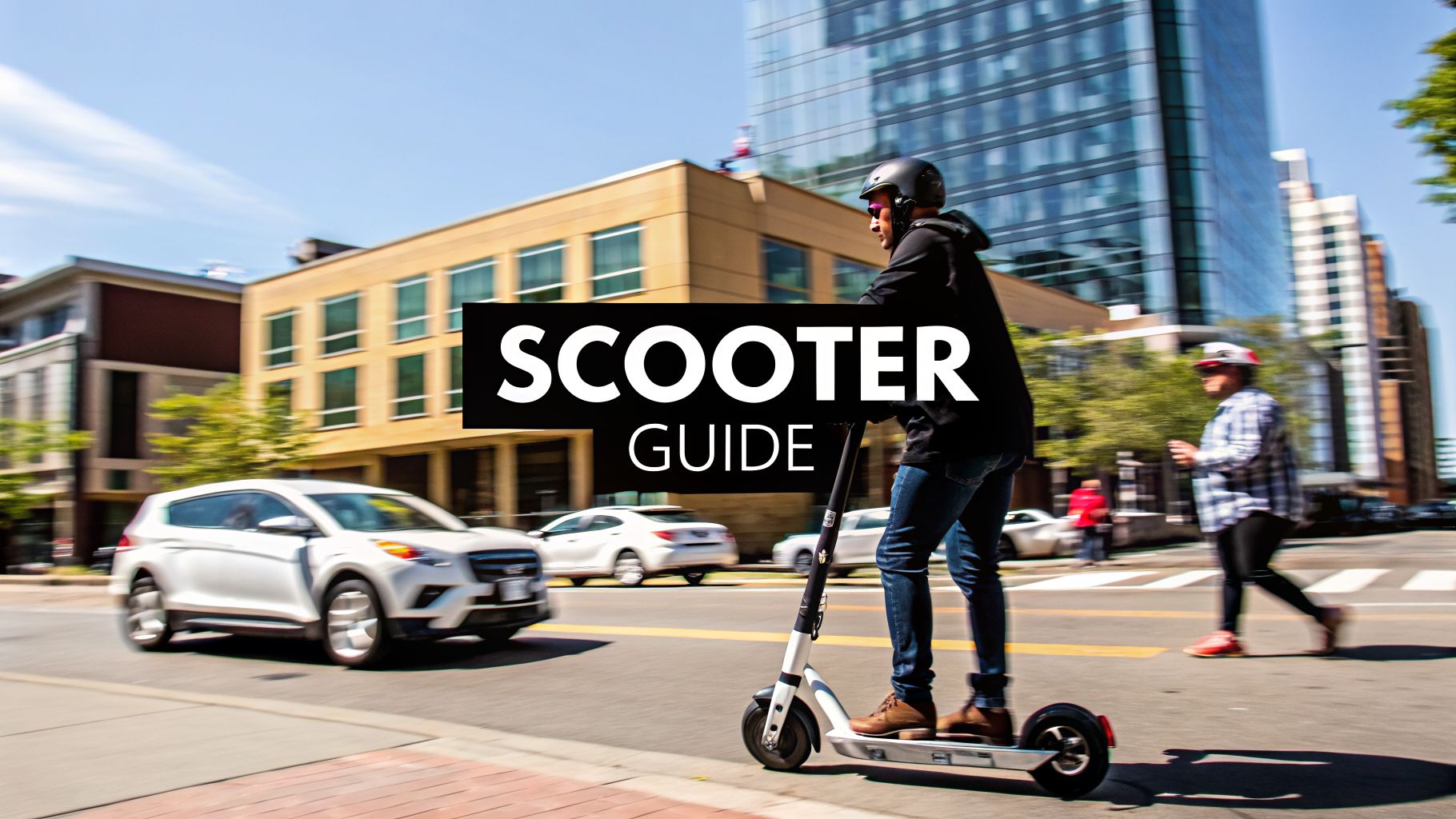
Let’s be real for a second. Are you tired of being stuck in traffic? That feeling of watching the minutes—and your patience—drain away is all too familiar for city dwellers. What if you could glide past all that gridlock, save a bit of cash, and maybe even have some fun on your way to work?
This isn't some far-off fantasy. It's the daily reality for a growing army of commuters who have discovered the power of the electric scooter for transportation.
Your New Commute: The Rise of the E-Scooter
For so many of us in packed cities like Sydney, Melbourne, or Los Angeles, the morning commute feels less like a journey and more like a daily struggle. But that frustration, along with a real push for greener ways to get around, has set the stage for something new. It's a whole new way of thinking about how we navigate our cities, which you can read more about in our guide to what urban mobility means today.
Amidst this change, the humble electric scooter has really come into its own. It's no longer just a toy; it’s a serious contender for your daily ride, offering a mix of convenience and fun that a crowded train or a bumper-to-bumper car ride just can't touch.
The Perfect Storm for E-Scooters
So, why now? A couple of big things have come together to make this the e-scooter's moment. First, city congestion has hit a breaking point. At the same time, massive improvements in battery technology mean these scooters can go further and last longer than ever.
This combo is driving some frankly staggering growth. The global electric scooter market is on track to hit a whopping USD 63.64 billion by 2032. Why the boom? It’s driven by commuters, aged 16-65, who are sick of high fuel costs and want to do their bit for the planet. E-scooters use 90% less energy than cars and slash CO2 emissions by an incredible 70% per trip compared to a gas-powered moped. If you're a numbers person, the full market research paints a pretty clear picture of where this is all heading.
An electric scooter can turn the most stressful part of your day into the best part. It’s not just about getting from A to B. It’s about taking back your time and actually enjoying the journey.
More Than Just a Last-Mile Solution
Not long ago, e-scooters were mostly seen as a "last-mile" option—something you’d use to get from the train station to your office. That’s changed. A lot.
Today's scooters are built differently. They have the range, the speed, and the durability to handle your entire commute, end to end. This is a game-changer. It gives you the freedom to travel on your own schedule, without being at the mercy of bus timetables or traffic jams. You have a reliable ride that’s ready to go when you are. This guide is your starting point for making that happen, and first, we'll dive into why so many people are already making the switch.
Choosing Your Perfect Ride: A Commuter's Buying Guide
So, you're ready to ditch the car or the crowded train and join the e-scooter revolution. Awesome. But one look at the spec sheets can make your head spin—watts, amps, pneumatic what-now? It’s a lot, I get it.
Don't worry. Think of me as your guide who’s already made all the mistakes so you don't have to. We're going to cut through the noise and figure out exactly what matters for your specific commute.
First, let's do a quick gut check. This flowchart is a great way to see if an e-scooter even makes sense for your daily grind.

If you found yourself nodding along, then you're in the right place. An e-scooter could genuinely change your daily travel for the better. Now, let’s find the right one for you.
What Does Your Commute Actually Look Like?
Before you even think about models or brands, grab a coffee and think about your journey. Seriously, this is the most important step.
How far is it, door-to-door? Are there monster hills on your route? Will you have to lug this thing up a flight of stairs to your apartment or onto a packed train? Be honest.
It's like buying a new pair of shoes. You wouldn't wear flashy dress shoes on a muddy trail. The same goes for scooters. Matching the machine to the mission is everything.
The Big Four: Nail These and You're Golden
You can get lost in dozens of specs, but honestly, it all boils down to four key things. Get these right, and you’ve won 90% of the battle.
- Range (Your Fuel Tank): This tells you how far you can go on one charge. But take the manufacturer's number with a grain of salt—they test in a perfect world with no hills, no wind, and a very light rider. A good rule of thumb is to knock 20-30% off the advertised range for a real-world estimate.
- Speed (The Fun Part): Most commuter scooters will top out around 25 km/h (15.5 mph), which is the legal speed limit in many places. That’s plenty fast for city bike lanes. What you really feel is the acceleration—how quickly it zips you away from a red light.
- Portability (The Back-Saver): This is all about weight and how easily it folds. If you're mixing your ride with a train or bus (a "multi-modal" commute), you need something light, preferably under 15 kg, with a dead-simple folding mechanism. If you’re just riding from home to work, you can afford a heavier, beefier model.
- Brakes (Your Safety Net): This is the one feature you absolutely cannot skimp on. Look for a dual-brake system. Having two independent brakes, like a disc brake on one wheel and an electronic one on the other, gives you reliable stopping power and a crucial backup if one fails.
Your perfect scooter isn't the one with the biggest numbers across the board. It's the one that finds the right balance for you. A monster-range scooter is useless if it's too heavy to get up your stairs.
To help you visualize this, here's a quick breakdown of what to prioritize based on your commute length.
E-Scooter Feature Showdown: What Matters for Your Commute
This table breaks down the essential features to help you decide what's a "must-have" versus a "nice-to-have" for your daily A-to-B.
| Feature | What It Means For You | Ideal for Short Urban Commutes (Under 8 km / 5 miles) | Ideal for Long Suburban Commutes (8+ km / 5+ miles) |
|---|---|---|---|
| Range | How far it goes on one charge. | 15-25 km is plenty. You'll likely charge it daily. | 40+ km for peace of mind and less frequent charging. |
| Weight | How heavy it is to carry. | Under 15 kg is crucial for stairs and public transport. | 15-25 kg is acceptable if you're not carrying it much. |
| Motor Power | Hill-climbing ability & acceleration. | 350W is fine for flat terrain. | 500W+ is essential for tackling hills with ease. |
| Suspension | Smooths out bumps in the road. | Optional, but nice for rough city streets. | A must-have for comfort on longer rides. |
Remember, this is a starting point. The best choice is always the one that fits your specific route and lifestyle.
Beyond the Basics: Details That Make a Difference
Once you've got the big four sorted, a few other specs can take your ride from good to great.
Motor Power (The Muscle)
Wattage isn't just about top speed; it's about torque—the power to get you going. A higher wattage motor (500W or more) is your best friend if your commute involves hills. It means you won't slow to a crawl on an incline and you'll get better acceleration from a stop.
Tires: Solid vs. Air-Filled
This is a huge debate in the scooter world, and it comes down to comfort versus convenience.
- Pneumatic (Air-Filled) Tires: Just like on a bike, these give you a wonderfully cushioned ride, soaking up cracks and bumps. The trade-off? You can get a flat tire, though they're usually easy to patch.
- Solid Tires: These are made of solid rubber and are 100% puncture-proof. The downside is you'll feel every single bump. The ride is much harsher.
My take? For most city commuters, the superior comfort of pneumatic tires is well worth the small risk of a puncture. Your back and knees will thank you.
Suspension (The Cloud-Like Ride)
If your route is a patchwork of bad asphalt, potholes, and poorly maintained roads, suspension is a non-negotiable. Acting like your car's shock absorbers, it smooths out the ride. A scooter with both front and rear suspension will feel like it's floating over terrain that would rattle your teeth on a lesser model.
Feeling more confident? Good. To see how these features stack up in the real world, you can compare electric scooter models using our detailed side-by-side tool. It's the perfect next step to zero in on your ideal ride.
Navigating the Rules in Australia, the US, and Beyond
Okay, let's talk about the number one question we get from pretty much every new rider: "So... is this thing actually legal?" It's a fantastic question, and for riders in Australia and the US, the answer is... well, it's a bit of a patchwork quilt. An e-scooter is an amazing way to get around, but making sure you're riding on the right side of the law is the key to a stress-free commute.
Let’s cut through all the confusing legal speak and get straight to what you really need to know in these regions, before taking a peek at how things differ in the EU and UK.
The Australian E-Scooter Legal Landscape
In Australia, there's no single national law for e-scooters. Instead, regulations are set by each state and territory, and they can vary significantly. Some states have embraced e-scooters with clear rules for private ownership, while others are still in trial phases with rental schemes.
Here's a quick look at a couple of key states:
- Queensland: Queensland is one of the most progressive states for e-scooter laws. Privately owned e-scooters are legal on footpaths, shared paths, and local streets (with a speed limit of 50 km/h or less). The speed is capped at 25 km/h.
- Victoria: In contrast, Victoria's rules are much stricter. Currently, only low-powered e-scooters (under 200W and with a top speed of 10 km/h) are legal to ride on public paths. More powerful private scooters are limited to private property. However, major rental trials are underway, which may lead to law changes.
Key Takeaway for Australian Riders: Always check your specific state and local council rules. A quick search for "[Your Capital City] e-scooter laws" is essential before you ride.
E-Scooter Rules in the United States
Much like Australia, the legal situation in the United States is decided at the state, and often city, level. There's no federal law governing e-scooters.
- California: California has been a leader in creating clear e-scooter legislation. Riders must have a driver's license, helmets are required for those under 18, and scooters are generally restricted to bike lanes with a speed limit of 15 mph (24 km/h).
- New York: In New York City, e-scooters are legal to ride in bike lanes and on streets with speed limits of 30 mph (48 km/h) or less. The speed of the scooter itself is capped at 15 mph.
The rules for speed, helmets, and where you can ride can literally change as you cross from one town to the next. To give you an idea of their popularity, Seattle’s bike and scooter share program clocked a whopping 10 million rides in 2025, showing how these little vehicles can become a huge part of a city when the infrastructure is there.
A Look at the UK and EU
For context, the situation is different across the pond. In the United Kingdom, it's currently illegal to ride a private e-scooter on public roads; their use is limited to private land. However, government-backed rental trials in many cities signal that laws are likely to change.
In the European Union, many countries like Germany and France have national laws legalizing e-scooters on public roads and bike paths, though speed limits, age restrictions, and insurance requirements differ.
The bottom line for anyone, anywhere, is simple: do your homework locally. Knowing the rules of the road is the first step to a safe and enjoyable commute.
So, What Does an E-Scooter Commute Actually Look Like?
We can talk specs and rules all day, but what does it really feel like to use an electric scooter to get around town? Let's move past the numbers for a second and dive into some real-world stories from people who have completely changed their daily grind.
These aren't just hypotheticals. They show how owning your own scooter gives you a reliability and performance you'll never find in a rental you have to hunt down on a street corner.

Chloe’s Last-Mile Dash in Sydney
Take Chloe, a graphic designer in Sydney. Her biggest headache was the "last mile" – that annoying 15-minute walk from Central Station to her office in Surry Hills. It was just long enough to be a pain, especially in the summer heat.
Now, her routine is a breeze. She zips to the station on her lightweight, foldable scooter, carries its 13 kg frame onto the train with ease, and then glides that last stretch in under five minutes. No more frantic power-walking in work shoes. She shows up cool and collected, and her scooter tucks away neatly right under her desk.
Marco’s Full Commute in Los Angeles
Then there’s Marco, a tech worker in Los Angeles. He lives about eight miles from his office, and his old commute was a 45-minute slog in soul-crushing traffic. Now? He rides his long-range e-scooter the whole way.
He specifically chose a model with a beefy battery and a powerful 500W motor to tackle a few hills along his route. Making the most of L.A.'s growing network of bike lanes, he's turned a tedious journey into a fun, 25-minute cruise. For Marco, the scooter isn't just for kicks; it's his main ride, saving him a ton of time and money every day.
Owning an electric scooter means it's always there for you—fully charged, perfectly maintained, and ready to go the second you are. It’s your personal ride, dialed in just for you, not some random, beat-up device you have to track down.
Dave’s Car Replacement in Austin
Over in Austin, Texas, you've got Dave. He was completely fed up with circling for parking and sitting in traffic just to run a few errands. His solution? He sold his second car and bought a rugged e-scooter with solid suspension and a higher load capacity.
Now, that scooter is his go-to for grabbing groceries, hitting the gym, or meeting friends downtown. A frustrating 20-minute car trip has become a fun 10-minute zip. Dave's story proves an electric scooter for transportation can be way more than a commuter gadget—it can replace a car for all those short urban trips.
These personal stories are part of a much bigger picture. E-scooter sharing services are also changing how we move, especially for those last-mile connections. By 2026, it's predicted that over 500 cities globally will have scooter fleets, logging 200 million rides and taking 100 million car trips off the streets. In major US and Australian cities, shared scooters are already handling a significant portion of short commutes, often paired with public transport. If you're a numbers person, you can explore the latest e-scooter market research to see just how fast this is growing.
Whether it’s Chloe conquering her last mile, Marco skipping traffic altogether, or Dave ditching his car, the common thread here is freedom. They all found a smarter, more enjoyable way to get around their city. It just goes to show you that the right electric scooter isn't just another device—it's your ticket to a better urban life.
A Little TLC Goes a Long Way
Think of your e-scooter as your trusty sidekick for navigating the city—it gets you past traffic jams and makes commuting genuinely fun. And just like any good partner, it performs best with a little bit of regular attention.
The good news? You don't need a garage full of tools or a mechanic's license to handle the basics. We'll walk you through a few simple habits that will keep your ride smooth, safe, and reliable for the long haul. Making these quick checks a part of your routine is the secret to getting years of top performance from your electric scooter for transportation.

Your Five-Minute Pre-Flight Check
Before you zip out the door, take a minute to give your scooter a quick once-over. This simple ritual takes less time than it does to brew a coffee and is the single best thing you can do for your safety and the scooter's health.
- Tires: Give them a good squeeze. Are they firm? Properly inflated tires aren't just for a comfy ride—they also boost your range and help you avoid pesky flats. If they feel a little soft, a few pumps from a standard bike pump are all you need.
- Brakes: Pull the brake levers. You want them to feel tight and responsive, not mushy. Give the scooter a little push and hit the brakes to make sure they stop the wheel dead in its tracks.
- Lights: If you're riding at dawn, dusk, or night, a quick flick of the light switch is a must. Check that both your front and rear lights are working. Being seen is just as critical as seeing where you're going.
- Listen for Rattles: Lift the front end up and give it a little jiggle. Hear anything new or rattly? If a new sound pops up, it's worth a closer look to see if a bolt needs tightening before you ride off.
How to Charge for a Happy Battery
The battery is your scooter's powerhouse, and how you treat it directly affects how long it'll last. It’s a lot like your phone's battery—some simple habits can make a world of difference.
Treating your scooter's battery right is key. Think of overcharging it like constantly over-inflating a tire; you're just putting invisible stress on the system that wears it out faster.
Following a few ground rules can extend your battery's useful life by up to 50%. That's a huge deal, and it can save you from a pricey replacement down the road.
Battery Care Do's and Don'ts:
| Do | Don't |
|---|---|
| Charge after a ride if the battery is below 80%. | Leave it plugged in for days after it's fully charged. |
| Store it at a 50-60% charge if you’re not riding for a while. | Let it sit on empty for extended periods. |
| Use the official charger that came with your scooter. | Charge it immediately after a ride in extreme heat or cold. |
A little patience pays off here. After a ride, let your scooter cool down for about 30 minutes before plugging it in. This gives the battery cells time to rest and helps maintain their capacity over the long term.
Keeping Your Ride Clean and Mean
A clean scooter isn't just about looking good—it's about keeping everything working properly. All that road grime, dust, and mud can sneak into moving parts like folding mechanisms, wheel bearings, and brake components, causing them to wear out faster.
Resist the urge to use a pressure washer or a high-powered hose, which can force water into the electronics. Instead, just grab a damp cloth and a gentle cleaner to wipe down the frame, deck, and wheels. A clean scooter is a happy, efficient, and much more reliable machine.
Your E-Scooter Commuting Questions Answered
Alright, even after you've crunched all the numbers and specs, it's totally normal to have a few questions rattling around in your head. Picking out an electric scooter for transportation is a big move, and you want to be sure about it. You're not the only one who feels that way.
Let's dive into the most common questions we get from people on the verge of becoming riders. We'll give you straight, simple answers to clear up any final doubts so you can feel great about your decision.
How Do I Ride an E-Scooter Safely in Heavy City Traffic?
Safety always, always comes first. For starters, wear a helmet. Seriously, this is non-negotiable. The real key to riding in the city is to be a defensive driver; just assume that no one—not the cars, not the cyclists, not the pedestrians—has seen you.
Be as predictable as you possibly can. Stick to bike lanes when you can get them, follow all the traffic lights, and use hand signals way before you turn or switch lanes. And give parked cars a nice, wide berth. You do not want to get acquainted with a suddenly opened car door.
Last but not least, be visible and stay aware. Most good scooters have bright, built-in lights, so use them, especially around dawn, dusk, or at night. This means putting your phone away and turning the music off. Your full attention needs to be on the road.
Can I Ride My Electric Scooter in the Rain?
This is a tricky one, so let's be clear. The vast majority of e-scooters are water-resistant, not waterproof. They have an IP rating (like IP54 or IP65) that tells you how well they're sealed against dust and water.
An IP54 rating is pretty common for commuter scooters. Think of it like a good raincoat—it’ll protect the electronics from splashes and light drizzle, but it’s not meant for a torrential downpour or being dunked in a puddle.
Honestly, we'd strongly advise you not to ride in heavy rain. For one, it’s just bad for the scooter's battery and electronics and can lead to some costly repairs. More importantly, wet pavement makes everything slick. Your braking distance gets way longer, and things like manhole covers or painted lines on the road become incredibly slippery. If you get caught in a real downpour, your best move is to find some cover and wait it out.
What Is the Difference Between Owning and Renting a Scooter?
Rental scooters are great for a random, fun trip or just to see what it’s like. But if you’re looking for something you can rely on every single day for your commute, owning your own scooter wins, hands down.
Here’s why:
- Cost-Effectiveness: Once you've made the initial purchase, the price per ride drops to practically nothing. Most daily commuters find their scooter pays for itself in just a few months when compared to what they'd spend on rentals.
- Availability: Your scooter is your scooter. It’s always there, charged and ready to go. No more wandering around the block hunting for a rental that isn't dead or broken.
- Condition and Performance: You’re in charge of maintenance. You know for a fact that your brakes are working, the tires are filled, and the battery is healthy. That peace of mind is priceless.
- Customization: You get to pick the scooter that’s perfect for you. You choose the range, the speed, and the features that fit your specific commute, instead of being stuck with a one-size-fits-all rental.
How Do I Keep My Electric Scooter from Being Stolen?
Getting a solid lock-up routine is just as crucial as picking the right scooter. You’ve got to treat it like you would a nice bike. A good lock is your first and best line of defense.
Get a heavy-duty U-lock or a thick, hardened-steel chain. When you lock it, make sure you're securing the main frame of the scooter—not just a wheel—to something solid that can’t be moved, like a real bike rack. Some people even use two different kinds of locks just to make things extra difficult for a would-be thief.
Of course, the absolute best way to prevent theft is to never leave it outside in the first place. That’s one of the huge perks of a lightweight, foldable scooter: you can just carry it inside with you, whether you're at home or in the office.
How Do I Charge It at Home?
When you’re thinking about an electric scooter, it’s natural to wonder about charging. It can be helpful to know about all your options, including the best home EV charger for different vehicle types. Thankfully, charging a scooter couldn't be simpler.
Every scooter comes with its own charger that plugs right into a standard wall outlet. It’s as easy as charging your laptop. Just connect one end to the scooter's charging port and the other to the wall. Getting a full charge usually takes somewhere between 4 to 8 hours, depending on how big the battery is.
Ready to finally ditch that stressful commute? At Punk Ride, we’ve hand-picked an awesome selection of the best electric rides from top brands so you can find the one that’s perfect for you. Check out our collection and take the first step toward a smarter, greener, and way more fun way to get around.
Find your perfect ride at https://www.punkride.com.
Share:
Long-Range Electric Scooters for Effortless Commuting
Navigating Local Laws for Electric Biking