Most folding e-bikes weigh about 15 to 22 kg, but that's a starting point for shopping, not a guarantee that you'll be comfortable carrying one. The useful number is the weight you can lift with the bike folded, equipped for your commute and balanced in your hand.
The gap between compact and portable can be substantial. A Gearscouted comparison reported a median weight of 60.5 lb, with only three of eight models below 50 lb. A bike can fit neatly into your hallway and still be a poor choice for getting upstairs.
For UK and EU commuters, choosing well means checking the carrying arrangement, the battery removal process and the bike's legal specification, not just the headline kilograms.
Typical Folding E-Bike Weights at a Glance
Published kilograms set your expectations, but they won't tell you how the bike carries. Across the broader category the spread runs well past the opening shopping range: ANIIoki's weight guide places many folding e-bikes at roughly 40–70 lb, or 18.1–31.8 kg. A stripped-back city folder and a fully equipped fat-tyre folder can share the "folding" label while sitting at opposite ends of that spread.
The bands below are practical shopping brackets rather than formal industry classes. Use them to shortlist designs, then confirm each candidate's folded weight with the battery installed before you trust the number.
Typical folding e-bike weight by class
| Weight class | Typical weight | Example model | Who it suits |
|---|---|---|---|
| Ultra-light folding e-bike | 10–13 kg | Prodrive Electric 2.0, published at 10.3 kg | Stairs and daily carrying |
| Compact premium folder | 15–16 kg | Brompton Electric P Line, published at 15.6 kg | Commuters using trains and stairs |
| Mainstream folding e-bike | 18–25 kg | Legend Monza, published at 19.5 kg | Ground-floor storage and car boot loading |
| Heavy fat-tyre or long-range folder | 25–32 kg | Fat-tyre folders at the top end of the 18.1–31.8 kg category range | Riders who rarely lift the bike |
These anchors come from separate published figures rather than weigh-ins under identical conditions. Cyclingnews reported the Prodrive Electric 2.0 at 10.3 kg in 2024, and The Independent reported the Brompton Electric P Line at 15.6 kg in 2025. In its 2024 group test, Auto Express listed weights from 15.6 kg for the Brompton Electric P Line Urban to 19.5 kg for the Legend Monza.
The table also leaves something out. Published figures rarely spell out whether mudguards, a rack or even the battery are included in the kilograms quoted, and two bikes at the same headline weight can feel very different once folded. I'd read any folder above about 25 kg as a wheel-it bike rather than a lift-it bike: fine for a car boot or a ground-floor hallway, punishing on a third-floor stairwell.
Shopping gut-check: If a listing already looks heavy before you add your lock and bag, arrange a carrying demonstration before committing.
Pick the class that matches how often the bike leaves the ground, then compare the models inside it.
What Makes a Folding E-Bike Heavier
Close the hinge on a folding e-bike and the scale doesn't change. The package gets smaller and easier to slide through a doorway, but the motor, battery and frame stay aboard, so what you carry is a dense load with no obvious place to hold it. Where those parts sit decides whether the bike hangs cleanly or twists against your wrist.
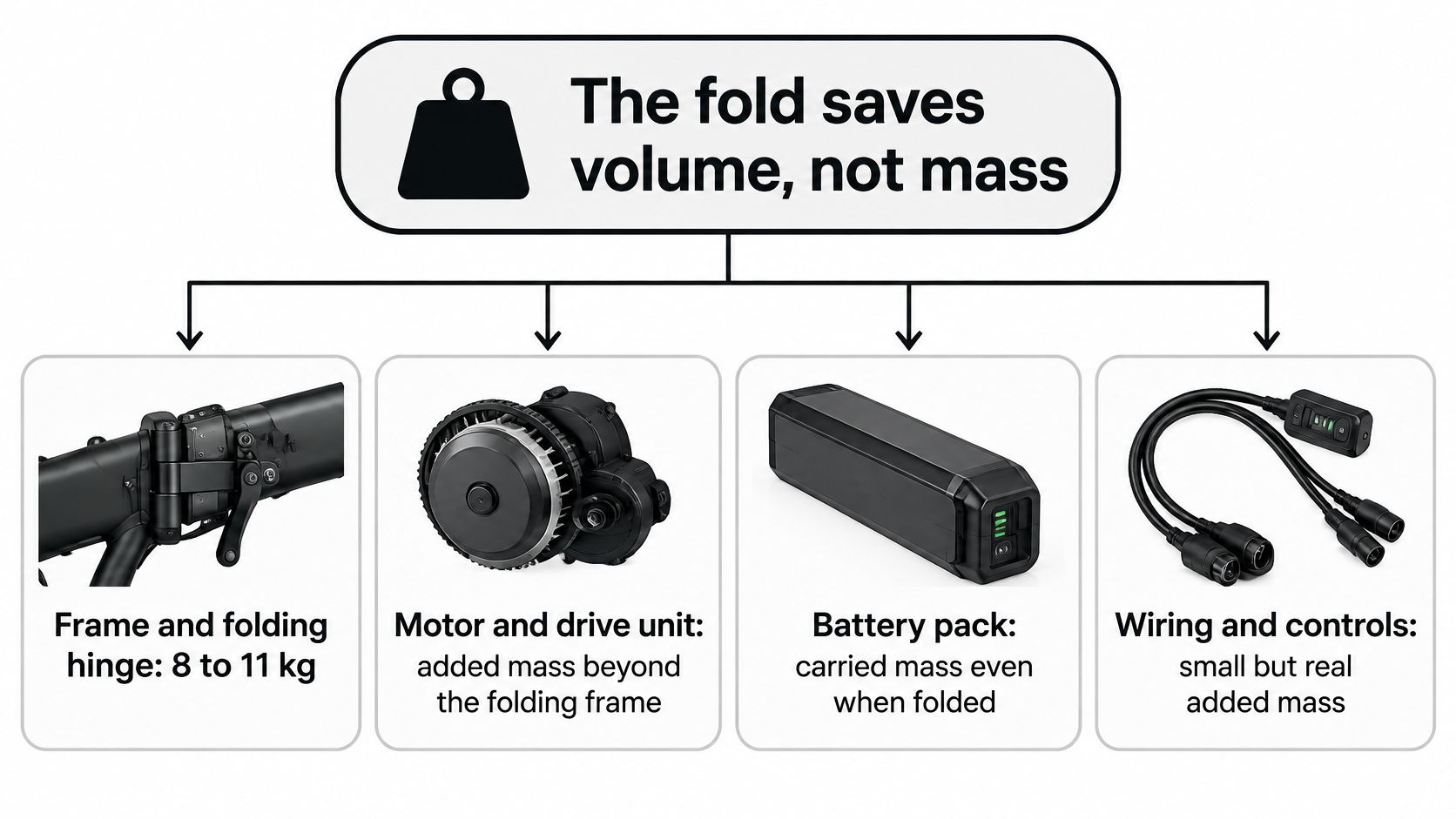
Where the weight comes from
Three components do most of the damage. Texas Instruments' electric-bicycle design note breaks down a typical build at approximately 8–11 kg for a lightweight bicycle structure, 3.0–3.5 kg for a mid-drive motor and 2.5–3.0 kg for a lithium-ion battery with its management system. These are illustrative component masses, not a bill of materials for every folding bike.
| Component | Typical weight | Effect when folded |
|---|---|---|
| Frame and folding hinge | 8–11 kg for the lightweight structure, not the hinge alone | Folding joints remain part of the carried structure |
| Mid-drive motor | 3.0–3.5 kg | Central placement influences folded balance |
| Lithium-ion battery with management system | 2.5–3.0 kg | A detachable pack can be carried separately |
| Wiring, controller and display | Roughly 1–3 kg combined | Distributed through the frame, so it can't be repositioned or left behind |
Don't add those figures together and call the result a model specification. Hub motors use a different arrangement, frame construction varies, and racks, suspension, tyres and mudguards all land on top of the electrical mass.
That's also why equipment choices are really weight choices. Longer range means a bigger battery. Comfort equipment has a physical cost: suspension hardware and substantial tyres stay attached when you close the hinge, and the extras that make a bike pleasant to ride are the same extras you feel on a staircase.
Balance matters as much as packaging
Compact dimensions alone don't establish practical portability. A PubMed-indexed intermodal-vehicle study described conventional folders available at the time as typically weighing 12–15 kg and occupying about 100 litres, against a research target of 5 kg maximum and roughly 20 litres, and its emphasis on ergonomic testing is the useful takeaway.
A centrally positioned load hangs more predictably, but only if you can reach a decent handhold. A protruding pedal or an exposed chain forces the package away from your leg, and that small gap is what makes a manageable kilogram figure feel heavy by the third flight of stairs.
For a detachable-pack design, inspect the release mechanism before buying. A stiff or fiddly latch is the difference between a battery you'll remove and one that stays on the bike. Our guide to an electric bicycle with a removable battery covers what to check in that mechanism.
How to Test the Real Carry Weight
Published weight isn't carry weight. You lift the bike you use, including the equipment that makes the commute possible, not a stripped display model.
Cemotoride's carrying guide explains that lifting difficulty includes grip quality, load distance, height, repetition and twisting, and notes that removing a detachable battery can reduce the load by approximately 2–4 kg. The important question is whether that saving makes your actual route manageable.
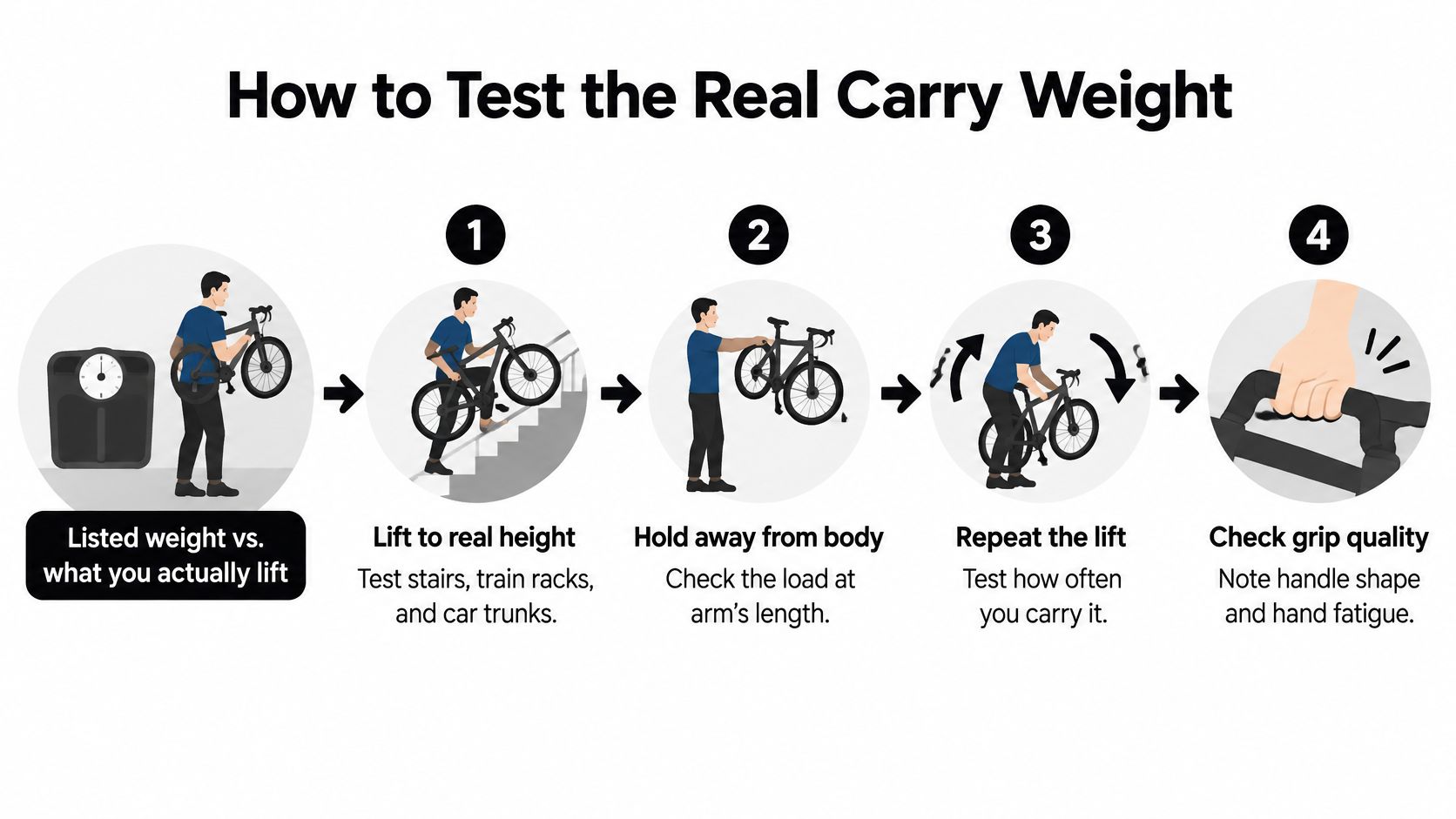
Run a route-specific carrying trial
Treat the repetitions and distances below as a suggested practical trial, not a certified lifting assessment. Start on level ground with help nearby, and stop immediately if you feel pain, lose balance or can't control the package.
- Weigh the configured bike. Use a suitable platform scale with pedals, rack, mudguards, lock and your normal bag included. Record what's attached so you can compare another bike fairly.
- Remove the battery and weigh again. Follow the manufacturer's removal procedure with the electrical system switched off. Check whether removing the pack requires unfolding the frame, moving the saddle or handling an awkward connector.
- Find the folded balance point. Secure the folded bike using its intended latch or retention system, then identify the manufacturer-approved handhold. Don't lift by cables, the display or a component that can slide.
- Try the actual loading height. As a proposed trial, lift from the floor to waist height and then to your car boot height up to five times, provided each lift remains comfortable. Keep the load close, move your feet rather than twisting, and don't attempt an overhead shelf.
- Test your stairs with support available. If the level-ground test is easy, try one flight up and down, then repeat without the battery if the design allows. Keep the route clear and don't continue if carrying the bike prevents you from using the stairs safely.
- Check folded rolling. Try a suggested 50-metre roll on a clear, level route. Check whether the wheels track straight, the folded assembly stays secured and you can steer without repeatedly lifting it.
Judge the whole task
Removing the battery doesn't eliminate its weight from your journey. You still need somewhere secure to carry it, preferably without occupying the hand you need for balance.
If you can't repeat the loading and stair tasks comfortably without stopping to recover, the bike is too heavy for that route in that configuration.
Don't push through wrist strain to justify a purchase. A manageable demonstration should feel controlled, not like a test you narrowly passed.
What You Give Up for a Lighter Frame
A lighter complete bike may use a smaller battery, simpler equipment or more expensive construction. It doesn't automatically have a weaker motor, and a light frame doesn't guarantee a light ready-to-ride package.
The useful trade-off is between carrying convenience and the capability your route needs. Saving weight by deleting equipment you'll immediately reinstall isn't much of a saving.
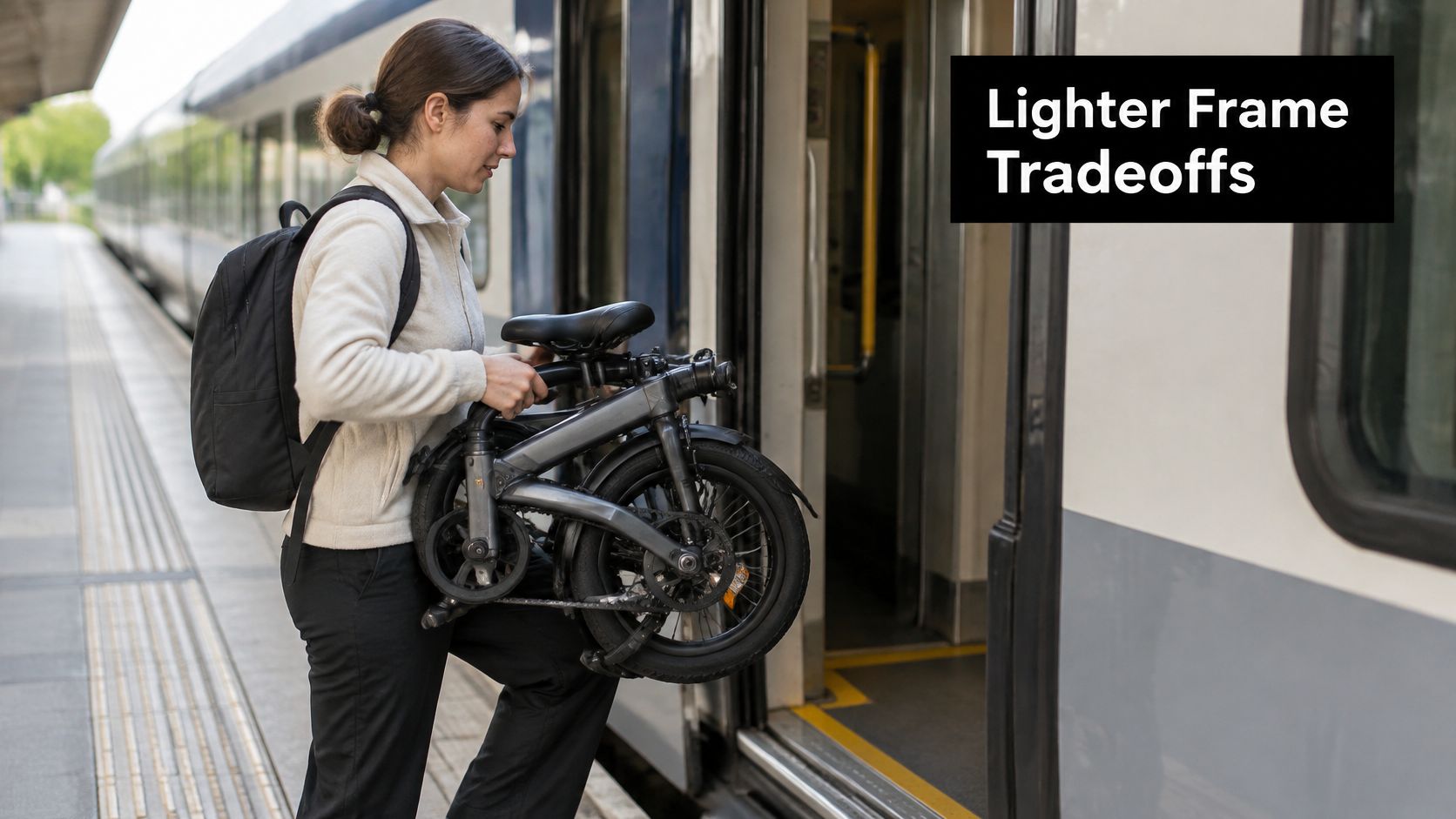
Match the compromise to your commute
- Ground-floor storage and occasional boot loading. Start with the mainstream shopping band and prioritise usable range, fit and hill performance. An occasional controlled lift may be an acceptable compromise for a bike that handles the whole journey comfortably.
- Stairs at each end of the day. Begin with compact premium designs, then test the configured package rather than trusting the category name. A convenient handhold and straightforward battery removal matter more here than equipment you rarely use.
- Repeated multi-floor carrying. Start with ultra-light designs and check whether the folded bike rolls between lifts. A smaller battery can make sense when the cycling distance is short and charging is convenient.
These are shortlist rules, not personal lifting limits. A rider's strength, mobility, landing space and ability to use a handrail can change the answer completely.
Don't trade away the reason for buying assistance
Lower vehicle mass helps energy efficiency, but hill performance also depends on motor torque, gearing, control behaviour and the total rider-and-bike load. A heavier bike with suitable gearing and assistance can be the better hill-climbing tool.
Say you're comparing a hypothetical 15 kg bike for a 15-minute ride with a 12 kg alternative. The lighter option only wins if its battery, gearing and assistance still meet the journey; insufficient battery capacity causes charging problems, while insufficient climbing support makes steep sections harder.
Don't confuse those problems. A more powerful motor doesn't mean fewer charging stops, and advertised wattage alone doesn't describe how naturally the assistance works.
A detachable battery offers another compromise: retain the capacity for riding, but split the load for transport. That's useful only when handling the separate pack doesn't make the journey more awkward.
Choose your maximum manageable carry weight first, then select the most capable bike beneath it. Don't buy extra range merely because it looks reassuring on a specification sheet.
UK and EU Weight and Power Limits
Power, assistance speed and operating behaviour determine legal classification more directly than portability does. A lightweight folder isn't automatically a standard road-legal pedal-assist bicycle, and folding the frame doesn't change the electrical rules.
Suffolk County Council's e-bike safety guidance describes the standard UK EAPC conditions as pedal assistance, a maximum continuous motor rating of 250 W, and assistance progressively cutting out before 25 km/h, or 15.5 mph. The ZIV EPAC technical statement sets out the EU exemption using 250 W and 25 km/h, with assistance stopping when pedalling stops.
UK and EU e-bike rules compared
| Rule | UK (EAPC) | EU (EPAC) |
|---|---|---|
| Maximum continuous motor power | 250 W | 250 W |
| Assistance cut-off speed | 25 km/h (15.5 mph) | 25 km/h |
| When the motor assists | Pedal assistance required | Only while pedalling; stops when pedalling stops |
| Maximum unladen mass | 40 kg including battery, historical consultation figure | No mass threshold established by the cited EPAC statement |
| Throttle-only operation | Don't assume ordinary EAPC treatment; check approval requirements | Outside the ordinary pedal-assist exemption |
The table's electrical thresholds come from the guidance immediately above. Continuous rated power is the relevant specification, not an attention-grabbing peak-output claim.
Treat the weight figure carefully
A UK government consultation document identified a 40 kg maximum unladen mass including the battery, with 60 kg for tandems and tricycles. That is a historical consultation figure, not sufficient evidence on its own of today's applicable UK weight rules.
A particularly heavy folder deserves a careful classification check, but don't use that document to decide whether a current purchase is lawful. Check current government guidance, the vehicle's approval status where relevant, and the requirements in the country where you'll ride.
Throttle descriptions need equal care. Walk assistance, pedal-dependent controls and propulsion without pedalling aren't interchangeable, so a listing that says throttle doesn't answer the legal question.
Our guide to whether electric bikes are street legal provides a starting point for those checks. Before comparing weight, establish the continuous motor rating, assistance cut-off and how the controls operate.
Spec Sheet Checks Before You Buy
A useful listing should let you distinguish riding weight, lifting weight and storage size. If it only gives a lightweight frame claim, you haven't yet got a usable portability specification.
Build a comparison sheet rather than switching between product tabs and trying to remember which figure excluded the battery. Record missing information explicitly instead of assuming the most favourable interpretation.
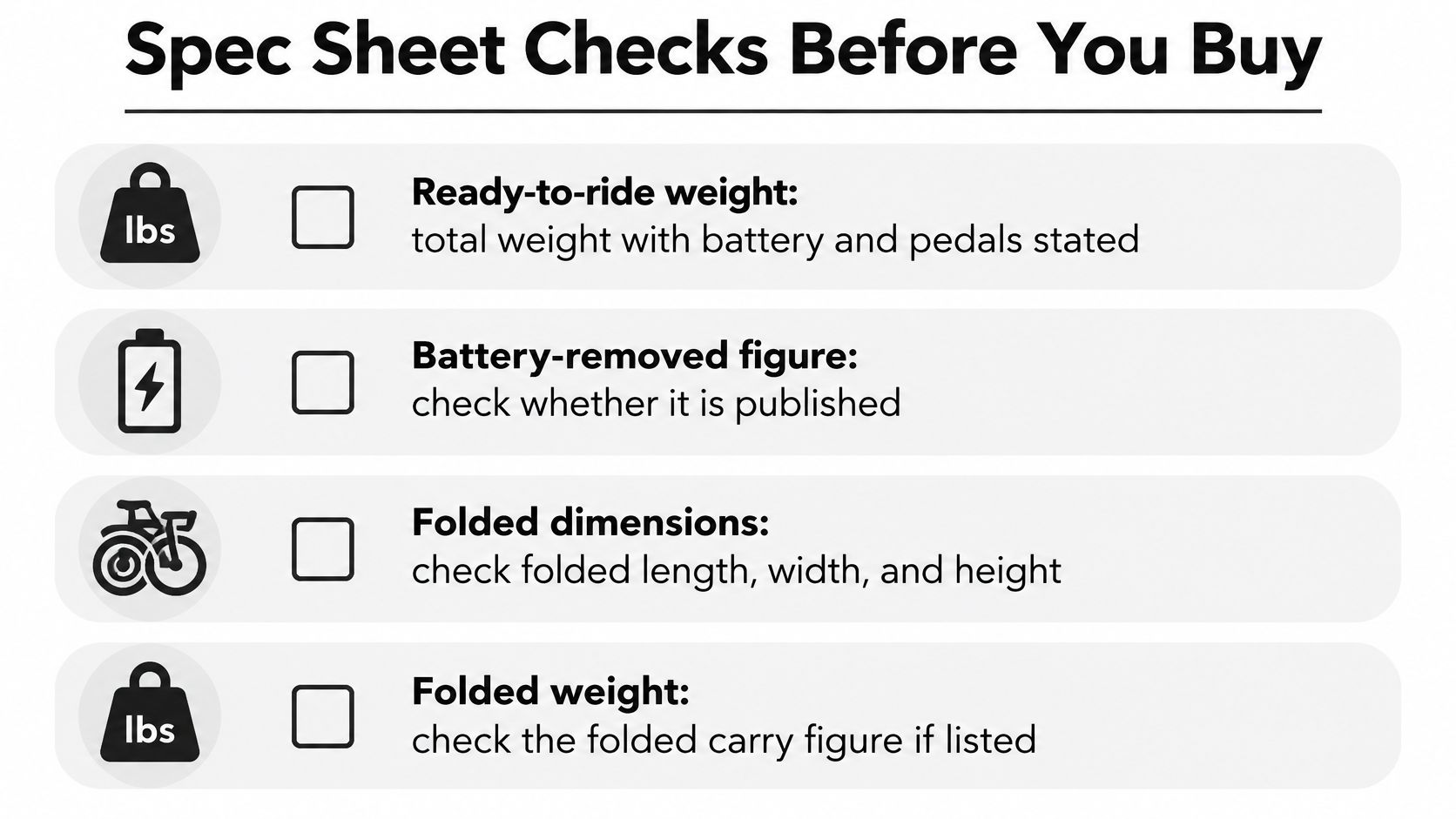
Separate the essential measurements
| Check | What to establish | Why it matters |
|---|---|---|
| Ready-to-ride weight | Battery, pedals and display included or excluded | Makes headline figures comparable |
| Battery-removed weight | Complete bike after pack removal | Establishes the load for a split carry |
| Folded dimensions | Length, width and height in the secured configuration | Determines whether it fits your space |
| Folded volume | Published volume and measurement method | Helps compare packages with different shapes |
| Electrical specification | Continuous motor rating and assistance cut-off | Supports the legal check |
| Battery and range | Capacity in watt-hours and conditions behind the range claim | Shows whether the riding capability fits |
| Wheels and payload | Wheel size and definition of the load limit | Helps assess fit, luggage and intended use |
Don't treat bounding-box volume as a promise that the bike will slide into a particular cupboard. Hinges, handlebars and pedals can snag, while a narrow opening can prevent access to otherwise adequate space.
Measure the opening, not just the space beyond it. For a car boot, include the loading lip and the room you need to place the bike without catching brake hoses or knocking the derailleur.
Resolve the omissions before paying
- Request a configuration statement. Establish whether the quoted weight includes mudguards, rack, lights and accessories, and whether the charger is counted separately as travel luggage.
- Check the rear rack. Confirm whether it's included in the weight and whether its luggage limit is separate from the bicycle's total permitted load.
- Account for your belongings. Compare the payload definition with your body weight, work bag and shopping, rather than treating the full allowance as luggage capacity.
- Inspect transport compatibility. If you'll use a vehicle-mounted carrier, check its load and attachment requirements; our Thule e-bike rack guide covers that separate decision.
A heavier published bike can be easier to lift after battery removal than a lighter bike with a fixed pack. The comparison only becomes meaningful when both listings describe the same configuration.
Pick Your Weight Limit Before You Shop
Set your carrying limit before choosing the bike. Use the weight and handling arrangement you can manage repeatedly, not the heaviest object you can briefly get off the floor.
Consider a hypothetical rider who comfortably handles 15 kg but not 20 kg, with a flight of stairs at home. A compact premium folder is a sensible starting point, but a slightly heavier example still needs testing; the rider shouldn't round their limit upwards because a model looks appealing.
An ultra-light design may justify a smaller battery if the cycling journey is short. By contrast, someone with ground-floor storage and occasional car loading can reasonably shortlist mainstream equipment and give more attention to range, gearing and comfort.
Make a shortlist you can defend
Write down your key requirements before browsing.
- The hardest lift. Name the location, loading height, awkward turn and whether a handrail must remain accessible.
- The daily riding job. Describe the hills, luggage, charging opportunities and storage arrangement.
- The evidence required. Get configured weight, battery-removed weight and continuous motor rating confirmed before paying.
We curate folding and compact e-bikes, including ENGWE folding models such as the T14 and Engine Pro 2.0, alongside step-through options such as the L20. Our ENGWE Engine X Foldable Electric Bike has a sale price of £1,049.00 and is offered in Black, White and Red, while the HIDOES C5 Folding Electric Bike has a sale price of £269.00.
Those prices don't establish carrying suitability or legal classification. Apply the same specification checks to each option, and confirm stock and delivery at checkout.
Buy for the lift you must do every day, not the storage space the bike occupies once you've got it there.
Punk Ride LLC offers a curated selection of electric rides, including folding and compact e-bikes for different commuting needs. Write down your heaviest lift and daily route, then visit Punk Ride LLC to compare suitable options against your carrying limit and confirm the specifications before buying.