You've got a review open, your commute mapped out, and a bike that looks convincing on paper. The reviewer loves the motor, the battery sounds generous, and the photos show lovely smooth roads. Your journey involves a cold morning, a steep climb and a work bag. That's where the useful questions start.
Good electric commuter bike reviews help you judge that journey, not just admire the bike. Look for repeatable tests, clear legal classification and an honest account of what happens after the purchase.
The Five Checks Every Commuter Review Should Cover
Say you buy a bike after reading a glowing review, then find that its range falls short on your cold, hilly commute. The review might not have been dishonest. But if it never recorded the load, weather or route, it didn't give you enough information to make the purchase.
Start with this scorecard rather than the reviewer's overall rating.
Five criteria for judging an electric commuter bike review
| Criterion | What a useful review measures | Red flag |
|---|---|---|
| Comfort | Saddle height range, riding position, suspension and ride over potholes | Specs quoted with no time spent on a real test ride |
| Range | Real miles on a repeatable route with rider and cargo weight recorded | An unsupported maximum-range figure with no conditions attached |
| Reliability | Component failures, service visits and consistency over repeated trips | No mention of repairs or parts after the first few weeks |
| Safety | Brake feel, lighting, tyre grip, battery and charger certification | Certification details missing or vague |
| Value | Price against battery replacement, insurance and theft cover | Price quoted with no running costs |
Score the evidence, not the enthusiasm
I'd score each criterion from 1 to 5 as an editorial judgement: the lowest mark means unsupported praise, the middle means useful observations with gaps, and the highest means clear measurements and limitations. Don't award points just because a reviewer lists expensive components.
Comfort needs more than a soft saddle. Look for usable saddle adjustment, handlebar reach and whether the reviewer could look behind without unsettling the steering. Suspension should be assessed over broken surfaces, not praised because it exists.
Motor behaviour matters too. A commuter should feel predictable when assistance stops, without repeatedly surging as you pedal around the cutoff. That's a ride-quality question a specification sheet can't answer.
Practical rule: If a review skips two or more criteria, treat it as incomplete, however persuasive the writing sounds.
Check whether the reviewer distinguishes a fault, a preference and a limitation. A rattling mudguard needs attention; a sporty position might suit another rider; a heavy frame might be acceptable with ground-floor storage. Those aren't interchangeable criticisms.
Keep this table open while you read. It gives you a way to separate evidence that helps you choose from details that merely make a bike sound appealing.
Test Range and Real Commute Use
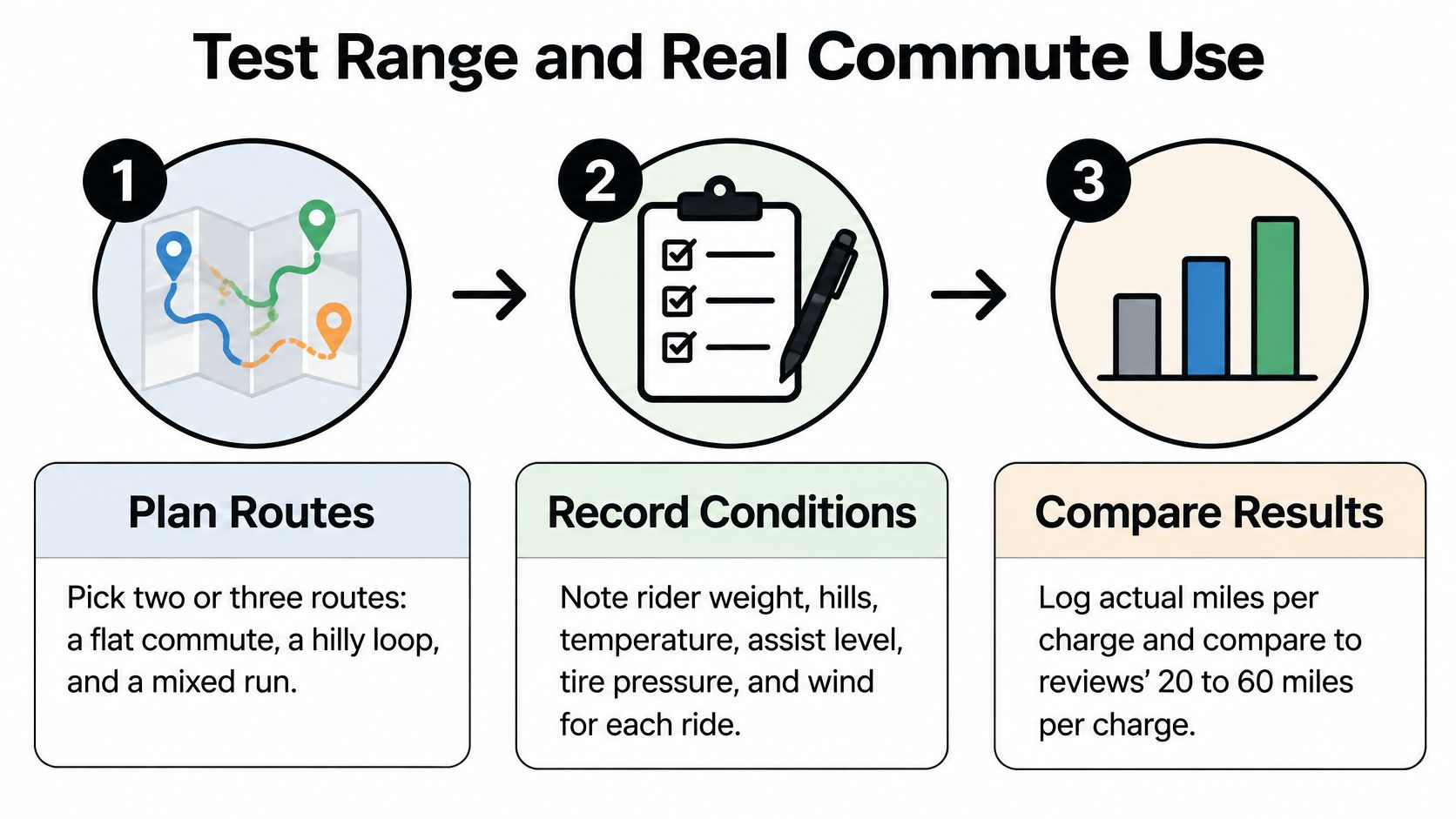
A useful range test starts with a repeatable method. Whether you're assessing a published review or arranging your own trial ride, use this sequence:
- Choose representative routes. Pick two or three: a flat city run, a hilly route and a loaded commute with lights and a pannier.
- Record the load. Include the rider, work bag, locks and anything else the bike carries.
- Record conditions. Note temperature, tyre pressure and wind, using a pressure gauge rather than squeezing the tyre.
- Keep assistance consistent. Use a fixed assist setting and log average speed, while noting unavoidable stops.
- Log the finish. Record distance and remaining battery percentage immediately after riding.
- Compare energy consumption. Divide battery energy used by distance to calculate watt-hours per mile.
Battery percentage only supports an approximation of energy consumption. Multiplying nominal battery capacity by the fraction consumed gives a rough estimate, not a laboratory measurement, because the display and usable capacity may differ. A reviewer should say how they calculated the result.
The basic process is easy to keep beside your ride log.
Match the test to your actual week
The Waterloo WeBike field trial followed more than 30 sensor-equipped e-bikes for nearly three years, finding that commuting was the primary use and most journeys lasted fewer than 20 minutes. Riding was concentrated in summer, charging analysis found no evidence of range anxiety, anticipated use had little correlation with actual use, and participants rated e-bike reliability close to, but slightly below, cars and conventional bicycles.
That doesn't promise an anxiety-free winter commute. It tells you to compare the test with the trips you make, rather than buying for an imagined riding routine.
Ask whether the reviewer needed to charge daily, whether removing the battery was awkward, and whether charging fitted around work. Ask how many repeat trips they completed and which conditions they covered. Consistent behaviour across ordinary journeys is more reassuring than a single impressive outing.
For planning, I'd aim for a 20% range buffer over your round trip as a starting allowance, not a guarantee. Leave more room when charging isn't available at your destination or the route regularly involves detours.
Compare consumption with practicality
Electric Bike Review Lab's ownership guide identifies rider weight, hills, temperature, assistance, tyre pressure and wind as range variables, and cites useful battery life around three to five years. Budgeting for battery replacement therefore belongs alongside range comparisons.
Use our longest-range electric bike guide to frame your shortlist, then prioritise tests resembling your route. A smaller advertised range can be the better fit if consumption is predictable and you can comfortably lift the bike upstairs.
On a trial ride, check saddle and handlebar fit, lift the bike by secure frame points, and assess suspension over representative rough surfaces. Enough range is useful. Enough range in a bike you don't dread handling is better.
Legal Limits Under UK and EU Rules
The fastest bike in a review may be the one you can't legally use as an ordinary bicycle. Treat classification as an early filter, before comparing acceleration or hill-climbing claims.
For Great Britain, the House of Commons Library's EAPC briefing specifies working pedals, maximum continuous rated motor power of 250 watts, assistance cutting off at 15.5 mph (25 km/h) and a minimum rider age of 14, with no registration, insurance, road tax or driving licence required for compliant EAPCs.
Common e-bike limits in the UK and EU
| Bike type | Motor limit | Assist cutoff | Registration and rules |
|---|---|---|---|
| Standard pedelec (UK EAPC) | Up to 250 W continuous | 15.5 mph (25 km/h) | No registration, insurance or licence; riders 14 or over |
| Standard pedelec (EU, typical) | Up to 250 W | 25 km/h | Check national classification and riding rules |
| Higher-powered or faster model | Above 250 W, or a faster assistance setting | Assistance beyond 25 km/h can change classification | Motor-vehicle rules may apply |
The EU row is a typical pedelec pattern, not blanket permission for every country or route. Also, a bike needn't exceed both power and speed thresholds before its classification becomes a concern.
Check the actual version being reviewed
A useful review names the market version, states continuous rated power, and explains the assistance cutoff. Peak-power advertising isn't a substitute for that information.
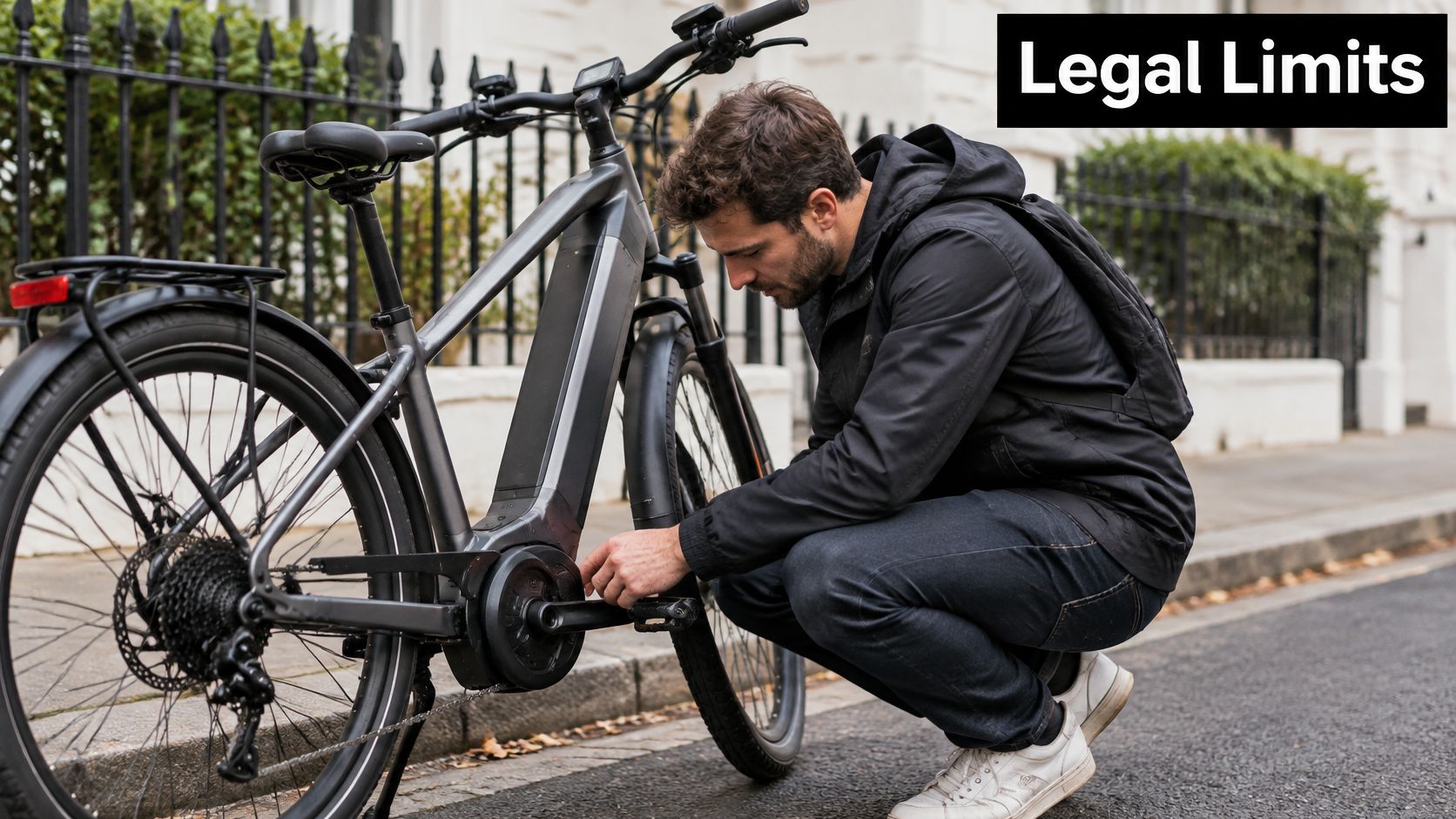
Inspect the motor label as well as the sales headline.
Be cautious when a review celebrates a higher-speed setting without explaining the consequences. A selectable restriction doesn't, by itself, establish that the exact bike qualifies as a compliant pedelec.
The cutoff concerns electrical assistance, not an absolute cap on how fast you can pedal or coast. A reviewer who confuses those points may also misunderstand the model's classification.
A road-legal claim should identify the exact bike configuration and market, not just repeat the seller's wording.
Public transport adds another check. Operators can have different carriage conditions for non-folding bikes, so confirm acceptance for your actual service rather than assuming a bicycle ticket settles it.
Before trusting any performance claim, compare the motor label, assistance cutoff and manufacturer's specification for the version you'll receive.
Legal Limits in the US and Australia
A US or Australian review needs to identify legal class, not merely report top speed. These markets use different definitions, and an overseas review may describe a configuration that isn't suitable for your location.
The US federal bicycle-transportation statute defines qualifying e-bikes as having fully operable pedals, a seat and a motor producing less than 750 watts, with class cutoffs of 20 mph for Classes 1 and 2 and 28 mph for Class 3, while preserving state and local restrictions.
Legal limits in the US and Australia
| Market and class | Motor limit | Assist cutoff | Rules |
|---|---|---|---|
| US federal Class 1 | Under 750 W | Pedal assist only, cuts off at 20 mph | State and local rules still apply |
| US federal Class 2 | Under 750 W | Propulsion without pedalling, no assist at or above 20 mph | State and local rules still apply |
| US federal Class 3 | Under 750 W | Pedal assist only, cuts off at 28 mph | State and local rules still apply |
| Australia power-assisted pedal cycle | Up to 250 W | 25 km/h, or above 6 km/h without pedalling | Models above limits may be treated as road vehicles |
The Australian infrastructure department's importer guidance describes an EN 15194-style cycle with maximum motor output of 250 watts, assistance ending at 25 km/h or when pedalling stops above 6 km/h; models exceeding the limits may require road-vehicle import approval and compliance with national vehicle standards.
Apply the market check
Check the declared class, the motor rating and the assistance behaviour against the bike's documentation. Then check your state, city and intended paths rather than assuming the national definition grants access everywhere.
Use this video alongside the written specifications, not instead of them.
Our guide to whether electric bikes are street legal can help organise those checks. Keep electrical-safety certification separate from road classification: evidence for one doesn't establish the other.
Safety Gaps Reviews Often Skip
A prospective German study published in BMJ Open Sport & Exercise Medicine monitored 1,250 e-bike users and 629 conventional-bike users over four consecutive weeks, finding that 22.4% of e-bike users reached the WHO target of at least 150 minutes of moderate-to-vigorous activity weekly, compared with 35.0% of conventional cyclists; after controlling for cycling time and frequency, the accident odds ratio for e-bike users was 1.63, with a 95% confidence interval of 1.02 to 2.58.
The basic accident comparison wasn't statistically significant. The adjusted association doesn't establish that e-bikes are unsafe or prove a particular bike caused accidents.
It does give reviewers a reason to examine more than motor response. Convenience, physical effort and safe handling deserve separate assessments.
Look beyond the brake specification
Apply this checklist to the review or a supervised trial ride:
- Wet braking: Look for controlled wet-condition testing, lever feel and predictable braking response. Don't conduct emergency-stop experiments in traffic.
- Lighting: Check whether lights use the main battery or separate cells, whether luggage blocks them, and whether the front beam illuminates your route.
- Visibility and signalling: Check bell and mirror placement, plus whether you can signal without wobbling.
- Low-speed handling: Assess tight turns, walking alongside the bike and starting with a loaded pannier.
- Rider controls: Make sure assistance buttons are reachable without releasing your grip or staring down at the display.
Brake brand alone won't tell you how confidently the bike stops. The reviewer should describe modulation, hand effort and whether the tyres maintained grip under the tested conditions.
Our e-bike accessories guide can help identify useful additions, but accessories shouldn't excuse poor basic handling.
Health claim check: Arriving less sweaty and completing an exercise session are different outcomes.
Assistance can make a journey manageable without delivering the exertion a reviewer implies. Judge transport efficiency on the journey completed, and exercise benefits on the effort required.
Value and Ownership Costs Over Three Years
Our ENGWE M20 Single-Battery Electric Bike is £839.00, offered in Green, White and Black, while our ENGWE L20 Boost Step-Thru Electric Bike is £1,099.00, offered in Green and Black. That purchase-price gap matters, but it isn't the whole ownership comparison, and price alone doesn't establish road suitability.
The NTSB docket specialist study includes proposed safety recommendations emphasising third-party testing of complete electrical systems and batteries. For a buyer, that makes identifiable certification evidence more useful than an unexplained safety badge.
Build a commuter risk profile
Before deciding that a bike is good value, record:
- Electrical evidence: Identify the certification, covered model and testing body. Confirm that the supplied charger is approved for that battery.
- Replacement availability: Establish whether a compatible battery and charger can be purchased in your region.
- Repair access: Identify a workshop willing to handle the electrical system, not just replace tyres.
- Parts lead times: Check availability of proprietary displays, controllers and connectors.
- Theft protection: Plan secure storage and suitable locks, then read insurance conditions and exclusions.
- Warranty and transport: Check labour, shipping and battery terms, plus compatibility with your intended transit services.
Use an itemised worksheet rather than a single purchase-price comparison.
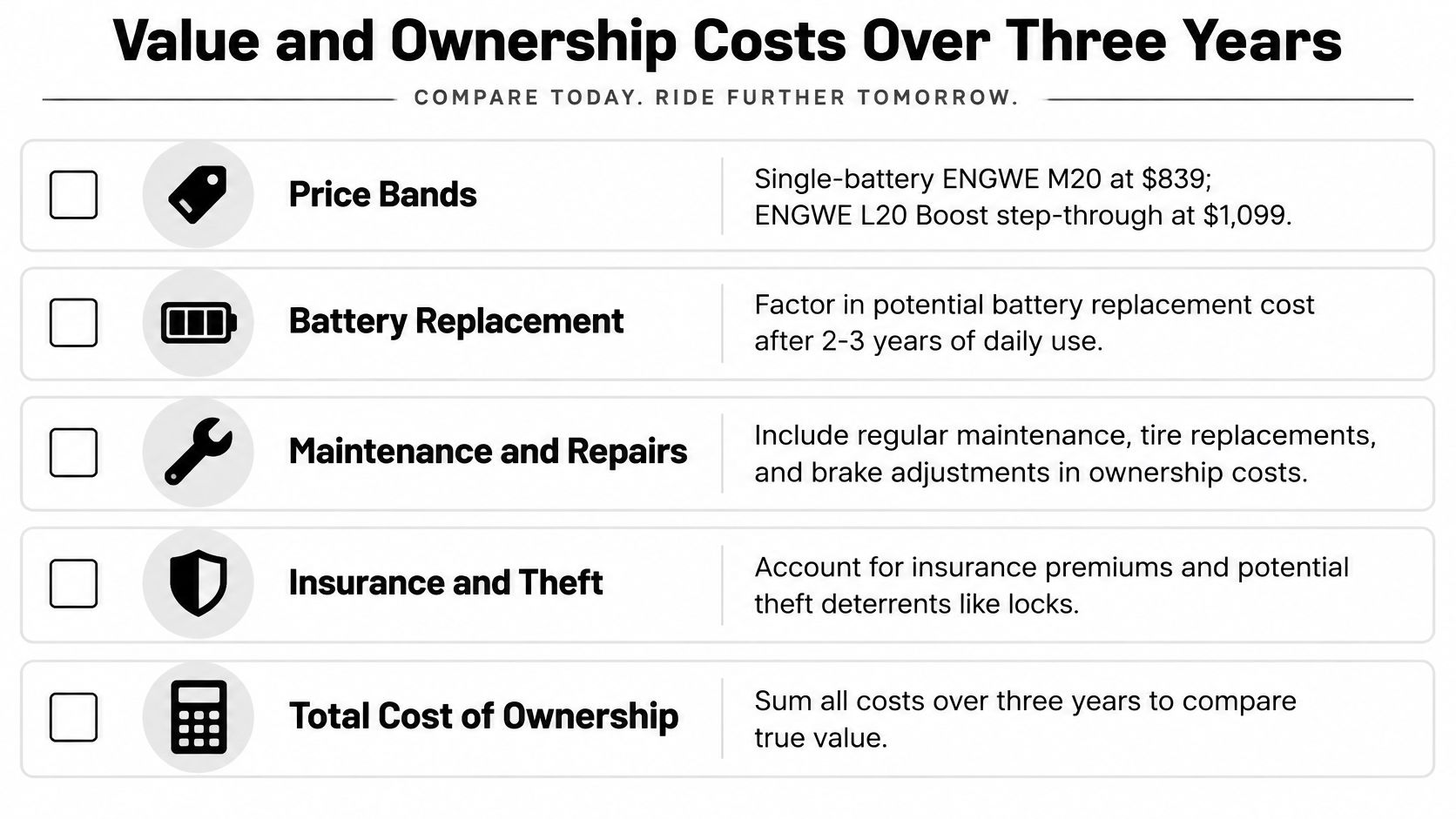
Treat battery replacement as a budget scenario, not a promise that it will fail within your chosen ownership period. Obtain the current replacement price and include maintenance, tyres, brake work, security equipment and insurance.
A cheaper bike with obtainable parts can cost less to keep usable than a dearer model awaiting proprietary spares. Conversely, a low purchase price offers little comfort if its classification prevents your intended use.
Write down a three-year cost including one battery replacement and insurance, then compare the bikes using that figure. Keep any unconfirmed cost clearly marked rather than treating it as zero.
Pick the Review That Fits Your Commute
Write down your commute before opening another ranking: distance, hills, weather, charging opportunities and luggage. Add where the bike will live and every place you'll need to lift it.
For a separate specification cross-check, HearSmart's electric bike specs and prices can help you assemble a comparison sheet. Treat it as a reference, not a replacement for route testing.
Make the shortlist earn its place
- Evidence: Does the review cover comfort, range, reliability, safety and value?
- Route relevance: Were conditions recorded on a repeatable journey resembling yours?
- Practical ownership: Does the legal classification fit your market, with realistic running costs and support?
Our ENGWE range includes folding models such as the T14 and Engine Pro 2.0, and step-through options such as the L20. Folding can help with storage and permitted transit carriage; step-through access helps with mounting, but doesn't automatically make a bike easier to carry upstairs.
A standard frame can be perfectly practical with secure ground-floor storage. Match frame design to handling and access rather than assuming a particular shape solves every problem.
Shortlist the two bikes that pass these tests, record their three-year costs including a replacement battery and insurance, and choose the one that fits your commute. Don't let the biggest advertised range make the decision for you.
Punk Ride LLC offers city and commuter e-bikes, folding models, step-through options and accessories, with free delivery on all orders. Visit Punk Ride LLC with your route notes and cost checklist to compare the bikes that suit your daily journey.