The advice on most shopping pages is to buy the fastest throttle bike you can afford and sort out the label later. That's the wrong order. In the US, a Class 3 e-bike is defined by pedal assist that stops at 28 mph, and a throttle that drives the bike without you turning the cranks belongs to Class 2, where assistance stops at 20 mph. A listing that reads "Class 3 with throttle" is usually a bike built against a different rulebook than the sticker suggests.
The best Class 3 ebike with throttle isn't the one with the highest top speed. It's the one whose throttle is capped at a speed that's legal on the streets you ride, with a pedal-assist cutoff and motor rating to match. That's a less exciting headline and a much better purchase.
What follows is the framework I'd use to judge any listing in about five minutes: three numbers, one comparison table, a test you can run in a shop doorway, and a short list of questions to put to the seller in writing before money changes hands.
Why a Throttle Breaks the Class 3 Label
A throttle that propels a bike without pedalling usually puts it outside the strict Class 3 definition. The Congressional Research Service's summary of US e-bike law explains the distinction: Class 3 requires operable pedals and motor assistance only while pedalling, with assistance cutting out at 28 mph. Class 2 permits a handlebar throttle to propel the bike without pedalling, but motor assistance must stop at 20 mph. Both classes have a 750 W motor ceiling.
A listing that calls a bike “Class 3 with throttle” needs closer inspection. The throttle may be limited, or its use may depend on state law. The label alone does not settle whether the bike qualifies. More than 39 states have adopted the three-class system, but rules differ on throttle use, helmets, minimum age, licensing and bike-lane access.
Check three specifications before relying on the label:
- Throttle cutoff: the speed the motor reaches with no pedalling.
- Pedal-assist cutoff: the speed at which assistance stops while you pedal.
- Continuous motor power: the motor's rated output, which affects whether the bike fits bicycle rules in the UK and EU.
Start with the throttle spec: if the throttle can propel the bike faster than walking pace, check the applicable rules before treating the Class 3 label as reliable.
The same bike can be legal in one place and restricted in another. A bike permitted on Florida streets may be treated as a motor vehicle in Manchester or Munich, so there is no single recommendation that works across all three markets. The practical choice is the bike whose throttle and pedal-assist limits fit the streets where you ride, not the one with the highest advertised speed.
Legal Speed and Power Limits by Market
Compare the legal limits before judging a bike by its advertised top speed. The same motor and throttle can fall into different categories depending on where you ride, and the table shows why a single “Class 3” label cannot settle the question.
| Market | Motor limit | Pedal-assist cutoff | Throttle limit |
|---|---|---|---|
| UK electrically assisted pedal cycle | 250 W continuous | 15.5 mph (25 km/h) | 3.7 mph walk assist only |
| EU pedelec exemption | 250 W continuous | Before 25 km/h, reducing progressively | Pedalling only in the standard category |
| US Class 2 | Under 750 W | 20 mph | Throttle can propel to 20 mph |
| US Class 3 | Under 750 W | 28 mph | No throttle in the strict definition |
| California e-bike rules | 750 W | 28 mph | Throttle up to 3.7 mph in walk mode |
| Australia | Set by state road rules | Set by state road rules | Set by state road rules, confirm with your state authority |
Britain sets a comparatively narrow boundary for an electrically assisted pedal cycle. The bike must have pedals that can drive it, a motor rated at no more than 250 W continuous, and assistance that cuts out at 15.5 mph (25 km/h). Riders aged 14 years old or over can use a compliant bike without a driving licence, registration, vehicle tax or insurance, as the UK government's electric bike rules explain. A bike advertised as Class 3 with assistance above 25 km/h does not fit the ordinary category and may instead be treated as a motor vehicle.
The EU exemption also depends on how the motor operates, not just its rating. The motor must stay at or under 250 W continuous, assist only while the rider pedals, reduce assistance progressively and cut off before 25 km/h. These conditions let qualifying pedal cycles avoid motor-vehicle type approval under the EU pedelec and type-approval rules. Exceeding a condition can bring national vehicle, insurance or approval requirements into play.
The US rows separate two different trade-offs. Class 2 allows a throttle to propel the bike up to 20 mph; Class 3 allows pedal assistance up to 28 mph but excludes a throttle in the strict definition. A bike cannot claim both definitions at once. California is a narrower case in this comparison: the listed throttle allowance reaches only walk mode, while pedal assistance can reach 28 mph. Check the rules for the state and route where you plan to ride, rather than treating a US class label as a universal permission.
Reading a row correctly
Australia does not map cleanly onto the US three-class system. Before buying or riding, confirm the motor rating and assistance cutoff with the relevant state transport authority. Check local road and shared-path rules separately, since a limit that applies to the bike does not by itself establish where it may be ridden.
The row that decides it: if the throttle works above walking speed on a UK bike, the bike is outside the ordinary pedal-assist category, regardless of the motor badge.
For US riders, state rules can change how a class label applies in practice. Use this guide to electric bike laws by state to compare local requirements before choosing a throttle setting or route.
Throttle Rules That Decide UK and EU Legality
A throttle can make an e-bike a poor fit for UK or EU roads, even when its motor rating looks modest. The key question is whether it propels the bike without pedalling, and how fast that assistance continues.
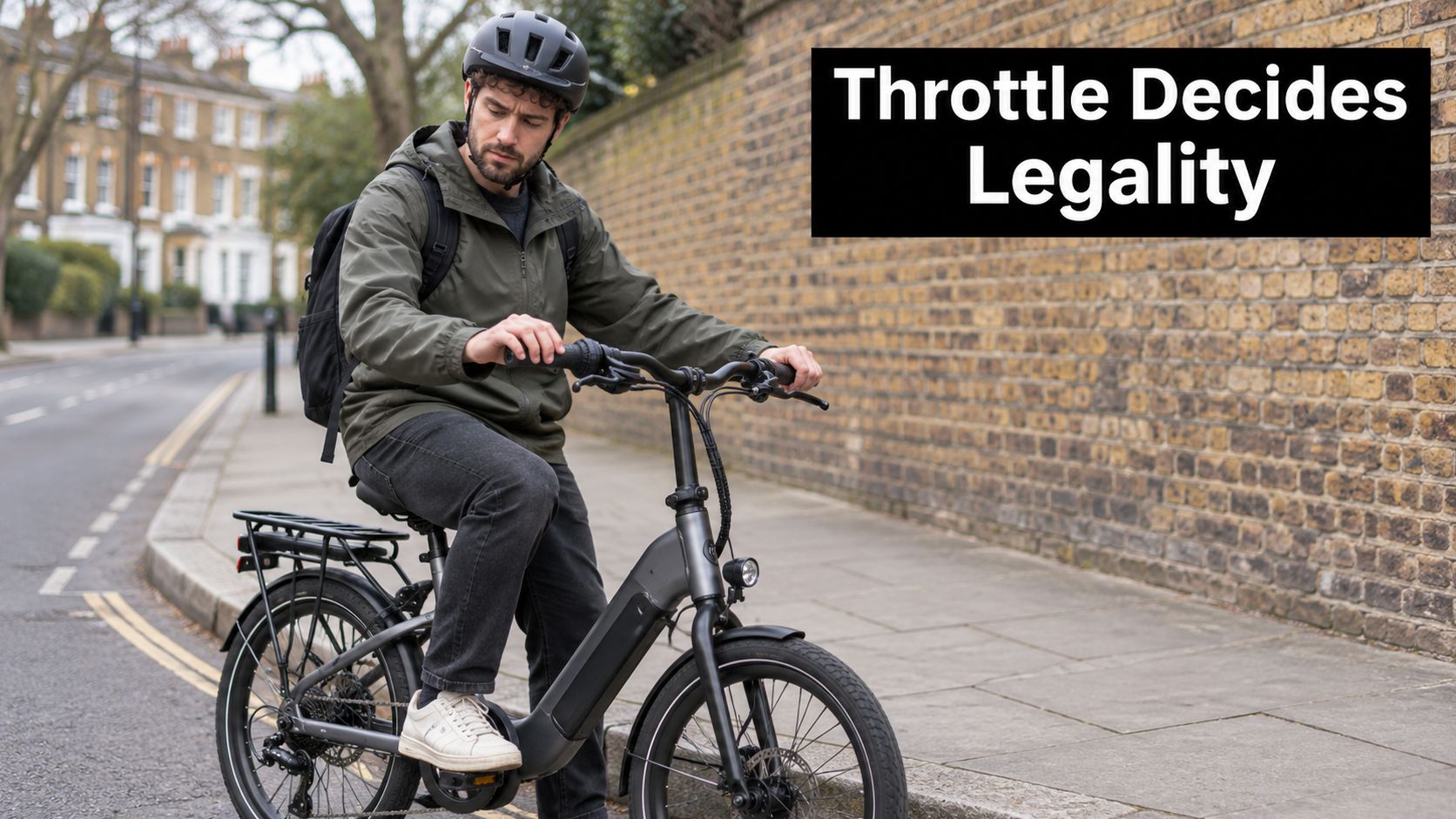
For ordinary UK pedal-assist use, the motor should assist only while you pedal, stop assisting at 15.5 mph, and limit walk-assist to 3.7 mph (6 km/h). A throttle that propels the bike above walking pace can put it outside the standard pedal-cycle category. Check Transport for London's e-bike safety guidance alongside the rules that apply where you plan to ride.
EU pedelec rules also distinguish pedal assistance from propulsion without pedalling. A throttle that drives the bike independently may take it outside the standard bicycle category, leaving national approval, insurance or registration requirements to consider. A throttle is not automatically illegal throughout Europe, but its operation can change how the vehicle is classified.
The five minute throttle test
Use these steps before buying, with the seller's permission and in a safe place:
- Switch on the bike without pressing the pedals.
- Press or twist the throttle, then watch the speed display.
- Note whether motor power stops at walking pace or continues beyond it.
- Check the manual for a separate walk-assist setting. Walk assist and a throttle may use similar controls, but their operation can differ.
- Ask the seller to identify the UK or EU rules the bike is intended to meet, and request written confirmation of its throttle cutoff and relevant settings.
A class label alone does not settle the question. The actual throttle behaviour matters, so get a clear answer about the cutoff and any relevant firmware setting before paying.
If the throttle propels the bike above walking pace, do not assume it qualifies as an ordinary pedal cycle. Check the rules for the country where you plan to use it, including any approval, registration or insurance requirements. The most suitable throttle is the one whose operation fits the roads you ride, not the one with the highest top speed.
Specs to Compare Before You Buy
Turn the framework into a shopping tool. Five criteria carry most of the weight, and the UK/EU target sits next to the US one so you can see where a single bike can't serve both.
| Criterion | UK and EU target | US target | Why it matters |
|---|---|---|---|
| Throttle cutoff | 3.7 mph walk assist only | 3.7 mph walk mode in California; 20 mph for Class 2 | Decides whether the bike is legal to ride |
| Pedal-assist cutoff | 15.5 mph (25 km/h) | 28 mph for Class 3 | Sets top speed under motor power |
| Continuous motor power | 250 W maximum | Under 750 W | Separates pedal-assist bikes from motor vehicles |
| Speedometer | Useful at the 15.5 mph cutoff | Required under many state Class 3 frameworks | Shows where assistance stops |
| Brakes | Strong, well-adjusted brakes | Same, with more weight on braking above 20 mph | Stopping matters more as speed rises |
The throttle cutoff row settles legality. Pedal-assist cutoff sets your real cruising speed. Motor rating decides which side of the bicycle/motor-vehicle line you're on. The DDOT e-bike guide is worth reading on this point: throttle assistance above 20 mph, pedal assistance above 28 mph, or a motor over 750 W takes the vehicle outside the state's e-bike definition and can pull in moped or motorcycle requirements.
Brakes deserve their own line because speed raises the stakes. A US Department of Transportation review summarised in the FHWA e-bike fact sheet found injury severity was slightly higher for Class 3 bikes than Class 1, which is an argument for hydraulic discs or well-adjusted mechanical brakes with fresh pads, plus a headlight you'd trust at dusk.
Two listings read against the table
Apply the rows to real stock rather than theory. The NAKTO F2 Plus is a 750 W fat-tyre electric bike listed at £827.47. That motor rating sits above the UK and EU 250 W continuous limit, so in those markets it isn't a pedal-assist bicycle regardless of how the listing is titled. In the US it's a perfectly usable machine, and you'd want the throttle and pedal cutoffs confirmed before assuming which class it lands in.
The ENGWE Engine Pro 2.0 starts from £1,299.00 and comes in Black, Green or Blue. Before buying, pull the throttle cutoff, the pedal-assist cutoff and the firmware mode out of the product page or ask us directly, because the colour choice is easy and the cutoff isn't.
Compare those specs before you compare prices. A cheaper bike with a documented walk-assist-only throttle is worth more than a faster one you can't legally ride to work.
If you're weighing motor layouts as well, our guide to the e-bike mid motor explains how drive position changes hill performance and brake load.
Battery Checks That Prevent Fire Risk
Speed and range dominate product rankings. Fire risk doesn't get a column, and it should. UK authorities recorded 267 e-bike and e-scooter fires in 2025, and batteries or generators were the ignition source in 235 cases, or 88% of reported incidents, according to the government report on fires in e-bikes and e-scooters.
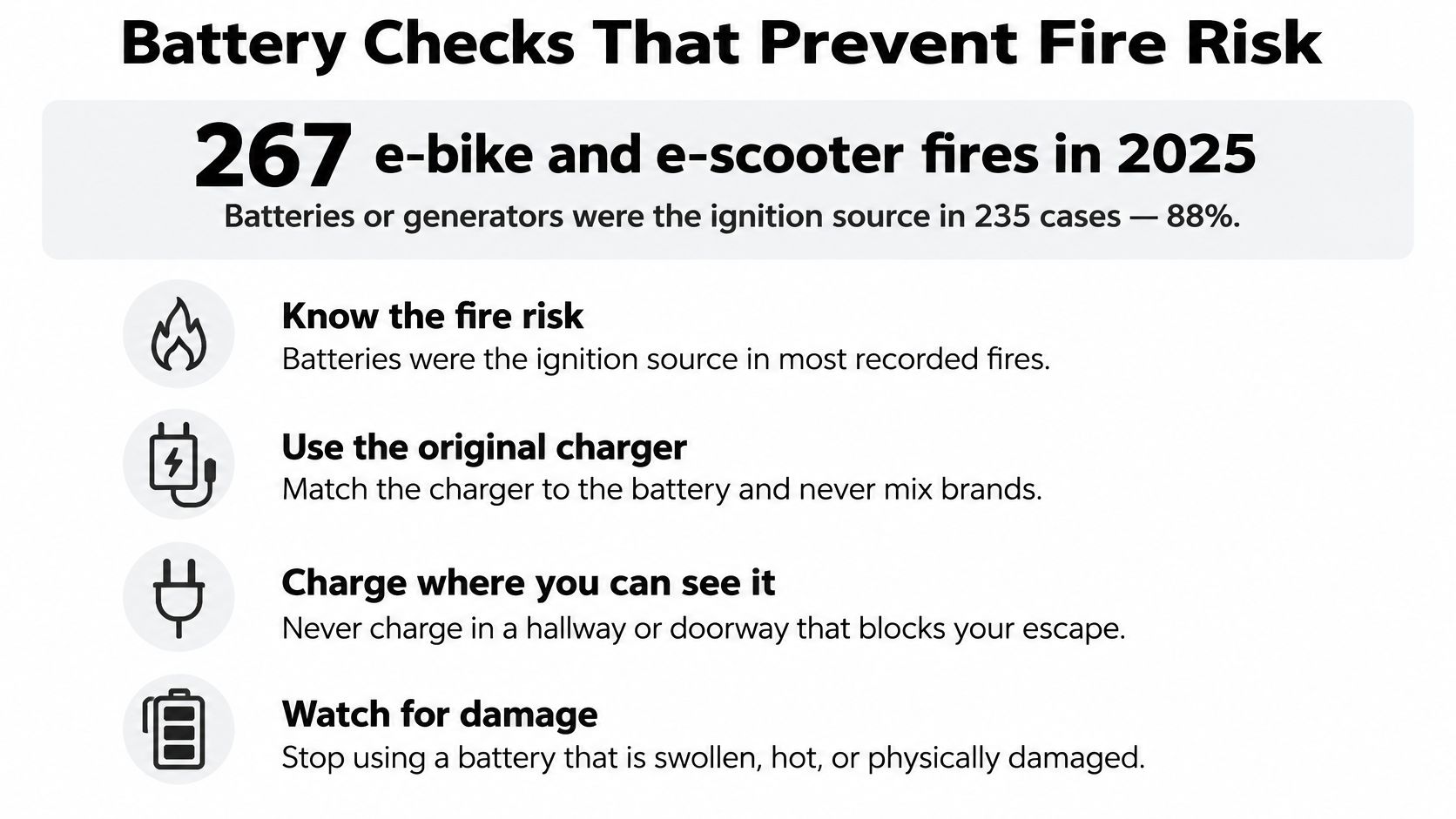
A high-powered throttle bike with a big pack deserves the same scrutiny as its motor. The useful benchmark isn't "lithium-ion cells", it's a documented third-party certification for the exact battery and charger combination. UL 2849 certification evaluates the integrated electrical system, covering the drive train, battery, charger and their combinations, while UL 2271 addresses batteries used in light electric vehicles. New York City requires applicable e-bikes and electrical systems sold, leased, rented or distributed there to carry certification from an accredited laboratory, and the US Consumer Product Safety Commission has urged manufacturers, retailers, importers and distributors to follow established micromobility safety standards.
The checklist I'd run before paying
- Certification mark and scope. Confirm the mark covers the whole system, not just the charger.
- Battery and charger as a set. A certified pack with a mismatched charger isn't a certified system.
- Seller recall history. Search the brand name with "recall" before you search for reviews.
- Charger output compatibility. Match voltage and current to the pack, and never mix brands.
- Storage temperature guidance. Ask for it in writing, especially if the bike lives in a shed or a hot garage.
- Damaged-pack handling. Know who takes a swollen or impact-damaged battery, because your kerbside bin won't.
- Warranty length and replacement pack cost. A pack you can't afford to replace shortens the bike's life more than a small range gap.
One habit worth keeping: photograph the battery label and the charger's rating plate the day the bike arrives, and charge where you can see the bike and leave the room quickly.
If you carry a spare pack or store one indoors, our electric bike battery bag guide covers safer storage and transport.
Real Riding Cases Where a Throttle Helps
A throttle is useful when it solves a specific riding problem. It can also push a bike outside the Class 3 definition, so choose one capped to a legal speed for your routes, not one with the highest advertised top speed.
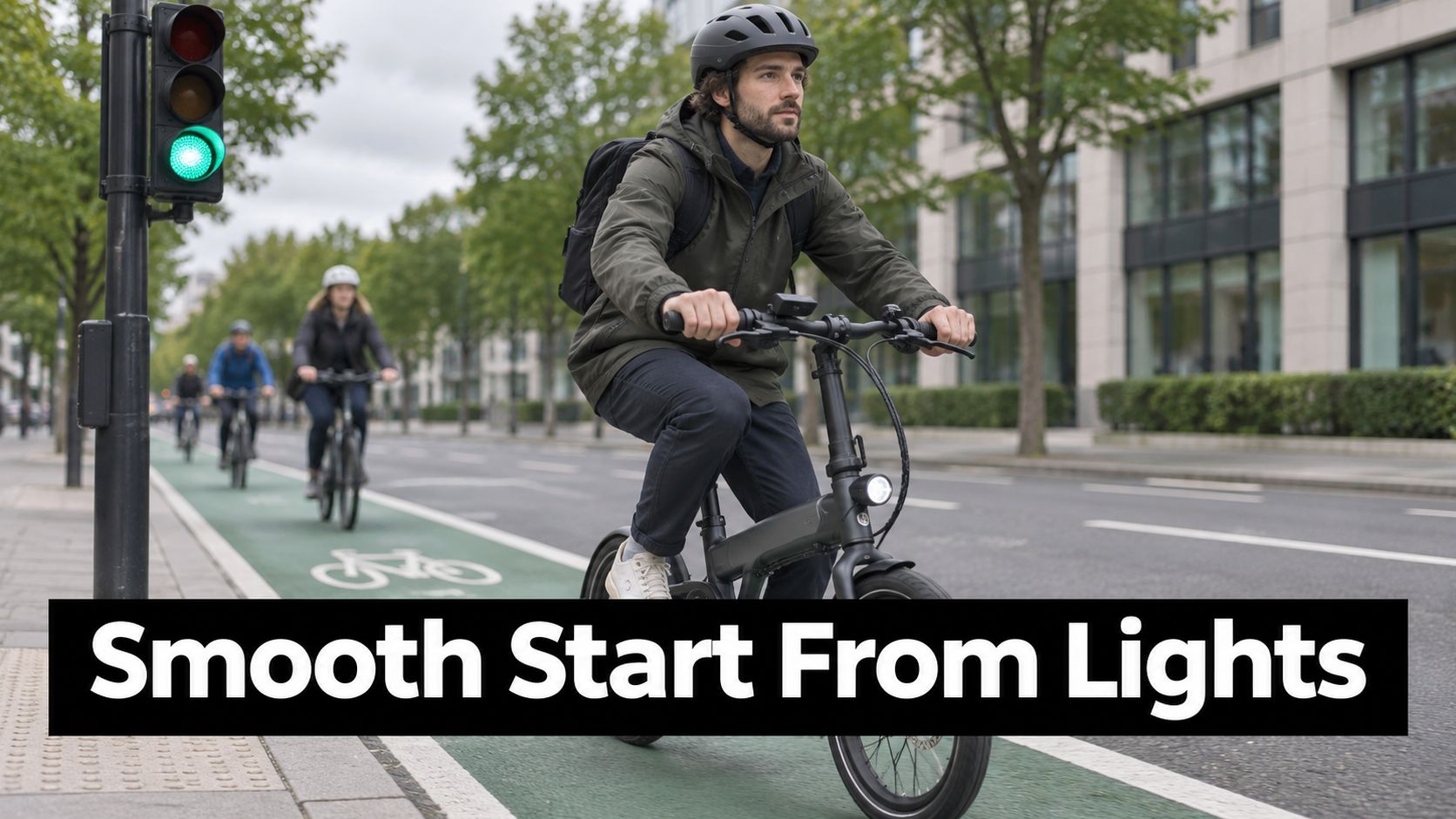
The UK commuter. On a 25 km/h cycle lane, a walk-assist throttle can help you pull away from traffic lights without pedalling. It keeps the bike in the pedal-assist category only if it works within the applicable rules. If you need power beyond the initial push, check local requirements before buying; a throttle that drives the bike at speed can change its legal status.
The hilly EU city rider. Long climbs and wet tram rails call for suitable gearing and dependable brakes. A higher-power throttle does little for a climb you are already pedalling up, while strong braking matters every time you need to stop. Decide whether your real problem is getting started or controlling speed downhill.
The rider with limited leg mobility. Starting from rest without pedalling can make a difficult junction more manageable. A capped throttle may help more than a faster motor, but only if it can start the bike safely on the slopes you encounter. Confirm how the throttle works before choosing the bike.
The California rider. The state allows a walk-mode throttle while limiting pedal assist under its Class 3 rules. Look for a pedal-assist bike configured for starts, and confirm whether the throttle is part of the original setup rather than an after-market conversion.
Turning injury concerns into spec choices
E-bike injuries have been increasing as use grows, as KPBS reports. That trend is a reason to match the bike's braking, lighting and tyres to the speeds it can reach, not a reason to rule out every throttle bike.
Check how the bike stops, whether the headlight is steady and visible, and whether the tyres suit your route. A throttle that helps you launch is only useful if you can control the bike once it is moving. Test the controls and brakes on the kinds of roads you expect to ride, and weigh stopping ability against top speed when comparing models.
Choose the Throttle Bike Your Route Allows
A throttle that drives the bike at speed usually rules out the Class 3 label. Choose for the streets and paths you ride, not the highest top-speed claim. For UK and EU riders, that generally means a compliant pedal-assist bike with the legal continuous motor rating, assistance that stops at the legal cutoff, and a throttle limited to walk assist. A bike meeting those requirements can be used without a licence, registration or insurance, subject to the rules where you ride.
California allows a different configuration. Its rules effective 1 January 2025 let Class 3 e-bikes use pedal assist above walking speed while limiting throttle power to 3.7 mph for start assistance or walk mode, according to Morrison Foerster's summary of the new California law. State rules differ, so do not assume the US is one market.
If you want the throttle to propel the bike without pedalling at speed, check whether local rules treat that configuration as Class 2 or another vehicle type. It may be a valid choice, but it does not become a Class 3 bike through marketing. Path access, age limits and helmet requirements can also differ.
Three things to confirm before you pay
- Get the cutoffs in writing. Ask the seller to confirm the throttle cutoff, pedal-assist cutoff and motor rating in a message you can keep.
- Match the certification to the battery. Check the mark on the battery and charger you will receive, not just the brand's other models.
- Check local rules. Confirm which rules apply to the roads and paths you plan to use before riding.
Punk Ride LLC offers electric rides across several categories, including E-Bikes and E-Scooters. The site also offers free delivery on all orders. Before choosing a model, compare its specifications with your local requirements. For example, a 750W fat-tyre bike and a compliant pedal-assist commuter may suit different uses, but the motor rating and throttle behaviour determine whether either fits your route's rules. Browse the Punk Ride LLC range and check the specifications before buying.