The advice you see on most roundups is simple. Grab the ebike under $1,500 with the biggest battery and the loudest motor number, then ride. I wouldn't start there. The bikes that come back unhappy are rarely short on advertised watts. They fail on brakes that fade after a wet winter, a battery you can't replace, or a display the local shop won't touch.
Treat the battery, the brakes, and parts access as the actual price tag. A low sticker can look clever on day one and expensive by month eighteen. A slightly dearer bike with documented spares can be the cheaper one to own.
This is written for UK and EU roads, where a legal pedal-assist bike is a modest machine, not a mini motorbike. US and Australian class rules are different, so don't carry a spec sheet across borders without checking local law. Sort the money first.
What Your Budget Actually Buys in the UK and EU
At recent rates, $1,500 sits near £1,150 or €1,300. Check the live rate before you sort listings, because a swing of a few percent moves a bike from one tier into the next. I split the band like this.
| Budget tier | Typical battery | Brakes you will see | Best use |
|---|---|---|---|
| £400-£700 | 250-360 Wh | Mechanical disc or rim | Short, flat commutes |
| £700-£950 | 360-500 Wh | Mechanical disc, some entry hydraulic | Daily commuting with mixed hills |
| £950-£1,150 | 500-720 Wh, some dual battery | Hydraulic disc common | Longer commutes, heavier riders, leisure |
What each tier gives up
£400 to £700 usually means a 250 W hub-drive bike, a 250 to 360 Wh pack, mechanical discs or rim brakes, and a basic drivetrain. You give up hill reserve and brake feel. Fine for a flat two or three miles. Miserable if you climb every day or ride in the rain with a laptop on your back.
£700 to £950 is where a 360 to 500 Wh pack shows up, along with some entry hydraulic brakes and better lights. You still often get a basic hub, a short warranty, and a spare battery that may not be stocked in your country. The ride is more useful. The after-sales story is still the risk.
£950 to £1,150 is where 500 to 720 Wh packs, the occasional dual battery, and hydraulic discs become common. Mid-drive motors start to appear near the top of the band. You are still under typical European pricing, so a higher sticker inside this band does not guarantee better support.
Bike Europe's market reports put sales in Germany, one of Europe's largest e-bike markets, at approximately 2.05 million electric bicycles in 2024, down slightly from 2.1 million in 2023, with a reported average price of €2,650. E-bikes represented 53% of all bicycle sales in Germany in 2023, and market statistics summarized by Statista put European sales at roughly 5.7 million e-bikes in 2024. A bike under $1,500 is a value buy, not the typical German purchase. Compare battery support, brakes, and warranty, not the gap to that average.
Practical rule: Pick the tier your daily miles and hills actually need before you open another listing.
Legal Limits for E-Bikes in the UK and EU
| Limit | Threshold for pedal-assist e-bike | What happens if exceeded |
|---|---|---|
| Continuous rated motor power | 250 W maximum | Generally treated as a motor vehicle such as a moped in the UK |
| Assist cut-off speed | Assistance stops at 25 km/h (15.5 mph) | Bike may be treated as a motor vehicle in the UK |
| Pedal function | Pedals must propel the bike and assistance tapers as speed rises | Throttle-led or unrestricted propulsion fails the test |
Price does not buy you a pass. A cheap listing that shouts 750 W peak or an "off-road" mode can still be the expensive one once it fails the road test.
In the UK, GOV.UK electric bike rules say a bike is an Electrically Assisted Pedal Cycle only if the pedals can propel it, continuous rated power is no more than 250 watts, and assistance cuts out at 15.5 mph (25 km/h). A compliant bike is used like a pedal cycle. No registration, road tax, insurance, or driving licence. It can use cycle lanes. It cannot be ridden on pavements.
Avon and Somerset Police explain the other side. If the bike can propel itself above 15.5 mph, the continuous rating is over 250 watts, or it otherwise fails those conditions, it is generally treated as a motor vehicle such as a moped or motorcycle. That can mean registration, vehicle tax, insurance, a driving licence, and an approved motorcycle helmet. It does not automatically get cycle lanes.
The EU line matches the same core idea. Cycling Industries Europe describes an auxiliary motor of no more than 250 watts, assistance only while you pedal, progressive reduction, and a complete cut-off before 25 km/h. Meet that and the bike sits outside the type-approval regime used for heavier motor vehicles.
A peak watt number on the advert is not the number that classifies the bike.
On the listing, read the continuous rated power, not the peak. Ask the seller, in writing, whether that exact model is sold as compliant in your country. If you want the street-use picture pulled into one place, see whether electric bikes are street legal where you ride.
Specs to Rank Before You Compare Prices
Carry this order into the shop. Price comes last.
- Brakes. Hydraulic discs are the one I want on a heavier commuter. Stopping power stays steadier, and you adjust them less often than cables. A cable brake is acceptable on a light bike you ride in the dry, if you are willing to tune it.
- Battery in watt-hours. Compare Wh, not miles. I treat about 360 Wh as a practical floor for a daily commute. Volts alone tell you almost nothing about how far you'll get.
- Motor and assist behaviour. Confirm a continuous rating of 250 W, a smooth start, and a clear cut-off at 25 km/h. A violent surge off the line is not a feature.
- Gearing. You want a low gear that lets you climb with the motor off, and at least seven speeds. A single speed feels fine until the battery is empty on a hill.
- Weight. Anything over about 25 kg is hard to lift onto a train, up stairs, or onto a rack. It also makes a flat battery a worse day.
- Lights and mudguards. Integrated lights and guards beat a bigger colour display at this price. You will use them every dark commute.
- Warranty and a spare battery. Ask whether replacement batteries are sold in your country, and who fits them.
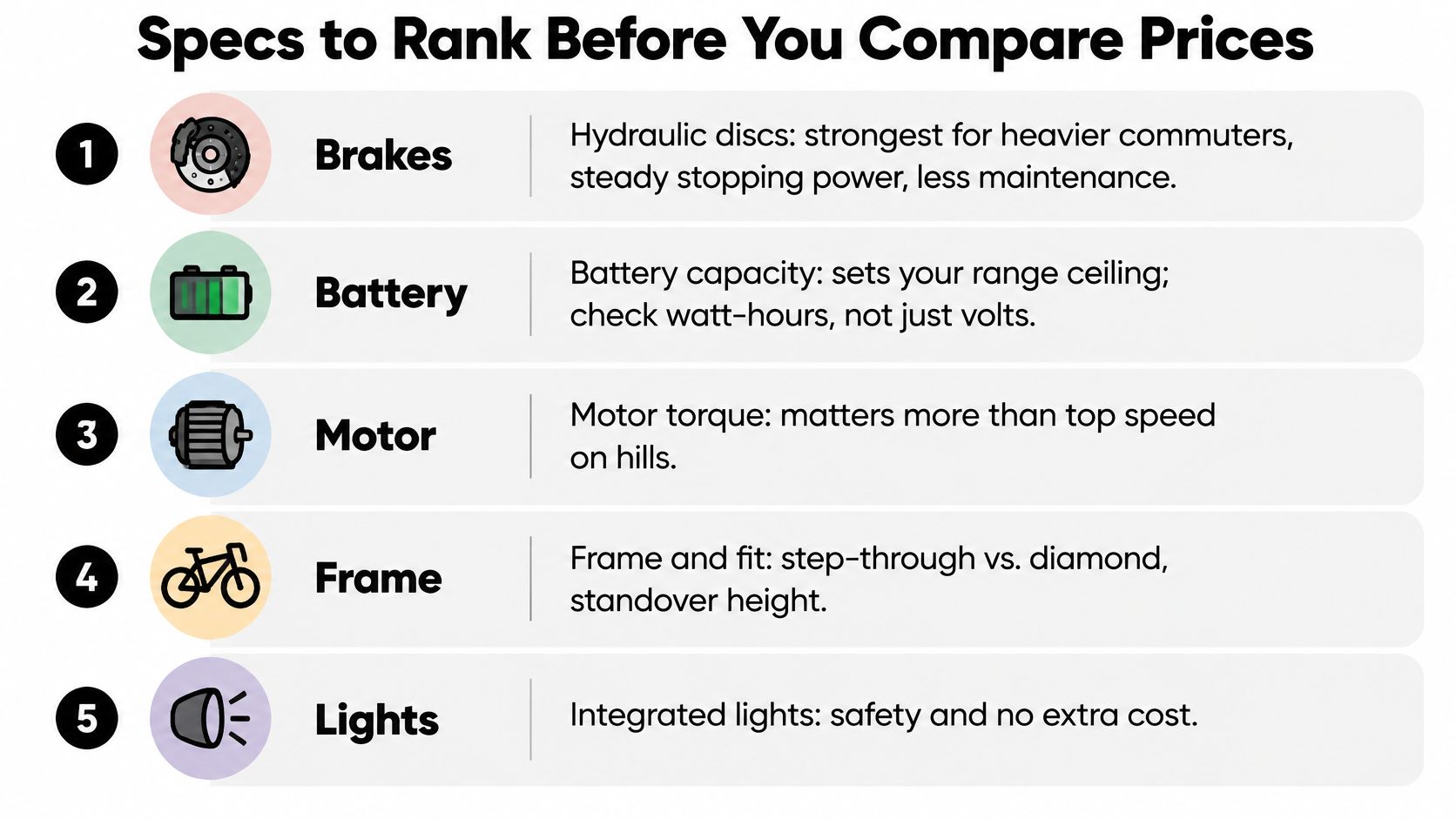
Rank three must-haves
Tick these before you compare prices:
- Brakes: hydraulic, or a cable system you accept maintaining.
- Battery: watt-hours written on the sheet, not a miles claim.
- Spares: a battery and a charger you can buy where you live.
If a bike fails two of your three, leave it. A prettier photo will not fix a weak brake or a mystery pack.
How the Main Bike Types Compare Under the Budget
Under this budget the formats you will see are folding, city or step-through, fat-tyre, and, rarely, cargo. Match the bike to the route and the cupboard, not the hero shot.
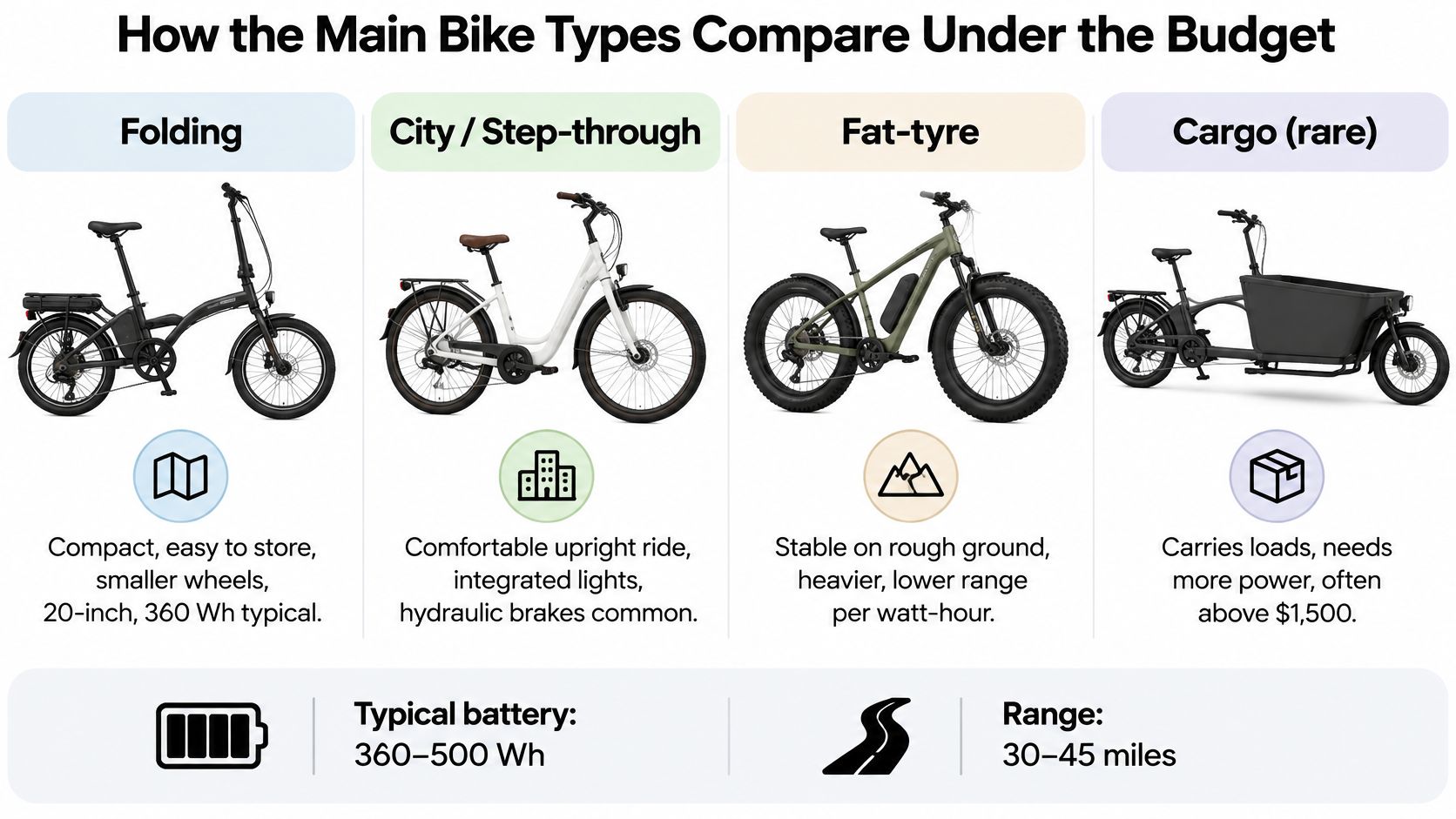
| Bike type | Typical weight | Main strength | Main trade-off |
|---|---|---|---|
| Folding | 18-25 kg | Fits trains, hallways and car boots | Small wheels and often a smaller battery |
| City or step-through | 22-28 kg | Upright, easy to mount, strong everyday commuter | Heavier than folders, basic components at the price |
| Fat-tyre | 24-30 kg | Grip and stability on gravel and soft paths | Heavy to lift and needs more battery per mile |
| Cargo | 30+ kg | Carries shopping or children | Rarely good value under this budget |
Folding bikes land around 18 to 25 kg. They disappear into a hallway, a train vestibule, or a car boot. Small wheels feel busier over a long distance, and the pack is often the smaller one in the range. A hilly commute with a train leg suits a folder that still has a low gear, so you can pedal the last bit if the battery sulks.
City and step-through bikes, about 22 to 28 kg, are the default for an everyday commute. Upright, easy to swing a leg through, and a sensible balance of range and weight. A 12 km flat suburban run is a natural fit for a step-through with a 360 Wh pack. At the bottom of the budget the drivetrain and brake hardware are still basic, so don't expect a premium groupset.
Fat-tyre bikes usually weigh 24 to 30 kg. They grip gravel and soft paths and feel planted. They drink more battery for the same distance, and lifting one with a dead pack is a workout. Choose this frame when the surface demands grip, not because the tyre looks tough in a photo.
Cargo bikes over 30 kg can haul shopping or a child seat, but they are seldom good value here. The frame, the brakes, and the battery all need to be stronger than this budget reliably buys. If you need to carry a lot, save up rather than forcing a light city bike into that job.
Real Range, Speed and Hill Limits
Battery size sets the ceiling. Hills, weight, cold, wind, and a high assist level pull the number down. These are planning bands, not a promise from a box.
| Battery | Flat, eco assist | Hilly route, higher assist |
|---|---|---|
| 250 Wh | 20-30 miles | 12-20 miles |
| 360 Wh | 30-45 miles | 18-30 miles |
| 500 Wh | 40-60 miles | 25-40 miles |
| Dual 720 Wh | 60+ miles | 35-50 miles |
A 250 Wh pack is a short, flat, eco-mode tool. 360 Wh covers a lot of daily riding if you stay out of the highest assist. 500 Wh is the point where a longer commute or a heavier rider stops feeling tight. A dual 720 Wh setup can pass 60 miles on the flat, and it is still the first thing I'd cut back on a hilly day.
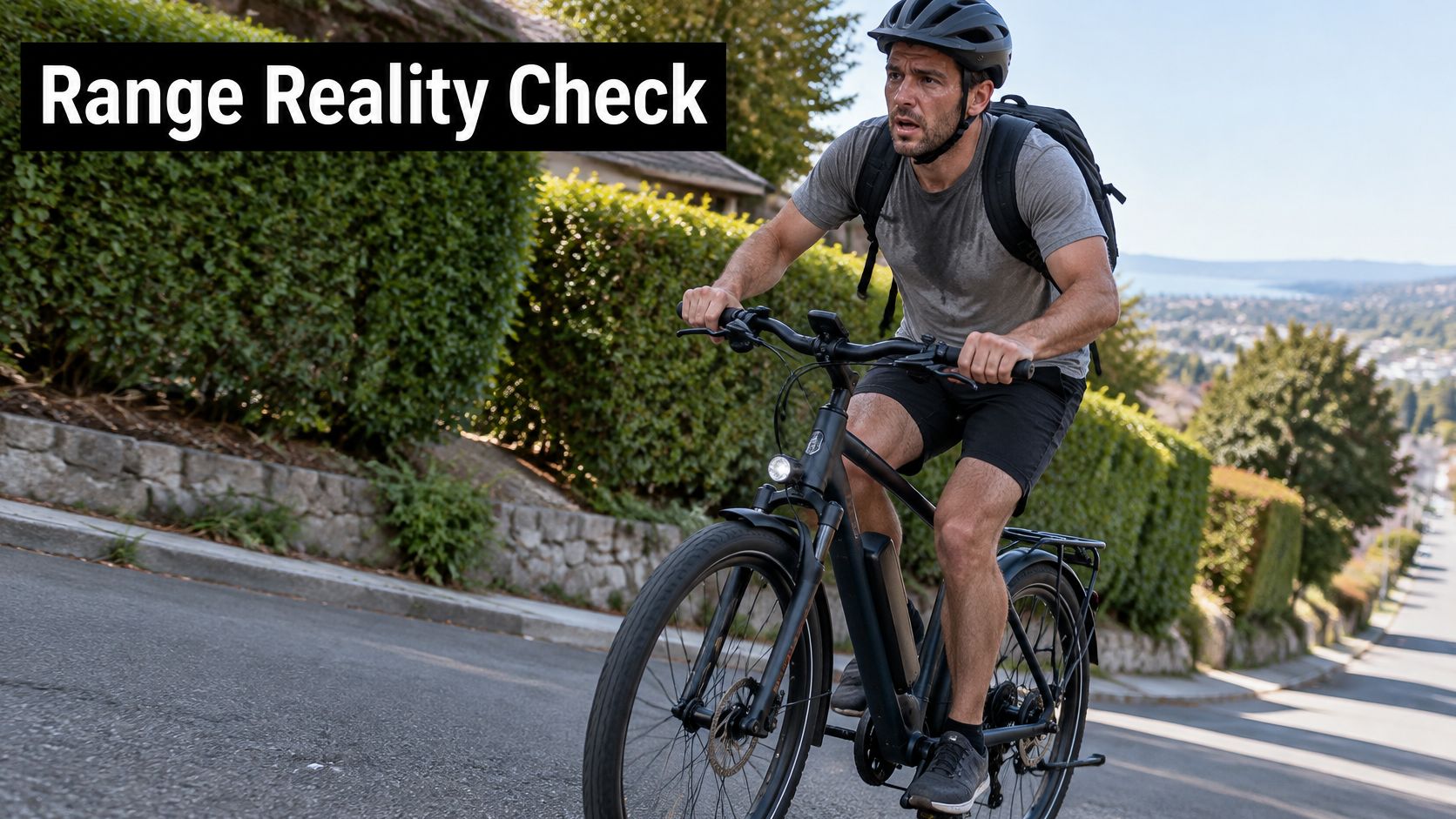
Advertised miles fail this test constantly. Consumer Reports runs a mixed course with flat, uphill, and downhill sections. In that testing the approximately $600 Kent E-Bike Hybrid achieved 16 miles and used cable-operated disc brakes, while the tested Heybike Cityrun reached 29 miles with hydraulic discs, a hub motor, front LED lighting, and a seven-speed drivetrain. Same price neighbourhood, very different day.
Assistance on a UK or EU road bike stops at 25 km/h (15.5 mph). A listing that advertises something faster is either talking about an off-road mode or a bike that is not a pedal cycle. Your commute plan should assume you are on your own power above that speed. For a wider look at distance claims, see how far electric bikes go.
A field test you can run
Ride your usual route once on full assist. Note the battery drop, then scale it. If 4 miles eats a quarter of the bar, a full charge is in the mid-teens on that route, not the 50 miles on the webpage.
I would budget for roughly 60 percent of the advertised flat-road range on your hilliest commute. If that scaled number doesn't cover the round trip with a margin, you need a bigger pack or a charger at the other end. You don't need a faster motor.
Brakes, Batteries and Safety Checks Before You Buy
A low sticker price can hide costs in the battery, brakes and parts you may need to keep the bike safe and running. Check those before comparing motor figures.
Certification should cover the complete electrical system, not only the battery cells. Ask for documentation showing UL 2849 or an equivalent standard, and check that the supplied charger is intended for that battery. The U.S. Consumer Product Safety Commission's proposed rule would require e-bike electrical systems to comply with UL 2849-20 and address risks including incompatible chargers, overheating, excessive voltage or current, and unsafe tampering.
Run the checks in this order
- Ask for the certificate. Get the document and the battery maker's name, then match both to the listing. A logo in a photo is not a certificate.
- Confirm the charger. It should be the one supplied for that battery. Treat a “universal” charger as a warning sign.
- Check the brakes. Test them at the bike's top assisted speed in a safe place. The stop should feel consistent. Cables stretch, so ask what an adjustment involves.
- Check motor cut-off. Assistance should stop when you stop pedalling. A lag or lingering thrust can make low-speed control harder.
If a battery swells, overheats, smells of burning or shows damage, stop charging it and contact the seller or a qualified professional. Use only a manufacturer-recommended replacement battery. Avoid electrical modifications and have conversion work done by a professional.
A cheap bike is only a bargain if you can keep its battery and braking system safe, and obtain compatible parts when something needs attention.
Three-Year Ownership Costs and Parts Access
A cheap bike can cost more to keep alive than one that looked ordinary in the shop. Look past the first year, because that is when the battery, the display, and the little electronic bits start to matter.
Work through replacements in the order they usually hit your wallet:
- Battery. This is the big bill. Price a replacement against the bike, and check the seller stocks it in your country.
- Display or controller. If either is proprietary, a failure can leave you waiting weeks for one part.
- Charger. A lost or failed charger is only cheap if the right one is still on sale.
- Brake pads, cables, tyres, and chain. These are normal bicycle wear. A shop should be happy to do them.
- A service. Cables, spokes, and a safety check once a year cost less than a surprise on a dark morning.
UK government guidance tells you to replace components only with manufacturer-recommended products and to use a professional for repairs or conversions. Long-term condition is a safety issue, not a fussy extra. Many ordinary shops will do brakes, the drivetrain, tyres, and basic wiring. Plenty will refuse proprietary electronics they have never seen.
Say you are choosing between a £1,000 bike with documented parts and a shop that will work on it, and a £1,400 bike with a stronger spec sheet and no after-sales trail. I would take the first over three years. The second looks better on day one and strands you when a controller dies. For a plain look at what upkeep runs to, read about electric bike maintenance cost.
If the battery died tomorrow, could you still pedal to work while you wait, and could a local shop repair the brakes? If either answer is no, the sticker is lying about the price.
Match Your Ride and Confirm Before You Buy
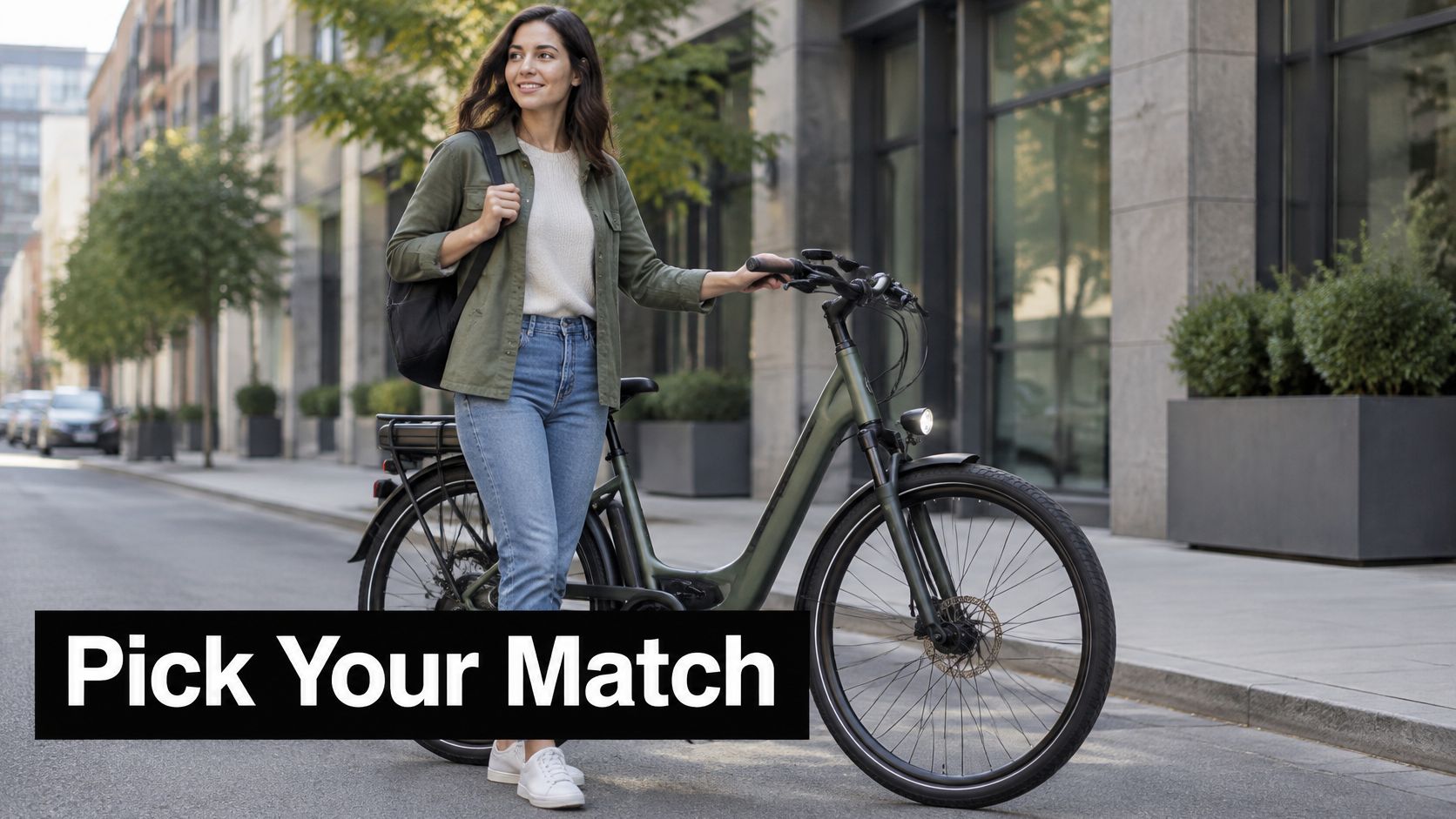
Four riders, four shortlists. Pick the one that sounds like your week, then throw out anything that fails the battery paperwork, the spares check, or the 25 km/h cut-off.
Daily urban commuter, flat or gentle. A city or step-through with at least 360 Wh, hydraulic brakes, and integrated lights. You don't need fat tyres for tarmac.
Rail or stairs. A folder under about 25 kg, a 360 Wh pack, and a low gear. Storage and the lift beat a huge battery you can't carry.
Hills or rough paths. Accept more weight for a 500 Wh pack, a low gear, and disc brakes. Take a fat-tyre frame only if the surface needs the grip.
First e-bike. A step-through, gentle assistance, and a warranty that names the battery. Learn the bike before you chase power.
On a flat commute in the lower band, the DUOTTS C29 Lite 250W is listed at £649, and the DUOTTS C29 with a single battery at £699. If you want a folder or an easy step-through, ENGWE electric bikes include folding models such as the T14 and Engine Pro 2.0, and step-through options such as the L20. Run each shortlisted model through the same three filters, and drop any bike that fails one.
A moving picture shows assist cut-in and brake feel better than another table.
Today, write down your route length, the hills, where the bike sleeps, and how far you must carry it. Match those four answers to one profile before you open a listing.
Punk Ride LLC keeps a curated set of electric bikes for city riding, with warehouses in the UK and Germany and our headquarters in Florida, so the same practical checks on brakes, batteries, and legal pedal-assist specs apply wherever you shop with us. If you are weighing ebikes under $1,500 for a real commute, start with the tier and the route, then see what fits. Visit Punk Ride LLC and line a shortlist up against how you ride.