You're standing in the kitchen at half seven, phone in one hand, looking at a scooter listing that promises 45 km of range. Your commute is 20 km each way. On paper that's plenty, so you tap add to basket, then a small voice asks whether the number counts a 60 kg rider on a flat path in July or a 90 kg rider with a laptop bag grinding up a hill in February. That voice is right to ask. An electric scooter range calculator answers it in about two minutes, and it does something a spec sheet never does: it gives you a worst case you can plan around instead of a best case you end up hoping for.
The Range Formula With Worked Examples
A range calculator is an energy budget, nothing more. Your battery is a fuel tank measured in watt-hours (Wh), your riding style is the burn rate in watt-hours per kilometre (Wh/km), and tank divided by burn gives distance. Treat the answer as a band, not a promise: expected from the rate you measure, optimistic when the route is kind, conservative once the 20% reserve is held back.
Getting your watt-hours right
Most labels give volts and amp-hours rather than energy. Multiply them: 36V × 10.4Ah is about 374 Wh. That is the size of your tank. Keep it separate from the kilometres, because a big tank paired with a thirsty motor still runs dry early, which is the trap with high-powered electric scooters that look generous on paper.
For the consumption side, use a measured rate rather than a brochure one. In a road test of the Xiaomi M365 Pro published in the University of Ruse conference proceedings, researchers recorded an average speed of approximately 18 km/h over a 5.7 km route and measured electricity use of about 95.2 Wh, equivalent to 16.7 Wh/km, giving an estimated distance from a full charge of approximately 25 km under comparable conditions. The useful part is the arithmetic: a 400 Wh battery at 16.7 Wh/km works out at about 24 km before reserve capacity, battery ageing, temperature, hills, rider weight, tyre pressure, wind, acceleration and drivetrain losses take their share.
Worked range examples by battery and consumption
| Battery (energy) | Consumption (Wh/km) | Range before reserve | Range with 20% reserve |
|---|---|---|---|
| 36V 7.8Ah (281 Wh) | 18 | 15.6 km | 12.5 km |
| 36V 10.4Ah (374 Wh) | 15 | 24.9 km | 19.9 km |
| 48V 13Ah (624 Wh) | 16 | 39.0 km | 31.2 km |
| 400 Wh benchmark (M365 Pro test) | 16.7 | 24.0 km | 19.2 km |
| 36V 10.4Ah (374 Wh), steep route | 22 | 17.0 km | 13.6 km |
Read the final column as the go or no-go number. If your round trip fits inside it with room for a detour, the scooter passes that route; if the trip only fits the raw column, it fails the test even though the maths looks close. The steep row shows why the input matters: the same 374 Wh pack that reaches 19.9 km after reserve at 15 Wh/km is down to 13.6 km once the burn rises to 22 Wh/km.
Practical rule: plan with the reserve column, never the raw one. Arriving with a fifth of a pack left is what keeps a headwind or a diversion from turning into a push home.
Find the row closest to your scooter, then hold your daily distance against the final column. If you think in miles, multiply kilometres by 0.62: the 374 Wh row at 15 Wh/km gives 24.9 km before reserve, about 15.4 miles, which sounds less heroic and more honest.
Legal Assist Limits That Change Your Inputs
Choose the assist profile before entering consumption. A scooter running on throttle and a bike sharing the work with your legs draw from their battery “fuel tanks” differently. The calculator needs to match how your motor operates, including when assistance cuts out.
For the EN 15194 pedelec profile, Australia's federal importer guidance for electric bikes describes a motor rated at no more than 250 W, assistance stopping at 25 km/h, and power stopping when the rider stops pedalling above 6 km/h.
Split that ride into assisted travel below the cut-off and pedal-only travel above it. Don't assign propulsion consumption to stretches where you're coasting without motor assistance. Equally, don't assume the motor switches off just because you're moving slowly.
A throttle scooter needs a throttle-based consumption estimate. E-bike classifications do not establish whether an e-scooter is legal on your route. For UK public-road riding, check current national rules and your local authority's position before treating a calculated journey as a usable commute.
Match the profile to the market
The differences below concern e-bikes, rather than permission to ride an e-scooter:
- Queensland: Queensland Street Smarts e-bike guidance specifies assistance up to 25 km/h, maximum continuous rated output of 250 W, and says a device propelled solely by throttle above 6 km/h is not legal as an e-bike.
- New South Wales: Transport for NSW describes permitted e-bikes with maximum continuous motor power of 500 W, throttle assistance only up to 6 km/h, and pedal assistance up to 25 km/h.
- United States: the Congressional Research Service overview of e-bike classes distinguishes Class 1 pedal assistance up to 20 mph, Class 2 throttle propulsion up to 20 mph, and Class 3 pedal assistance up to 28 mph.
Pedalling changes the battery's share of the work, but it does not guarantee greater range: speed and rider effort still matter. Select the matching riding mode rather than borrowing a consumption figure from another class.
Keep conservative, expected and optimistic results for that profile, with the reserve retained in each. Use the conservative result for your route's go-or-no-go decision. Legal access and sufficient battery are separate checks; the journey needs to pass both.
Factors and the Nine-Step Calculator Run
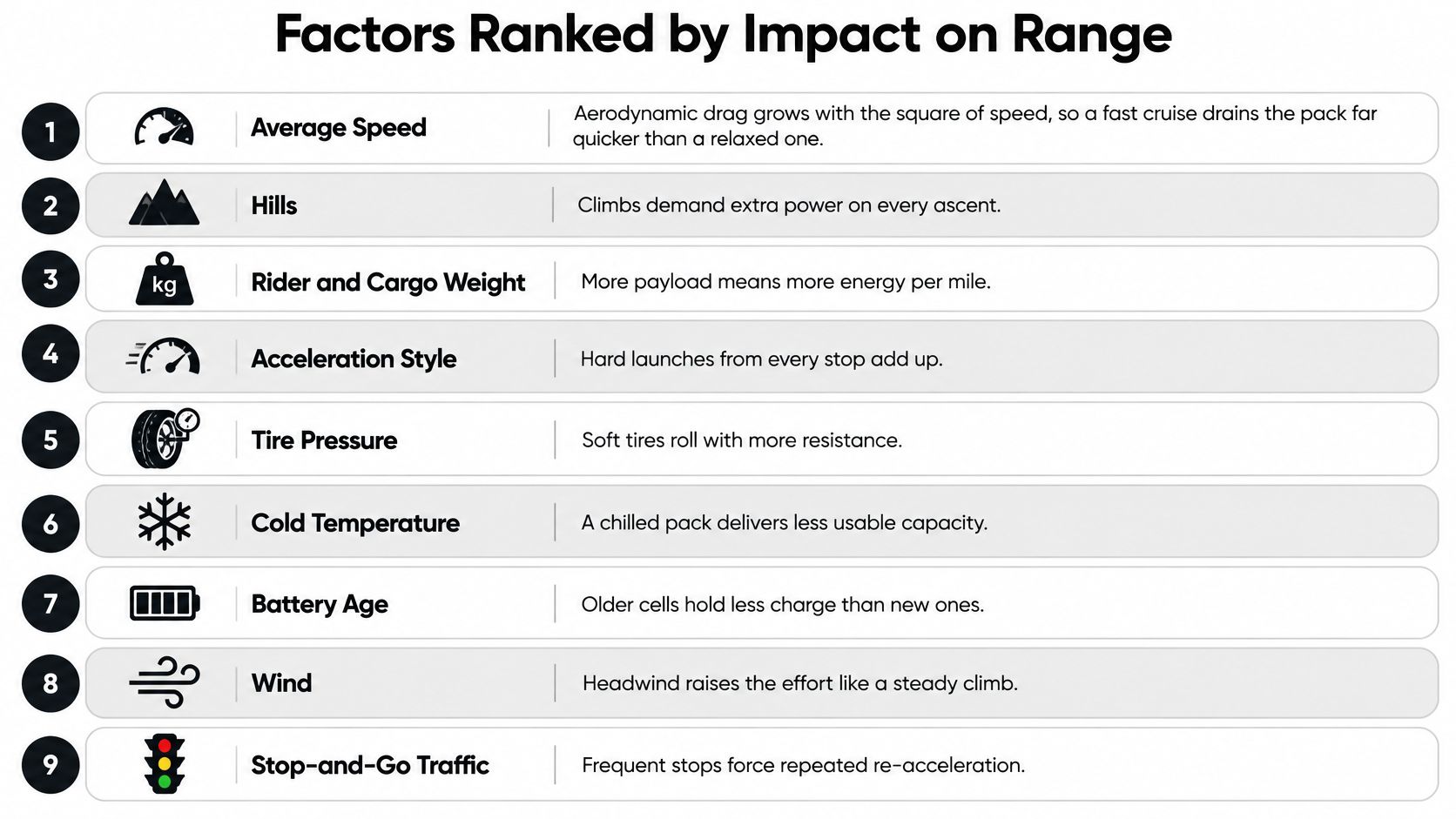
Not all range losses are equal, and knowing the order stops you obsessing over the wrong thing. Here's the hierarchy I'd work down.
What moves the needle most
Average speed sits at the top. Aerodynamic drag grows with the square of speed, so holding a fast cruise drains the pack far quicker than a relaxed one, and the motor is fighting that drag every second you're moving. Hills come next, because every ascent asks for extra power that you only partly get back on the way down.
Then comes payload. Think of the battery as a backpack: adding weight to it costs energy on every climb and every restart, and you never get that energy back at the traffic lights. Stop-start riding is the same problem repeated, since each launch pulls a big gulp of current.
Smaller effects still add up. Under-inflated tyres squirm and add rolling resistance, a headwind behaves like a gentle permanent climb, and your riding mode sets how eagerly the controller feeds the motor. Eco stretches the tank, boost empties it.
Terrain trumps the average speed readout, too. An Edinburgh commute over a couple of steep streets behaves nothing like a flat canal-path ride at the same average, which is why the hill field deserves more care than the decimal places on your speed.
Range factors, their effect and what to enter
| Factor | Effect on range | What to enter in the calculator |
|---|---|---|
| Average speed | Higher speed sharply raises drag and consumption | Your typical cruising speed, not top speed |
| Rider and cargo weight | Heavier loads draw more current, especially uphill | Total weight in kg |
| Hills and gradient | Climbing can cut range far more than flat riding | Share of route that is uphill or hill severity |
| Stop-start traffic | Repeated acceleration drains the battery quickly | Stops per km or a city/mixed setting |
| Temperature | Cold reduces usable capacity and heat speeds up ageing | Typical temperature of your riding season |
| Tyre pressure | Under-inflated tyres add rolling resistance | Target pressure printed on the tyre sidewall |
| Wind | Headwinds increase drag, tailwinds help | Headwind, tailwind or crosswind share |
| Riding mode | Eco modes stretch range, boost modes cut it | The mode you actually ride in |
For a sanity check on the consumption figure you type in, a 2024 life-cycle assessment of shared dockless e-scooters in Sweden estimated energy demand at 0.017 kWh/km for a 0.344 kWh non-swappable-battery case and 0.016 kWh/km for a 0.733 kWh swappable-battery case. Those are fleet machines in Swedish conditions, so treat them as a ballpark for a mid-sized pack rather than a promise for yours.
The nine-step run
- Read the battery energy in Wh from the label, or multiply volts by amp-hours if only those are printed.
- Enter your body weight plus whatever you carry, including the lock and the shopping.
- Enter the speed you hold on a normal ride. Top speed is a party trick, not an input.
- Pick flat, rolling or steep, and be pessimistic if your route has one nasty climb.
- Choose the temperature band for the season you're planning, not the day you're calculating.
- Select the mode you use most, which for many riders isn't eco.
- Add a 20 percent safety reserve so the last part of the pack stays unspent.
- Write the answer down as a band with a low, middle and high figure, not one number.
- Test it against a real ride. Charge fully, ride a route you know, then convert the percentage drop into energy: 10 percent of a 374 Wh pack is about 37 Wh. Divide that by the kilometres you covered to get your own Wh/km, and plan with whichever is higher, your measured rate or the calculated one.
Step nine is the one people skip, and it's the one that makes the other eight trustworthy. A single measured ride beats any online estimate, because it captures your tyres, your weight, your hills and your right hand. Keep a gauge in your bag and check pressures weekly against the number on the sidewall, and if you're unsure what to run, our guide to electric scooter tyre choice and care covers the basics.
Worth remembering: a calculator tells you what to expect. A test ride tells you what you've got.
Reading Range Outputs and Dispelling Myths
A single confident number is the weakest thing a range tool can give you. Look at how the published claims scatter: one electric scooter range calculator at Mr Scooty claims typical accuracy of roughly ±10 to 20 percent, while other calculators apply their own deductions and publish noticeably lower real-world estimates. Those are different promises built on different assumptions, and the headline figure alone never shows which assumption is doing the work.
Treat it like a weather forecast. You don't pack for the headline temperature, you pack for the spread between the overnight low and the afternoon high. Range works the same way, so ask for three figures and read the conditions attached to each one.
What each range output assumes and when to use it
| Output | What it assumes | Best used for |
|---|---|---|
| Conservative (lowest) | Cold, hills, full-throttle riding, ageing battery | Winter planning and round trips |
| Expected (middle) | Typical speed, mixed terrain, mild weather | Daily commute planning |
| Optimistic (highest) | Flat ground, steady pace, eco mode, new battery | Setting the ceiling |
| Round trip with 20% reserve | Both legs covered with a fifth of usable range left over | Go-and-return commutes |
| Advertised single figure | Controlled test conditions, often a light rider | Comparing models only |
Now the go or no-go test. Say your daily round trip is 40 km and the calculator returns a band of 32 to 44 km with a 20 percent reserve recommended. To keep a fifth of the pack unspent, a 40 km route needs a total range of 50 km: 80 percent of 50 km is your 40 km ride, and the remaining 20 percent stays in the tank. The conservative figure fails by a wide margin, and even the optimistic 44 km falls short of the 50 km you need. That is a no-go, because you would be relying on a tailwind and green lights every single day.
The rule is simple. If the conservative figure covers your route with the reserve intact, you are safe. If only the optimistic figure covers it, you are gambling, and you will find out on the coldest morning of the year.
Four myths worth dropping
Myth one: the advertised range is a lie. It is a test result under specific conditions. An energy-consumption modelling study on arXiv using the Mi Electric Scooter Pro 2 identifies a 446 Wh lithium battery, a stated maximum range of 45 km and a top speed of 25 km/h, which implies about 9.9 Wh/km. That is an idealised benchmark, and the same study derives real efficiency by relating the drop in battery state of charge to odometer distance, so your own trips can be expressed in Wh/km too.
Myth two: 50 percent battery means half the range. The indicator is a voltage estimate rather than a true fuel gauge, and it is least precise near the bottom. Voltage sag under hard acceleration makes the bars dip, so the final stretch can feel shorter than the arithmetic suggests.
Myth three: more watt-hours always buys proportionally more range. A bigger pack is heavier, and if the extra capacity arrives alongside a faster motor, you will happily spend the gain on speed and climbing. Compare Wh alongside the consumption rate, never alone.
Myth four: a higher top speed ruins range. Only if you use it. A capable machine ridden at a steady moderate pace can be gentler on its pack than a modest one ridden flat out.
So when any tool hands you a figure, ask one question: what does this number assume about me?
Battery Age and Cold Weather in Your Planning
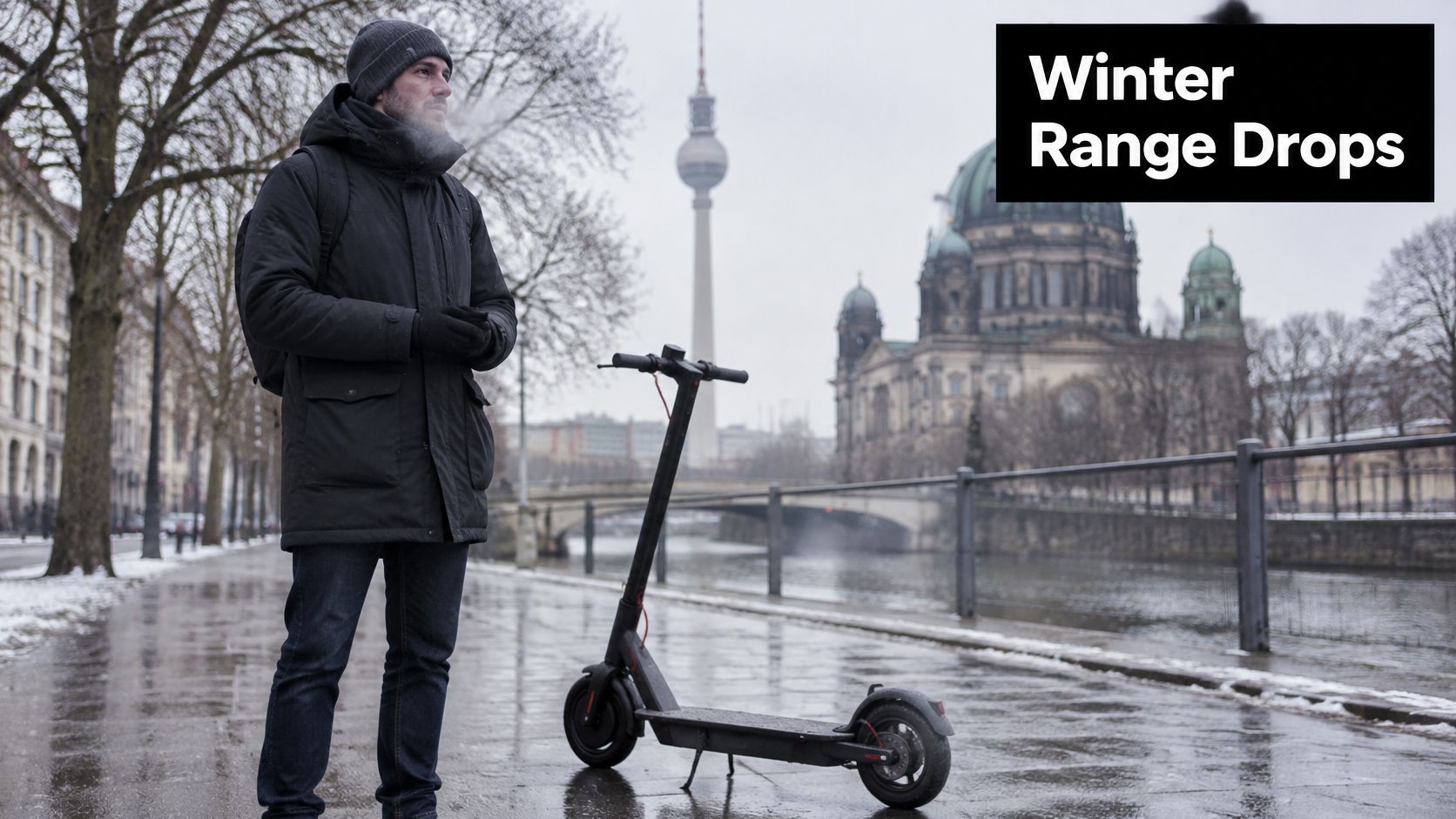
A Berlin commuter with a 12 km ride each way buys a scooter in June, gets comfortably to work and back with charge to spare, and by January is watching the last bar vanish two streets from home. Nothing broke. Two separate things happened at once, and it's worth pulling them apart because you plan for them differently.
Cold temporarily reduces the energy you can pull out of the pack. Warm the battery back up and that capacity is largely still there, so winter loss is a seasonal planning problem rather than a dead battery. Ageing is the other thing, and it doesn't come back.
A battery range calculator overview at VoltCalcs summarising academic review work notes that real-world battery ageing is affected by daily temperature swings, humidity, mechanical shocks, irregular charging, storage duration, deep cycling, high charging currents and high temperatures, conditions that constant-current laboratory tests at 25°C don't capture. Long-term heat exposure and demanding charge and discharge patterns are what shorten a pack's life, not a cold Tuesday.
Here's a walkthrough of how to fold both into your planning.
Ask your calculator for three separate outputs rather than one:
- New-battery range: what the pack does today, in mild weather, with your measured consumption rate.
- Temperature-adjusted range: the same ride in your coldest riding month, so you know whether January still works.
- End-of-life planning range: a lower figure you'd accept after a couple of years of commuting, which is the number to buy against if you plan to keep the scooter.
Storage habits decide how far apart those figures end up. Keep the battery somewhere cool and dry at a moderate charge when the scooter's parked for weeks, top it up periodically rather than leaving it drained, and never leave it baking in a car or on a sunny windowsill. Charge indoors, and let a cold pack warm up before you plug it in.
The question isn't what range you have this week. It's what range you'll have next winter, and the winter after that.
Check Your Real Route Before You Commit
Treat the route test like packing for a journey. The map distance is the shirt you plan to wear. Hills, cargo, weather and detours are the extras in the backpack. Range works the same way. You need room for the whole day, not just the trip on paper.
- Measure the actual distance: both legs, using a map tool or your phone's track, not the straight-line guess.
- Use your own inputs: your typical speed, your weight plus cargo, your riding season.
- Keep the buffer: the conservative figure should sit above your route length plus 20 to 30 percent.
- Read the terrain: one steep hill can matter more than a long flat stretch, so mark the climbs.
- Confirm the rules: UK and EU requirements differ by country and change over time, so check your local regulations before you buy or ride.
- Plan charging stops: note where you can plug in mid-route if your return leg is longer than your comfort buffer.
- Check what you would need at the scene: if you ride in traffic, a guide to preserving evidence after a scooter crash explains what riders may need to capture.
Use the answer as a go or no-go test. If the conservative range clears the route plus reserve, the maths gives you room to ride. If the buffer is thin, choose more battery or a different machine in the same class rather than riding on the edge every day. Our guide to choosing an electric scooter for daily commuting walks through that trade-off.
The advertised range figures we list for AOVO electric scooters are manufacturer estimates, and actual range varies with rider weight, terrain, temperature and riding settings. Compare battery Wh and your own measured Wh/km rather than the headline number alone.
We offer commuter, folding, fat tyre, off-road and performance scooters, with warehouses in the UK and Germany. That means you can match battery capacity to a route you've measured instead of guessing from a spec sheet. Work out your conservative range with reserve first, then browse the e-scooter range at Punk Ride LLC and check each candidate's watt-hours against that number. If you're between two packs, take the bigger one and enjoy the quiet mornings.